Beyond Tokenisation: Making RWAs Useful Onchain
These days, it’s all about RWAs, with a race involving every protocol and ecosystem, rushing to list new assets and boasting about their market size or asset count.
However, these numbers mean little without context.
What is the point of having thousands of RWAs, fragmenting liquidity, if no one uses them?
At their core, RWAs become widely adopted only if they separate themselves from their Traditional Finance counterparts with added value.
This report is about what RWAs are really about; we take a pragmatic look at how to build a fully functional ecosystem, focusing on utility and composability.
To do so, we use Mantle as an example.
If you have been following us, we have discussed Mantle’s early focus on RWAs extensively, documenting their progress in our previous report.
The interesting part of an RWA roadmap is less about accessing tokenised equities. Listing assets is now the easy part: Kraken, Robinhood, Crypto.com, xStocks, Backed, Securitize, Ondo, Franklin Templeton, BlackRock and a long list of exchanges, custodians and tokenisation platforms are all pushing some version of tokenised asset access.
The harder question is whether those assets can become efficient capital once they arrive onchain.
This time, we take it one step further, moving beyond asset count and tokenised asset values in favour of a more practical analysis of whether they can become productive capital.
It’s All About Utility
RWAs have historically been framed as crypto’s pathway to institutional legitimacy. Put TradFi assets such as treasuries, private credit, funds, equities or commodities onchain and watch institutional investors flood the gates.
That story was useful early on, but now tokenised assets are no longer rare, and each listing loses marginal utility. As a consequence, the market is filled with wrappers, tracker products, fund interests, stablecoins, tokenised notes and synthetic equity-like exposure.
Competition among chains cannot be won by simply listing assets, for everyone can do that nowadays.
Instead, the most important question when approaching this subject is utility.
For every new asset listed, protocols should ask themselves: now what?
The RWA sector is evolving, and the next phase of RWA competition will be won by utility rather than asset count.
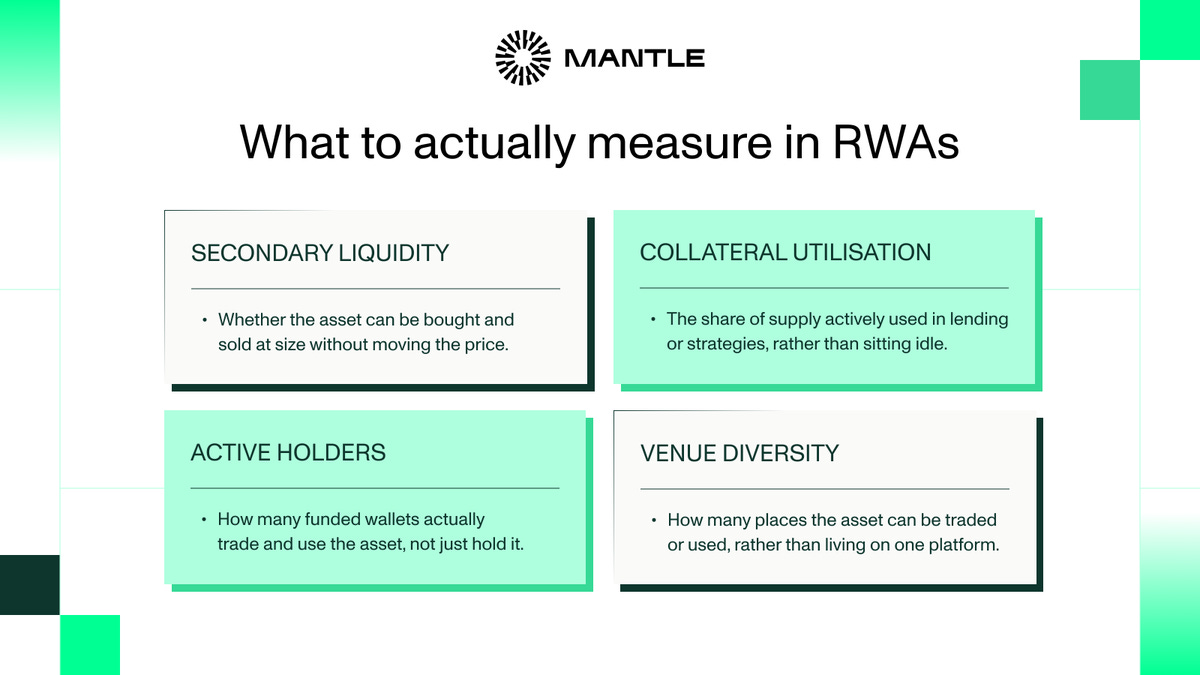
Tokenised assets only become productive when they trade against deep liquidity, can be used as collateral, are composable across venues, and are accessible to anyone; otherwise, it works counterintuitively, increasing fragmentation with no value addition.
We just mentioned this, but it’s worth reiterating: RWA can reach widespread adoption only by differentiating itself and adding utility beyond its TradFi counterparts.
We focus on two:
Accessibility
Composability
Capital access has historically been uneven, shaped by geography, regulation, brokerage relationships, and minimum ticket sizes, rather than information and research.
Digital assets have changed this for many, with stablecoins as a major example. Many in inflation-plagued places now prefer to hold their savings in stablecoins rather than a weak fiat currency.
Tokenisation promises to do the same for TradFi assets: Treasuries, stocks, ETFs, pre-IPO allocations, and more are being redesigned as onchain digital instruments.
As a consequence, this is driving a broader shift toward global access to these assets, with Nasdaq moving toward 24/7 trading.
The first part of the RWA wave has focused on building the initial infrastructure to make this shift possible, aided by a friendly regulatory process.
Stablecoin frameworks, market-structure proposals, MiCA in Europe and tokenisation pilots by large financial institutions have made the sector less marginal.
This has led to over $38 billion of assets tokenised onchain.
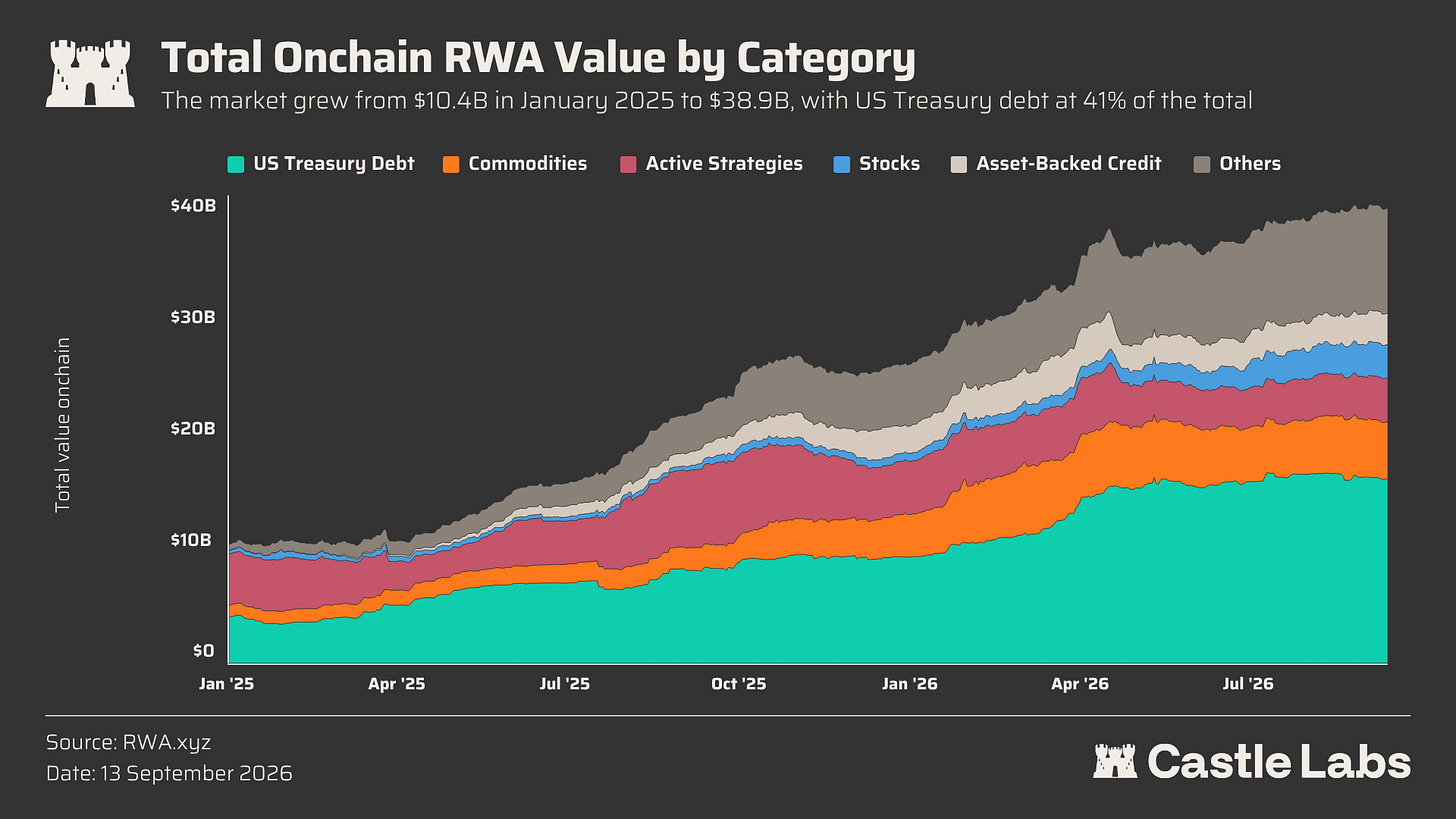
Starting with US Treasuries (over $15.9 billion), users can now access a wide range of RWA instruments onchain, including commodities ($4.9 billion), active strategies ($3.6 billion), asset-backed credit ($2.56 billion) and stocks ($2.52 billion), among others.
From an accessibility perspective, progress has been major.
Users can now access a wide range of assets across many networks.
From now on, it will be less about listing more assets (which will continue to proliferate, especially long-tail ones) and more about focusing on the second promised utility of RWAs: capital efficiency and composability.
With accessibility being continuously addressed, another question that surrounds RWAs, which is relevant to both institutions and retail audiences, is how these assets can be further utilised and take advantage of the already established onchain ecosystem to produce further yield.
24/7 trading will soon no longer be a value proposition exclusive to crypto, as it will soon become part of the market structure for TradFi equities as well.
RWAs must move from plain digital representations of TradFi assets to capital-efficient, programmable assets.
While tokenisation has drastically improved access to TradFi assets, they need to be embedded in the existing onchain ecosystem to be used more effectively.
Given the context we provided, with upcoming 24/7 trading, the increasing role of Tradexyz as a venue for trading RWAs, increasing participation of institutions, expected clarity on regulation, and more, this shift matters even more.
Composability can take many forms.
Let’s look at a few of those.
The RWA Roadmap
As already established, what makes an RWA stand out is both accessibility and composability. Many networks and issuers have started to reflect on both. In this section, we study Mantle as a network and how it addresses both verticals simultaneously with its current offerings.
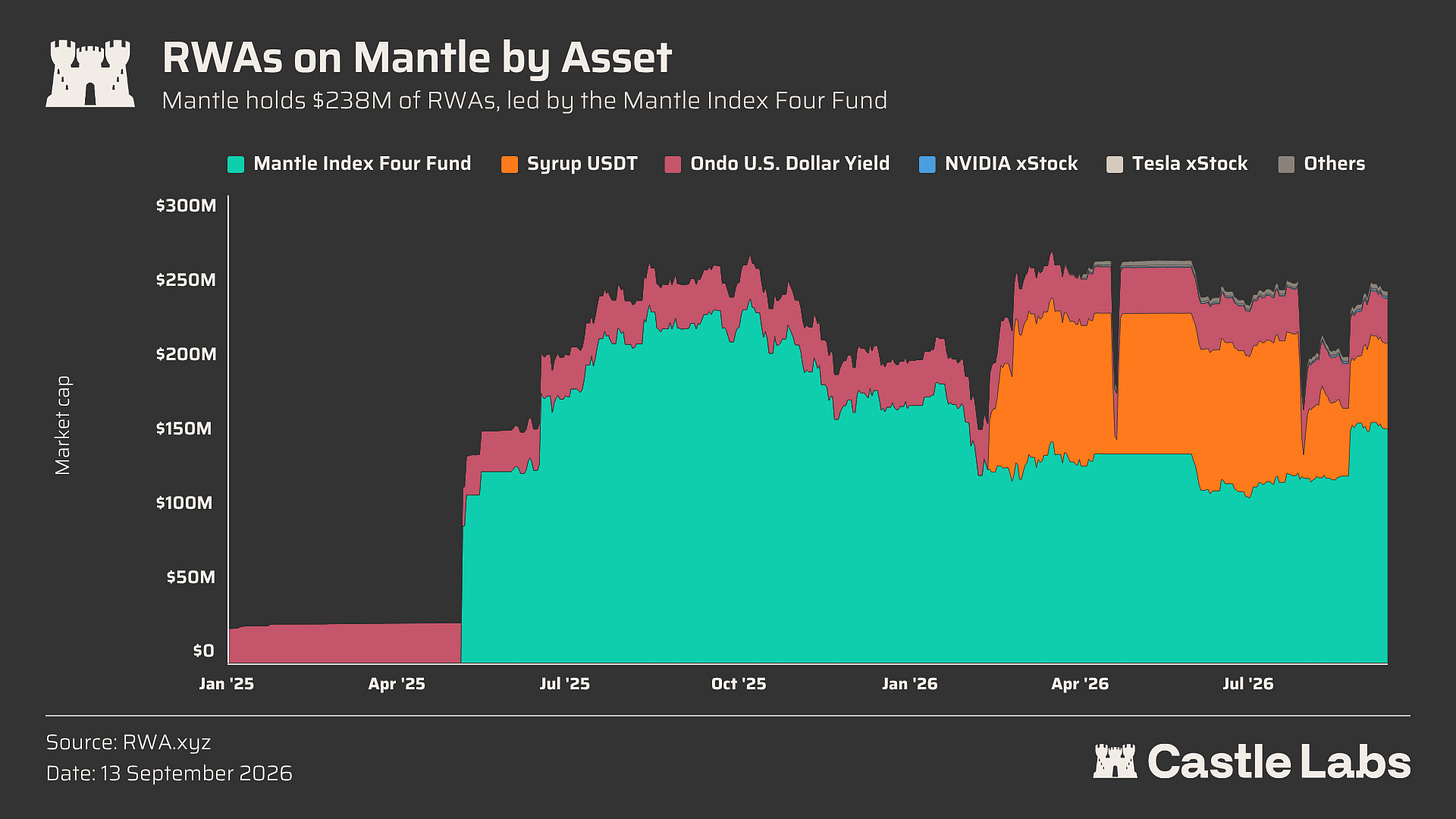
The Mantle ecosystem now hosts over $225 million of assets:
Over 60% of the value sits in Mantle Index Four Fund, an active RWA strategy
21% is represented by syrupUSDT, representing credit or yield exposure to Maple markets
15% is in Ondo USDY, representing tokenised U.S. Treasury and dollar-yield exposure.
2% is in xStocks, representing tokenised equities and exchange-traded fund exposure.
Mantle’s approach to its RWA roadmap reflects the shift we discussed above.
It all started with a focus on infrastructure and laying the foundation which would allow the future RWA ecosystem to flourish. This includes onramps, offramps, provider integrations, a tokenisation-as-a-service platform, DEXs, and more.
Then, it’s important to take a phased approach to listing key assets slowly, ensuring liquidity is bootstrapped properly. Once these look solid, Mantle focuses on listing as many of these assets as possible, giving users plenty of choice.
Once quantity is not an issue, the focus shifts to quality: execution, utility, and composability. This includes ensuring execution through deep onchain and offchain liquidity, integrations, and the possibility to move, trade, and borrow using those assets.
Only once all these tassels are in place does the focus shift to user acquisition and distribution.
These are obviously not set in stone: user acquisition will be part of the process throughout, for example, but there is a sweet spot where it is convenient. Inviting users with high incentives into a desert ecosystem can do more harm than good, because they will farm incentives and not convert.
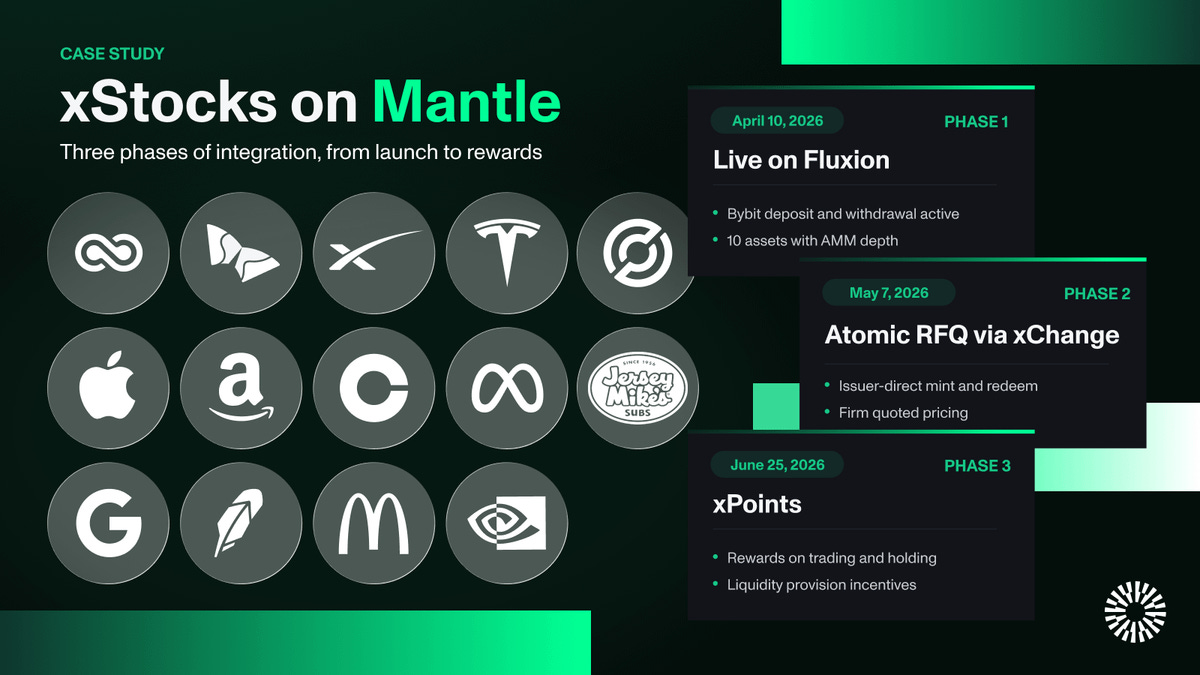
Using Mantle’s xStocks launch, we show this process in practice: they first listed only 10 assets on Fluxion, Mantle’s native DEX. The phased release ensured proper AMM depth.
Secondly, onchain liquidity was complemented by an atomic RFQ system via xChange (xStocks’ own platform). This addition is fundamental to ensure good price execution, the first element of comparison of many approaching RWAs from a TradFi or institutional lens.
RWA assets need comparable execution to their TradFi equivalents if they want to compare. Otherwise, any other value provided is an accessory while the asset’s core value is missing.
The last part of the xStock campaign on Mantle, live since the end of July, is an incentive campaign through xPoints to bootstrap adoption.
This brings us to another aspect to consider: active holders and user acquisition.
User Acquisition for RWAs
Accessing a wide range of assets onchain without restrictions offers incredible benefits, especially compared to TradFi. To boost accessibility and distribution, Mantle works closely with Bybit, offering its products to the exchange’s user base.
However, once Nasdaq introduces 24/7 trading, competition will shift from plain accessibility to settlement, liquidity, and composability.
Before we dive deeper into user acquisition using Mantle as a case study, it’s important to note that there are several distinct niches within RWA users:
Cryptocurrency users who have never traded TradFi assets: tokenisation has brought onchain stocks, funds, and other money markets that give cryptocurrency users exposure to assets previously restricted to TradFi operators.
TradFi retail users who now have access to more possibilities with the assets they have previously traded ‘traditionally’.
TradFi institutional users looking for regulated and compliant solutions to improve the capital efficiency of the assets they have traded ‘traditionally’ onchain.
These vary in degree based on ecosystem-specific focus, but it’s a useful exercise for user granularity. Remembering how everyone is competing for the same users makes differentiation pivotal.
Different levels of holders are expected among RWA assets, given their inherent profile.
While the Mantle Index Four Fund holds most onchain RWA value, it has only 6 holders because of its institutional nature.
Meanwhile, xStocks has seen strong retail growth, rising to over $4.4 million since its March launch.
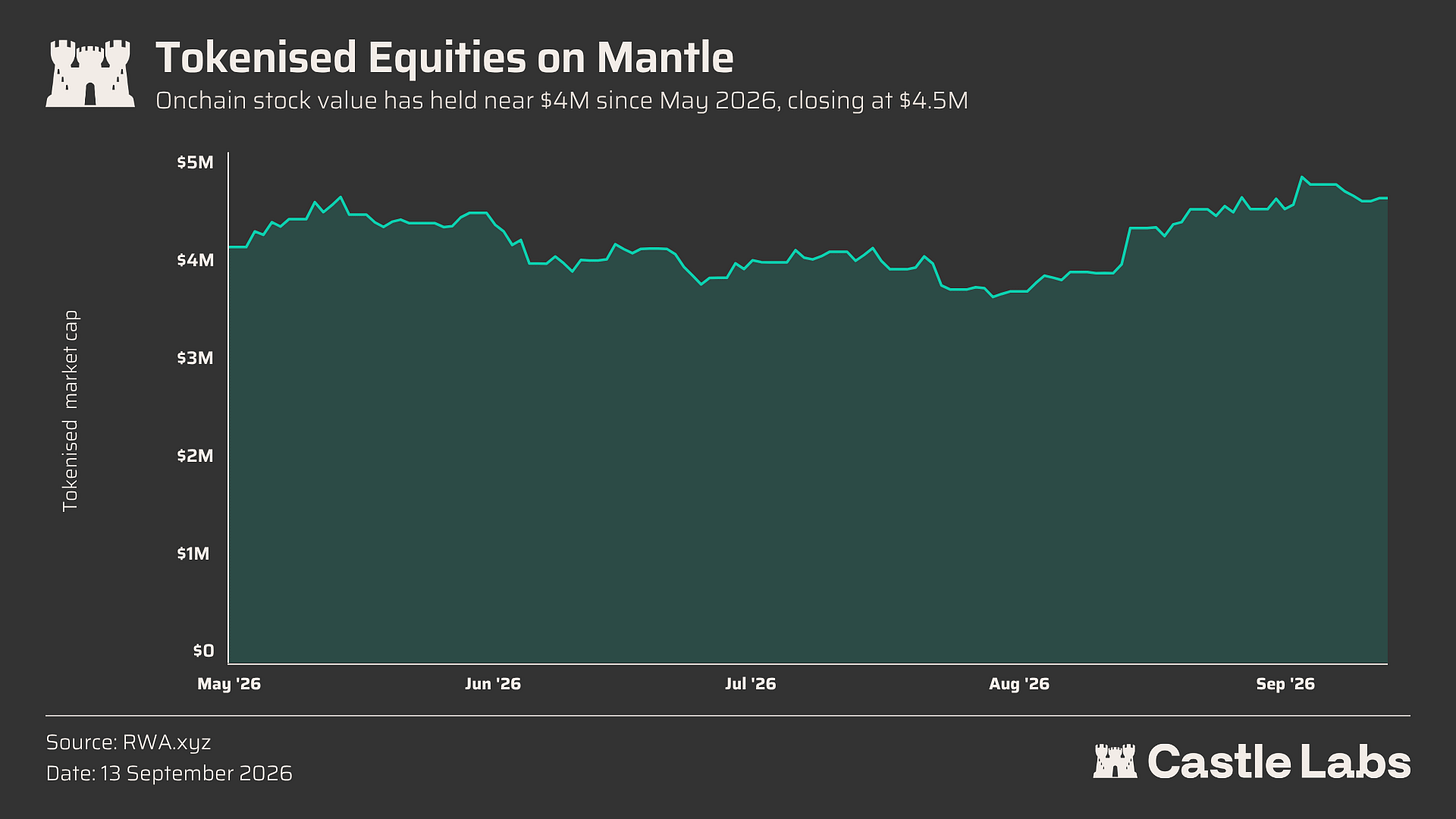
Retail user acquisition, especially for equities, has been a key focus in recent months.
The top assets currently owned by onchain users are:
Agora aUSD
Ondo USDY
Tesla xStock
CRCL xStock
NVIDIA xStock
Alphabet xStock
Aside from onchain user growth, there is a simple explanation for this development. Mantle benefits from a unique relationship with Bybit, one of the bigger CEXs.
As part of this, Mantle assets benefit from a unique distribution network on Bybit, with over 40 million users. In particular, the two have been working more closely as part of Mantle’s RWA focus. For instance, Bybit just expanded its Dual Asset support for 10 tokenised equities from xStocks, including TSLAx, METAx, CRCLx and HOODx. Dual Asset is a structured product that lets users buy or sell cryptocurrencies at a target price while earning yield.
This is extremely telling about Mantle’s utility-focused approach: 96% of the RWA value sits in yield-bearing assets, with over half in active strategies, 25% in asset-backed credit, and 14% in US treasuries.
This is also a strong differentiator for Mantle, positioning it as a network where tokenised equities can move between CEX liquidity, onchain venues, and DeFi.
A tokenised equity sitting inside one app is just meant to provide access to a product. If it can move into DeFi or a CEX for lending or to earn yield, it becomes efficient capital.
For now, stocks represent an easy way to keep users engaged by listing ‘hot’ tickers, such as SKHYX in July and the more recent Jersey Mike stock listing after its IPO. Listing mid-cap consumer stocks is a useful test of whether demand for these assets can materialise onchain.
However, stocks are but one side of the coin, with many other assets available. For example, Openstock’s pre-IPO vault had over 49% of its first-day deposits coming from Mantle. Also, Fluxion just supported RWAlpha income strategies, making it the first venue on Mantle where users can access yield products via tokenised equities.
Mantle also recently joined the Global Dollar Network (GDN), an initiative operated by Paxos, around USDG, a regulated stablecoin now available on Mantle, alongside AUSD, USDe, USDY, and USDT0.
By combining its own onchain users with external distribution channels, Mantle can get its foot in both shoes, target CEX audiences, and ensure easy integration of its yield products, as shown by the Dual Assets from xStocks.
Conclusion and Food for Thought
Early tokenisation rewarded the ability to bring assets onchain.
The next phase will reward the ability to make those assets useful.
A ‘useful’ RWA ecosystem creates two benefits at once.
First, they give the chain access to liquidity that previously existed outside the ecosystem. Tokenised stocks, money-market funds, credit products and active strategies can bring external capital into onchain applications. That capital may come from users who want TradFi exposure, institutions looking for crypto-native distribution, or asset managers looking for faster settlement and broader reach.
Second, productive RWAs can create sticky liquidity. A user who only comes to buy a tokenised stock may leave after the trade. A user whose tokenised assets can be routed into strategies, used in DeFi, posted as collateral or paired with stablecoins has more reason to stay.
Capital becomes stickier when it has more jobs to do.
Before concluding, we want to leave you with some questions, which could potentially lead to more meaningful metrics to evaluate an RWA ecosystem:
Can users move the asset between exchanges, wallets and DeFi venues?
Is there real secondary liquidity, or only theoretical availability?
Can the asset be used as collateral under conservative risk parameters?
Are there active strategies built around the assets?
Are oracles, custody and legal wrappers clear enough for institutional use?
For users, the RWA stack must solve four jobs: access, movement, liquidity, and use.
Access means the user can reach assets that were previously difficult to buy. That could be a U.S. stock, an exchange-traded fund, a money-market fund, a Treasury-backed product, a pre-IPO allocation or an offchain strategy.
Movement means the asset can leave the app where the user first bought it. If the asset is technically onchain but cannot move freely, cannot reach wallets, cannot enter DeFi and cannot be used across venues, the product is closer to a TradFi balance than an asset truly owned by holders.
Liquidity means the user can enter and exit with acceptable depth and spreads. Asset availability without liquidity is a weak form of access, which cannot compare with TradFi execution.
Use means the asset can sit in a strategy, be paired against other assets, earn yield, or act as collateral.
For institutions, the RWA question is different. They already have access to many assets. Their problem is distribution, settlement, liquidity, reporting, custody, compliance and integration with crypto-native demand.
The institutional value isn’t just cheaper access; it’s faster distribution into a market that already understands these assets, plus the ability to connect issuance with liquidity, custody, cross-chain movement, and DeFi use.
The future of RWAs is no longer about asset listing, but about making these assets productive and moving toward borderless access to capital that can actually move, settle, trade, collateralise, and integrate with the rest of finance onchain.
Originally published in the Castle Labs newsletter. Subscribe at research.castlelabs.io/subscribe.