Onchain Perps: A Study of the Evolution of Design Choices and Growth Catalysts
This excerpt is from our research on Mapping the Perpetual Trading Ecosystem: A Comparative Analysis of Perp Trading Venues across Design, GTM and Microstructure, highlighting the perp ecosystem, including the key growth enablers, the architecture on which the protocols are built, and the GTM strate

Download the complete report here.
Perp trading is 4.7x larger than spot trading on most major venues, accounting for over 82% of total crypto trading volume over the past 30 days.
Perps have become one of the sector’s most important products because they let users maintain continuous (and leveraged) price exposure without owning the underlying asset.
Perp trading was already powerful for liquid cryptocurrency assets like BTC and ETH, even more so now that more asset categories are being traded onchain.
Most perp trading still happens on CEXs, with over $4.56 trillion traded, compared to $614.5 billion on DEXs over the last 30 days. The gap is even bigger than spot, with DEX trading being more spot-weighted.
In this paper, we dive deeper into onchain perps and provide more context for the sector’s overall growth.
The initial perp landscape was dominated by players such as dYdX and GMX.
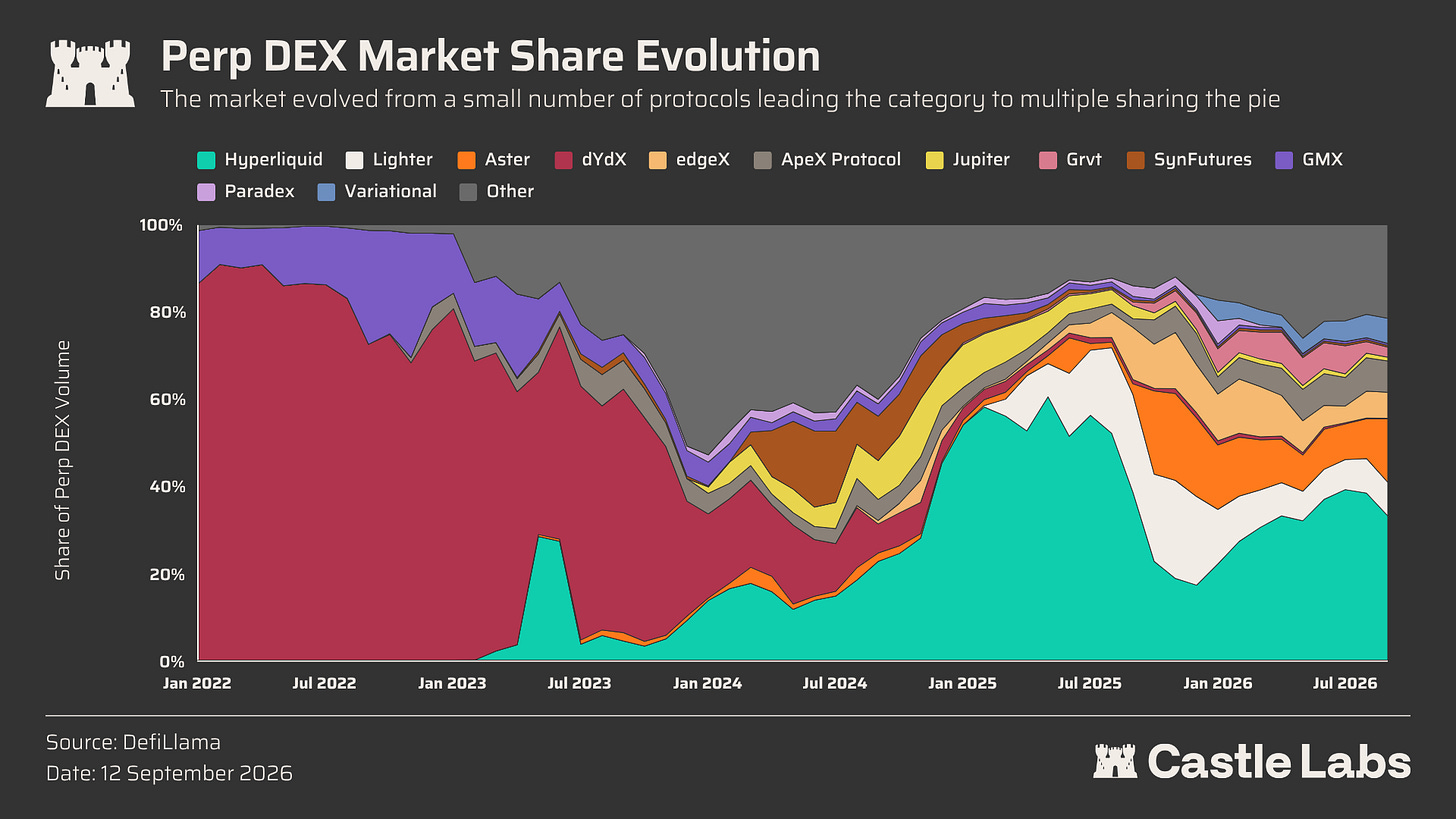
Each product had distinct characteristics, which we still see today, though adapted.
Built on the Cosmos SDK, dYdX was one of the first protocols to see the value in verticalisation and in becoming an app chain using a CLOB.
dYdX moved from StarkEx to its own Cosmos appchain. Strategically, that made sense for the team, as an appchain gave them more control, more decentralisation, and sovereign infrastructure. However, for traders, this added friction through bridging, funding complexity, and onboarding flow. Moving cross-chain might seem like a given now, but it wasn’t back then.
Furthermore, the transition to an appchain wasn’t without technical challenges, including downtime, validator delays, and more. Decentralised governance also slowed product development velocity and made decisions that eroded community trust, such as shutting down token bridges while holders still had liquidity and assets there.
GMX V1 instead pioneered the GLP model: a dynamically balanced basket of assets such as ETH, BTC, and stablecoins that acted as the counterparty to trades opened on the platform.
GLP was a good early answer to bootstrapping perp liquidity, but it was not a clean long-term market structure. It pooled assets, used LPs as traders’ counterparty, and paid LPs fees. The trade-off was that LPs absorbed traders’ PnL, asset exposure, and inventory imbalances.
In short, the GLP model was hard to scale and bundled too many risks into one product. Every new market added risk to the same liquidity base, so OI caps, fees, oracle design, and pool composition constrained long-tail expansion. GLP was never meant to scale for long-tail assets, but only for majors and large caps. This also caps demand for offered assets because of capital inefficiency, which can reduce demand as competition increases.
GLP V1 also suffered a $40 million hack in 2025 due to a reentrancy attack, further undermining depositors’ trust.
GMX eventually also moved away from GLP to V2 and the GLV model, adding more flexibility and capital efficiency. Because of their inherent design, pool-based models are less flexible than order-book models for launching new markets and scaling horizontally.
Nonetheless, others have modified and used this model: Hyperliquid with the Hyperliquidity Provider (HLP), and Variational with the Omni Liquidity Provider (OLP).
The total addressable market for perps has always been large. However, earlier models couldn’t scale liquidity and, as a result, failed to compete with CEXs, with most users still trading perps there.
This is still true today, but the share of perps traded on DEXs has grown to over 13%, from 4% in 2024.
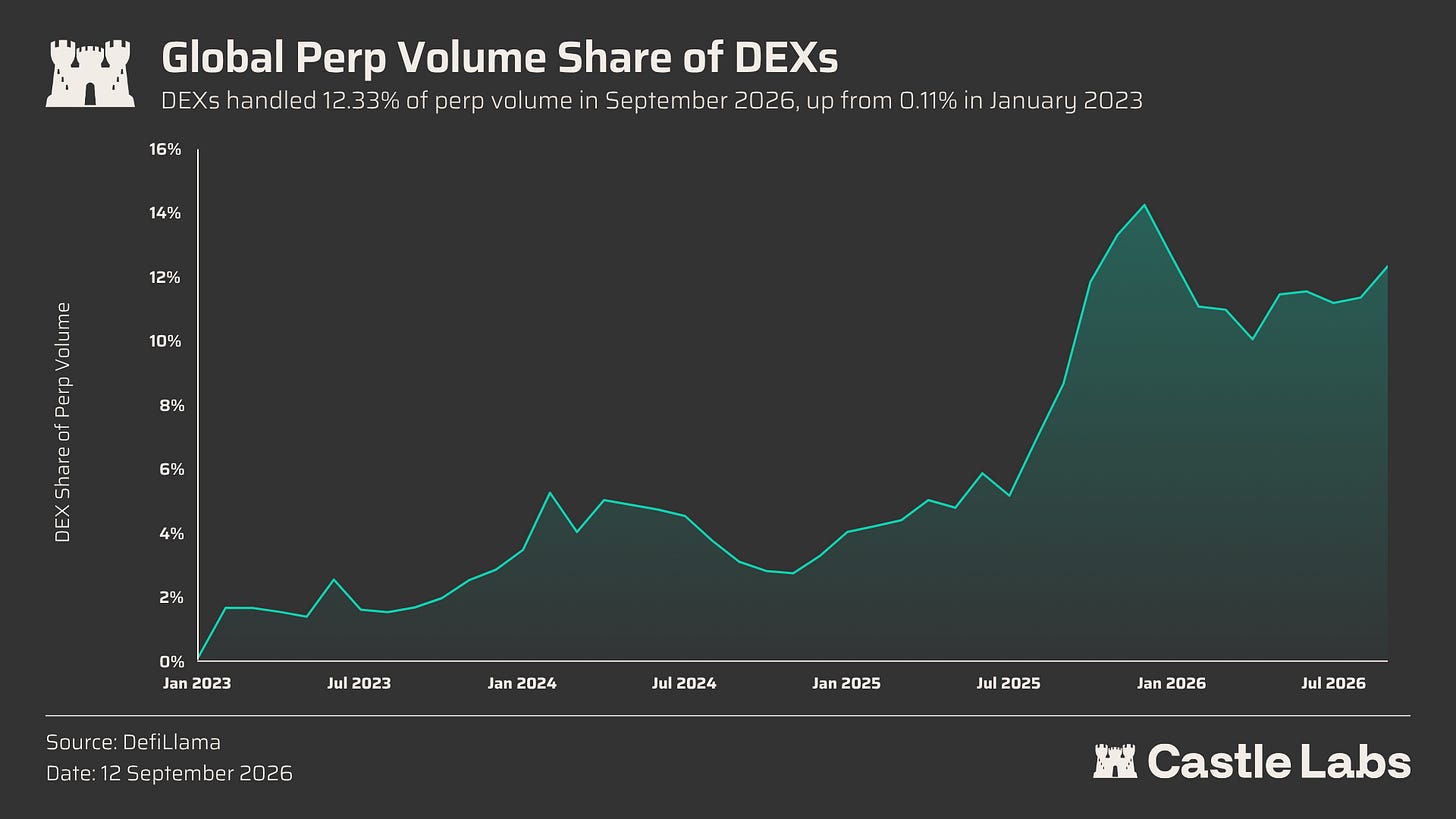
The peak so far happened in December 2025, when DEX perps reached over 14.25% of total volume.
This higher-level view tells only half the story and could even look disappointing. But by looking deeper into perps, we can see consistent growth, especially through 2025.
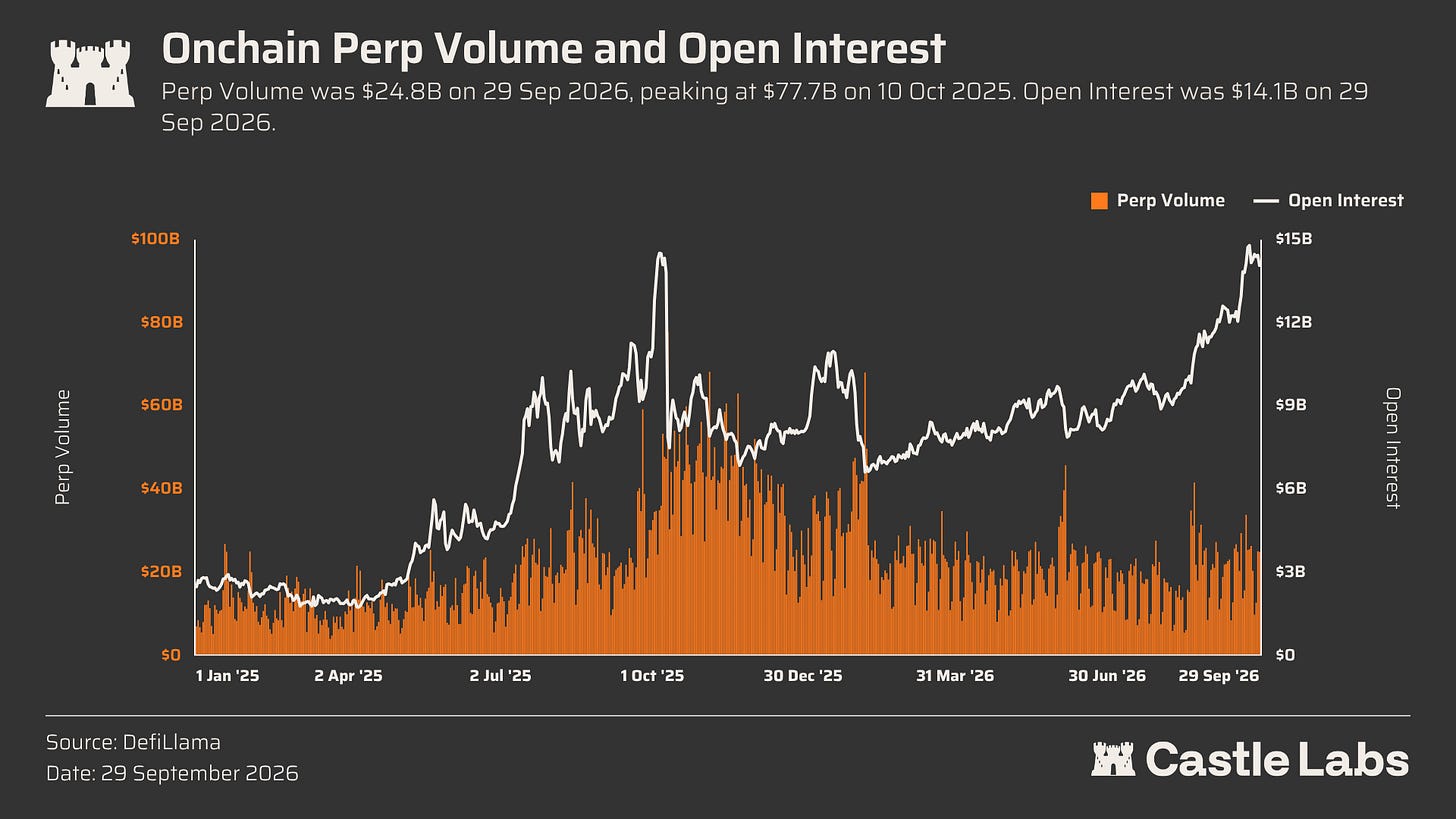
While many catalysts have driven this, the chart above shows that volume picked up at the end of 2024, coinciding with Hyperliquid’s launch and success, which we cover in more detail in the next section.
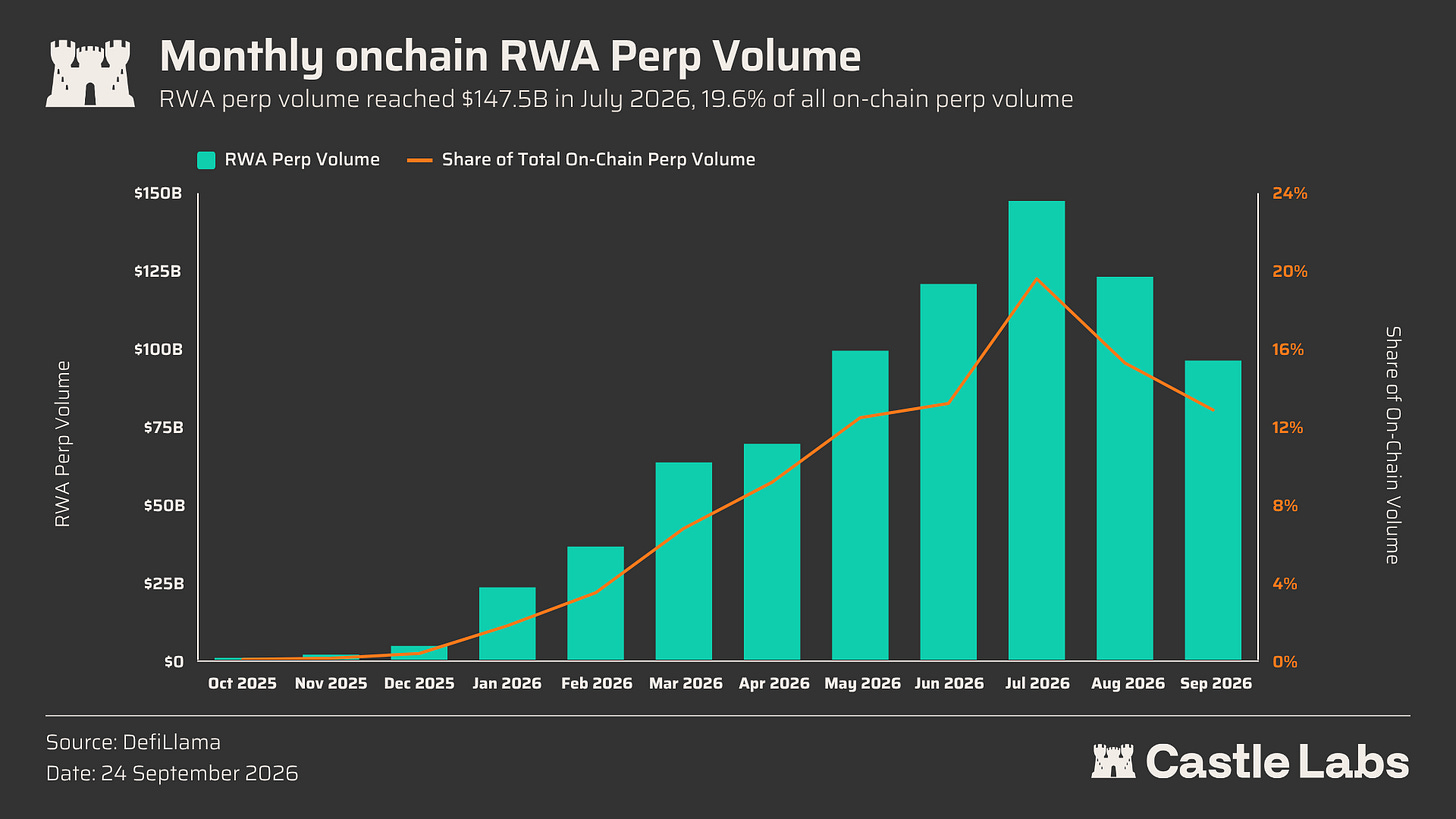
The latest spike from 2026, instead, can be attributed to a combination of the rise of RWA assets, which now can be traded through perps, as well as the rise of many venues to do so, such as Lighter, Variational, Extended, Entropy, and all the other ones (and more) mentioned in this report.
After Hyperliquid, in fact, over 261 perp DEXs have launched.
As it stands, Hyperliquid still leads the perp DEX market share by far, with over 56% of total open interest, followed by Aster (9.7%), Variational (6.2%), and Lighter (5.7%).
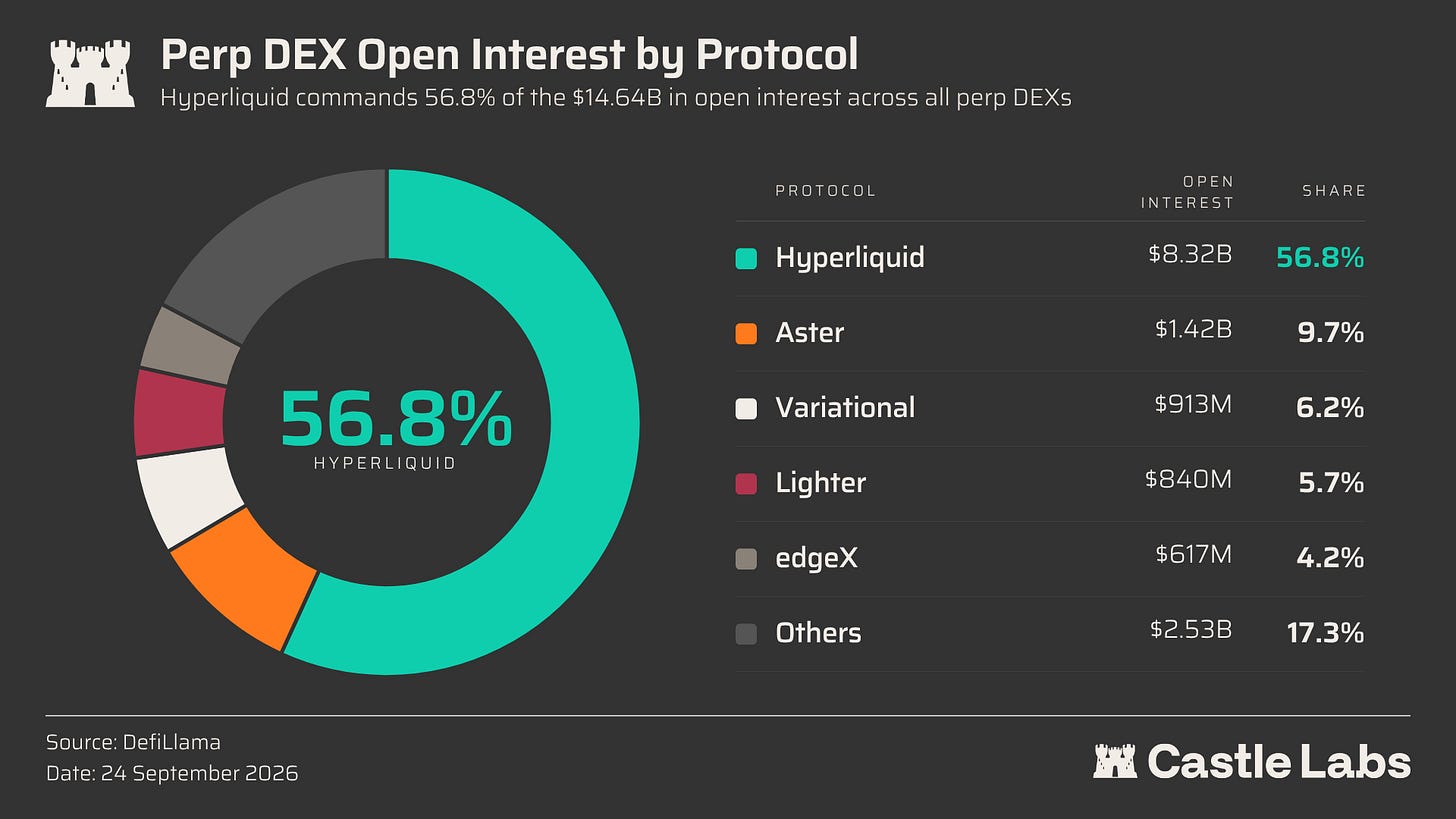
We mentioned that the landscape was initially dominated by dYdX, then GMX. Since Hyperliquid’s launch, it has led in market share, except for a brief period in November 2025 when Lighter claimed the lead.
The end of 2025 still represents the peak in monthly perp volume, with a cooldown throughout 2026.
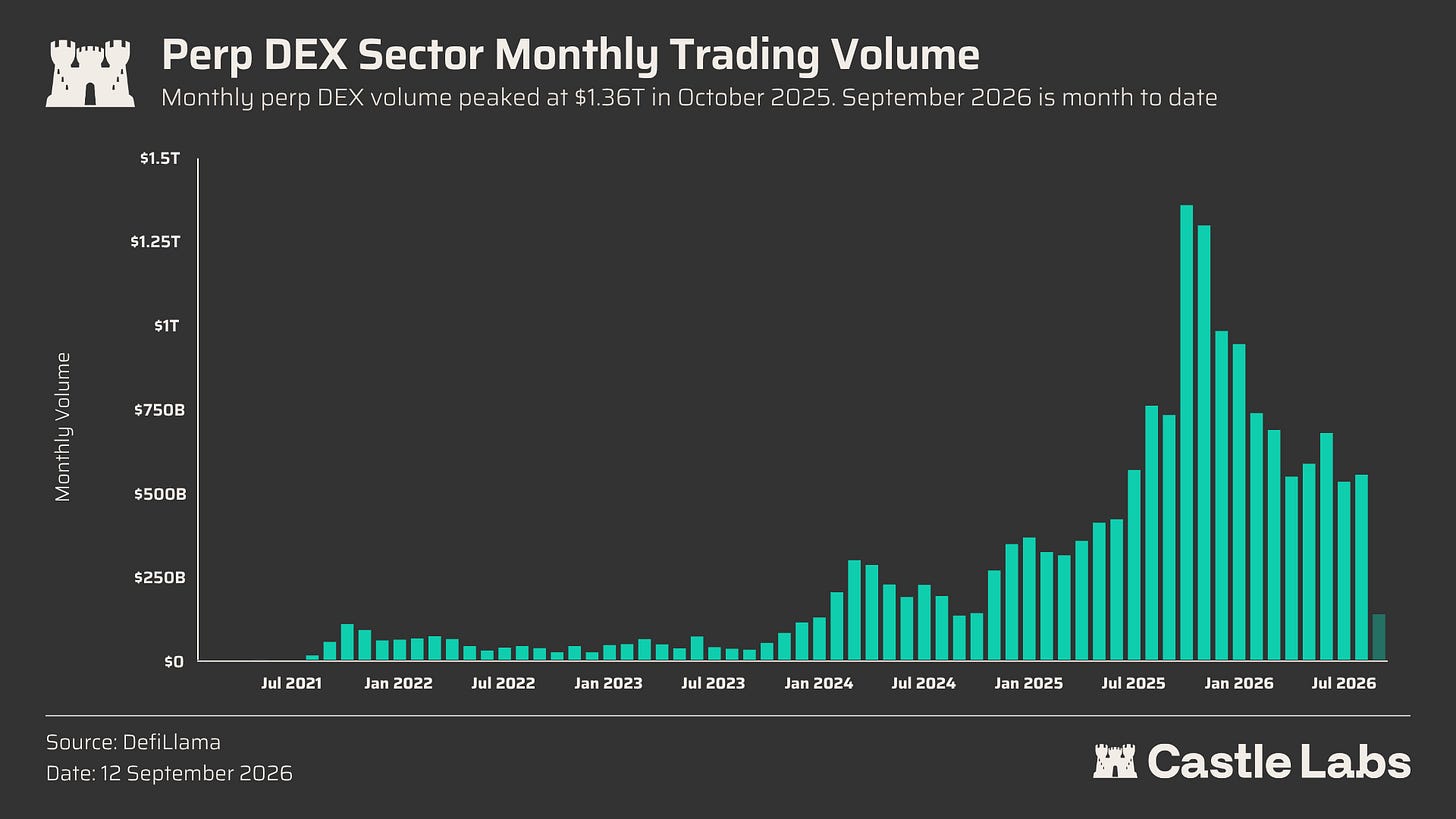
The leadership change reflects a broader shift in the perp landscape, especially around listing and supporting RWA assets.
One of Hyperliquid’s most distinctive aspects, which gave it broad resonance outside crypto, was Tradexyz’s role in listing assets previously unavailable onchain and making them tradable 24/7; at its peak, this accounted for 50% of the platform’s volume.
A prime example is crude oil (CL). During the Iran crisis, the US attacked Iran on a weekend, when traditional trading venues were closed. Tradexyz was the only place to trade CL.
We wrote a full microstructure analysis comparing the CL market on Tradexyz vs the CME. In 3 weeks, CL went from a novel market to an established venue where traditional finance players could hedge their exposure.
For us, this is one of the clearest ways to show the utility of onchain RWA trading and drive adoption. As a result, many funds, such as Abraxas, are now loyal aficionados of RWA trading on Tradexyz.
Part of Tradexyz’s success is that it allows 24/7 trading of RWA assets through discovery bounds. These restrict price movements within a ±(1/max leverage) benchmark of the reference price during outside trading hours.
During the first weeks of testing bounds, the CL market actually hit the 5% bound, and markets stopped during the weekend. Now that this method has been battle-tested, Tradxyz uses re-anchoring to ensure continuous price discovery: once an asset’s price hits a trigger (e.g., nears the bound), it can re-anchor and use that price to set new bounds.
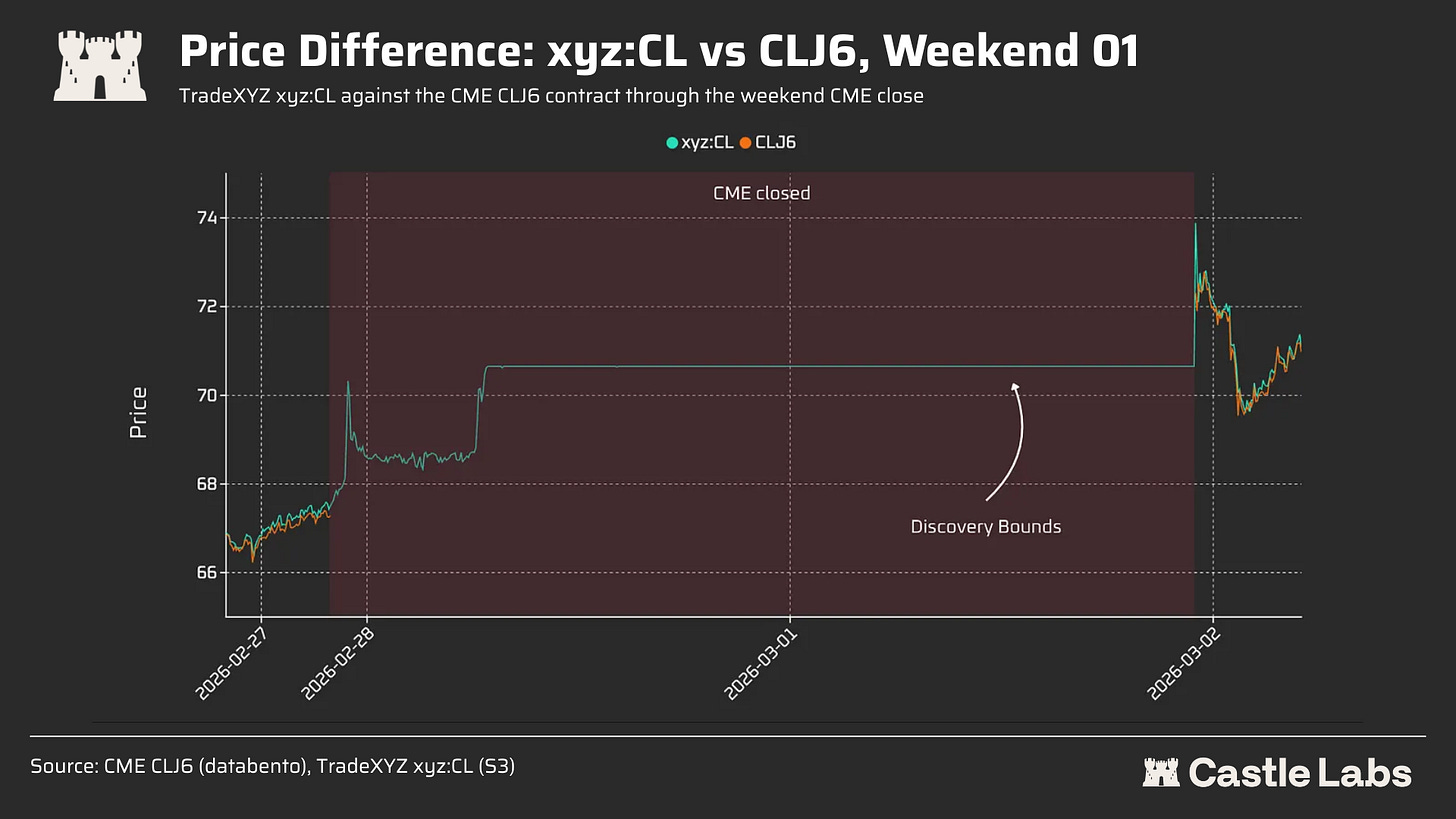
Beyond offering previously inaccessible assets to the retail public, RWAs also offer an interesting alternative to TradFi institutions.
This becomes evident when we look at the top 10 assets traded in perps as of 10 September 2026. Seven of the top 10 assets are RWAs, led by the Nasdaq 100 index and Gold, which together have over $1.4 billion in 24h volume and $850 million in open interest.
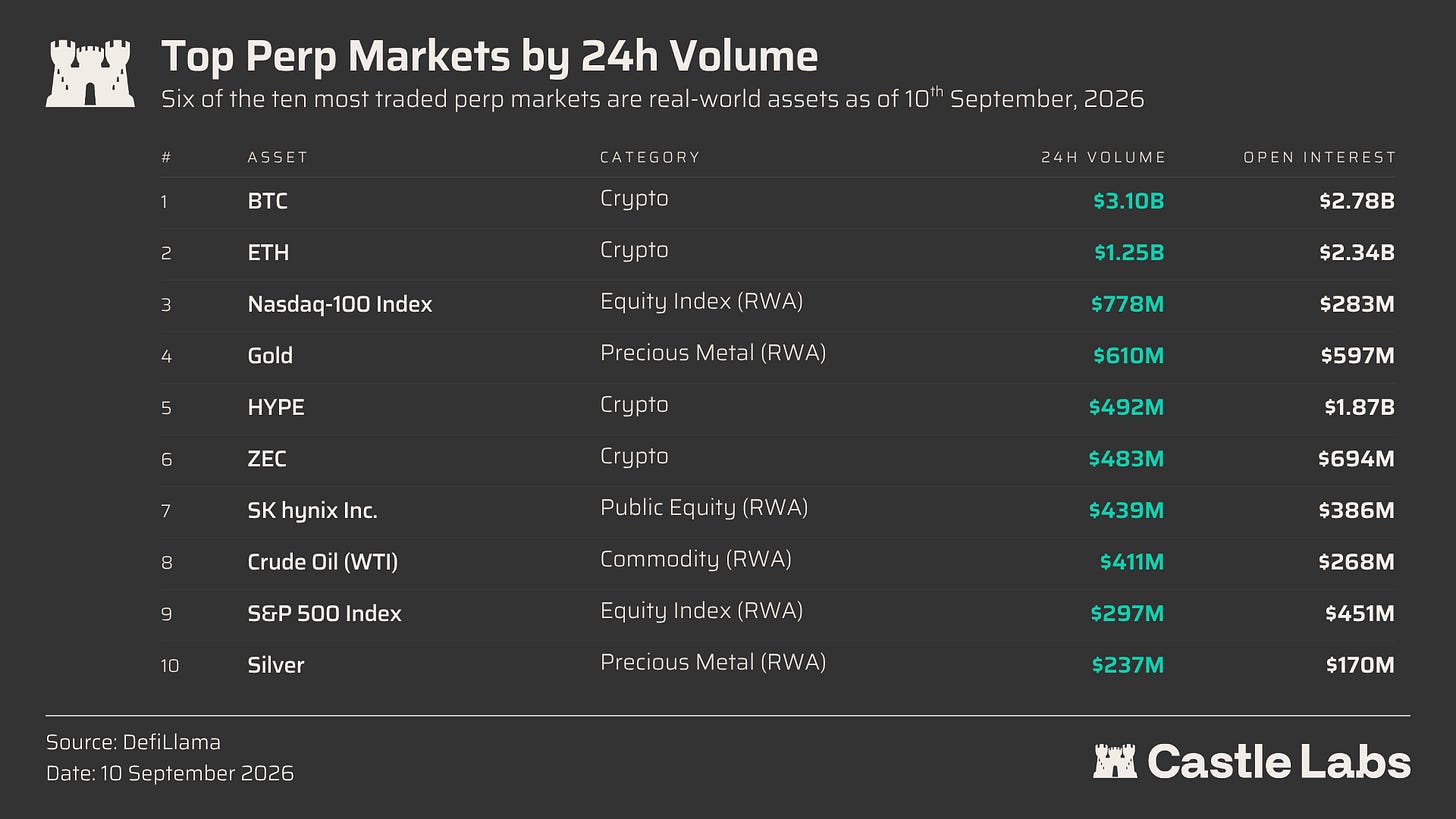
For this reason, we argue that perps have shifted from venues offering leveraged exposure to underlying assets to venues offering price exposure to previously unavailable assets.
As a consequence, RWAs have become a key aspect of a perp GTM, as we will see in the related section.
The Hyperliquid boost
One of the main catalysts for perps has been Hyperliquid’s rise. Both its TGE strategy with the airdrop and its shift from a perp exchange to a full-fledged ecosystem, aimed at becoming the “AWS of Liquidity”, have revived demand to build these primitives and create a blueprint others can adapt.
The important point isn’t just that Hyperliquid grew in volume. It changed what an onchain perp venue could be. Before Hyperliquid, perp DEXs were mostly understood as front-end trading venues: onchain versions of CEX perps, with lower custody risk but usually worse execution, weaker UX and less liquidity.
After Hyperliquid, the category expanded into something closer to a full trading platform.
Hyperliquid changes what traders can expect from an onchain perp venue, bringing together several pieces that had usually been separate:
HyperCore, the high-performance trading layer for spot and perp markets.
HyperEVM, a native builder environment around the venue.
HIP-3, which lets builders deploy new perp markets and pushes listings closer to a permissionless marketplace.
HIP-4, which introduces outcome markets, useful for prediction markets and options-style instruments.
Builder codes, which let external front ends route order flow to Hyperliquid and monetise that distribution.
HLP, Hyperliquid’s liquidity provider vault, which gives passive capital a role in market making.
RWA front ends such as TradeXYZ, which use Hyperliquid infrastructure to bring equity and other offchain exposures into the same trading environment.
Each element contributes to Hyperliquid’s success; together, they put HYPE at the centre of these growth vectors, elevating the venue above previous perps platforms.
HyperCore gives traders the core exchange experience: orderbook trading, fast execution, deep liquidity and an easy interface. HLP gives the venue a native liquidity primitive. HyperEVM gives builders an ecosystem to build around. HIP-3 turns market creation into a product and revenue surface. HIP-4 adds outcome markets to the equation. Builder codes turn wallets and apps into distribution partners. TradeXYZ shows how to use the stack to bring TradFi assets into the same trading interface.
Together, they let users maintain portfolio margin across the platform, so they can run more complex strategies, such as gaining exposure to spot and perp markets for crypto and RWA assets, depositing liquidity, hedging against events, and more. Last week, Hyperliquid also launched manual borrows, allowing anyone to supply HYPE or BTC to borrow USDC and USDT.
Early in its growth, Hyperliquid followed a pattern similar to previous perps: it ran a point campaign and a major airdrop to reward users with skin in the game, helping build an initial base of loyal traders.
However, unlike many, the TGE was only the beginning of Hyperliquid’s growth path.
At its core, it’s a strong alignment across every aspect of its protocol and ecosystem.
This is reflected in its lifetime revenue of over $1.24 billion.
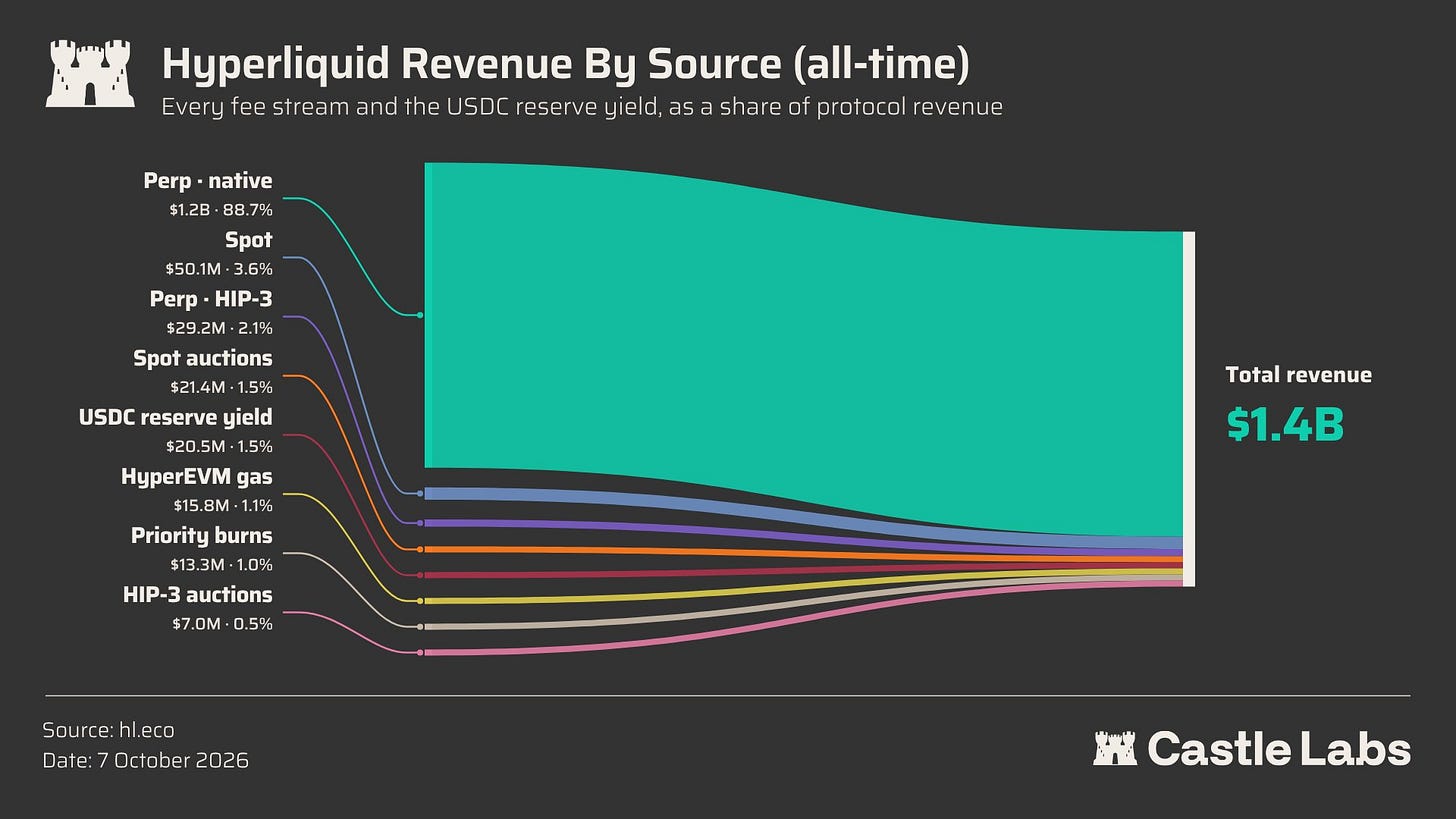
Contrary to popular thinking, not all of it comes from perps. Instead, spot markets, auctions, priority burns, and HyperEVM gas fees all contribute to the revenue surface, while $HYPE remains at the centre of growth.
Here’s how each element contributes.
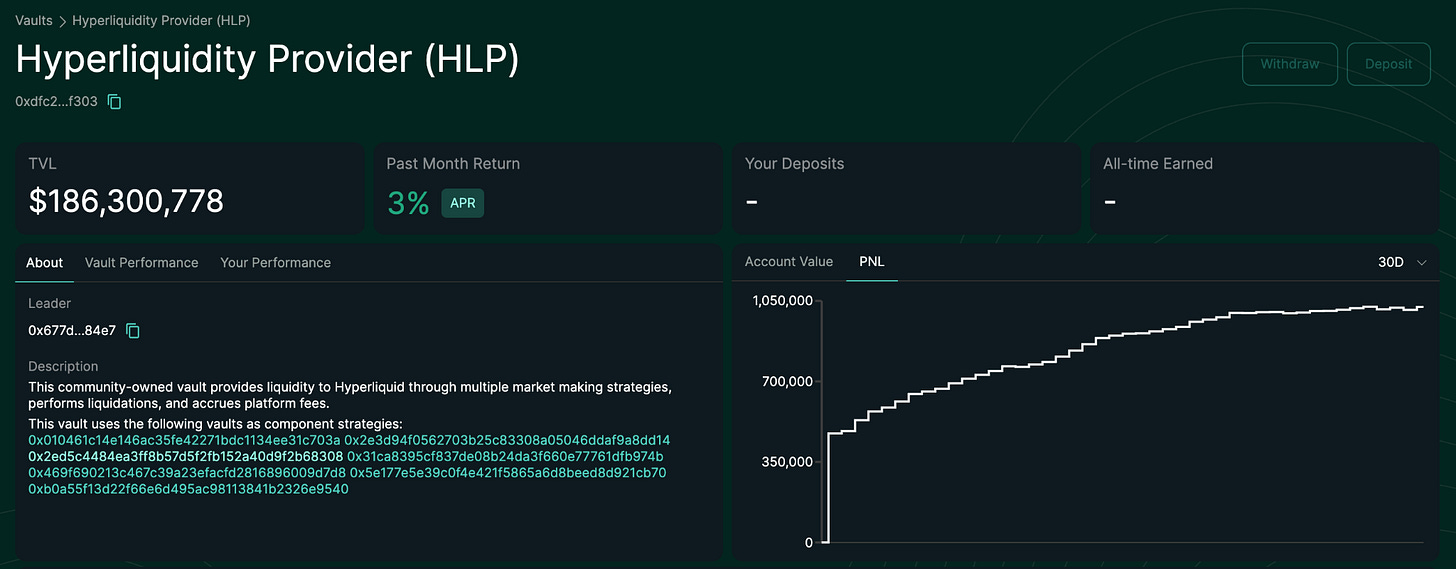
The HLP was initially strategic for bootstrapping HyperCore across several dimensions. The HLP was Hyperliquid’s market-making vault where users could deposit capital and run passive strategies.
It played a key role in bootstrapping initial market liquidity and offered an additional retention loop for users who don’t want to trade but prefer passive strategies.
HLP provided an initial, native liquidity layer, so Hyperliquid didn’t rely on external market makers or outside capital.
In several ways, HLP is different from GMX’s GLP model. The former is more active than a static pooled liquidity basket, reinforcing Hyperliquid as a frontend where users can run different strategies.
Eventually, Hypercore and market-making activity grew so much that HLP is no longer fundamental and has slowly been deprecated, even though it seems to have picked up again after mid August 2026, with plans to move underused HLP USDC into lending to avoid idle capital.
Using the HLP did not come without challenges. One was the JELLY incident in March 2025, when a trader tried to short-squeeze the Hyperliquid market by pumping the spot token and holding a combination of short and long positions on the asset. We cover this in more detail in the upcoming sections.
Let’s use HIP-3 markets as an example. Instead of Hyperliquid being the only team deciding which markets matter, builders can deploy perp markets through the protocol’s framework by purchasing tickers through an auction system, with fees flowing back to the token.
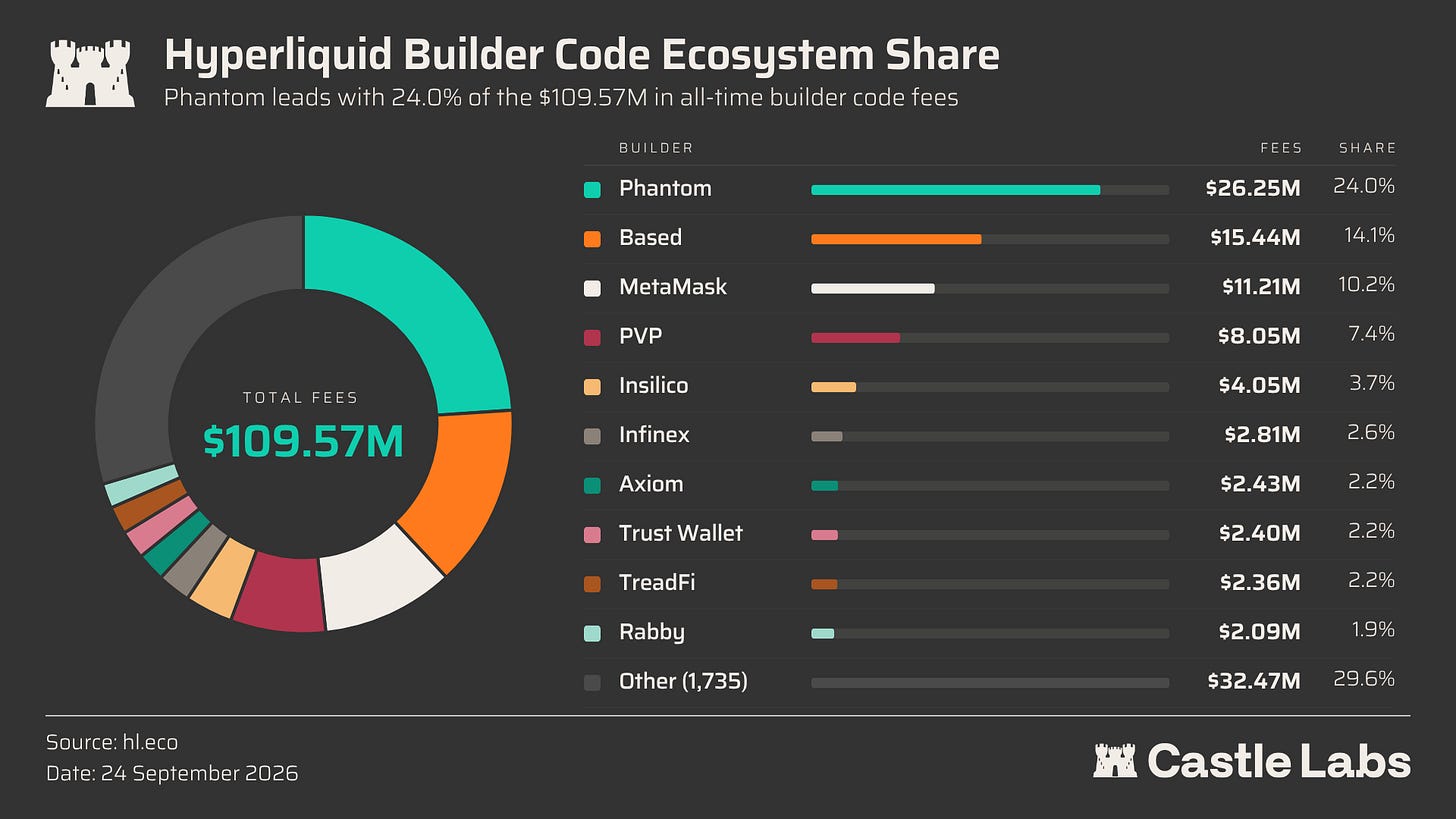
In addition, builder codes meant Hyperliquid didn’t have to focus only on acquiring users; it could also expand horizontally by offering its trading technology as a white-label solution, so others wouldn’t have to build a perp trading engine from scratch.
Builder codes have been extremely successful, showing Hyperliquid’s focus on backend infrastructure. They bring more distribution to Hyperliquid, driving over $40 billion in volume, or 7.4% of the total, in the last 24 hours. Many wallets, such as Phantom and MetaMask, avoided building perp trading infrastructure from scratch and instead integrated builder code, generating over $25 million for Phantom and $10.5 million for MetaMask.
Recently, Hyperliquid announced HIP-4 markets, its version of binary outcomes, which can help the platform expand into event and prediction markets as well as options.
With this competition, perps platforms have to move and operate faster than ever. Launching new features isn’t the issue.
User acquisition is becoming harder. There are only so many active traders, and they are increasingly mercenary. A venue needs distribution, liquidity, product breadth and a reason for traders to keep coming back.
Hyperliquid’s answer has been to make the platform useful from several angles at once: trade on the core venue, build on the EVM, route flow through builder integrations, deploy markets through HIP-3, trade outcomes through HIP-4, or access new asset classes through external front ends.
Something not evident from the pieces we have mentioned is the strong alignment between the platform’s success and HYPE, the token. This is reflected in the programmatic buybacks: 95% of all fees the protocol gathers (on HyperCore, Builder Codes, HIP3 tickets, etc.) go toward HYPE buybacks.
To date, the protocol has bought back over $1.26 billion through open-market HYPE purchases.
Whether through HIP-3, builder codes, or HIP-4, Hyperliquid has focused heavily on expanding distribution.
A venue can manufacture activity before a token launch. It is much harder to keep activity after the obvious airdrop trade is gone and mercenary capital leaves.
For most exchanges, activity peaks before the airdrop because the product’s value is still unknown. Studying Hyperliquid shows how token alignment, execution, and the right distribution can create a deeper flywheel that moves the project story well beyond TGE.
Many protocols are trying to replicate this model, but whether they can match Hyperliquid’s trajectory remains a question.
Closing Thoughts
Onchain perps are expanding rapidly and are at an all-time high in OI. These venues have struggled with and overcome multiple design challenges, from low blockchain throughput that didn’t allow orderbooks to scaling liquidity to support institutional sizes.
The onchain perp ecosystem has evolved, and most activity has shifted from previous incumbents like DYDX and GMX to Hyperliquid, Variational, and Lighter. This evolution brought different architectural choices, and these products explored and introduced a new growth lever for these markets: RWA perp trading.
Platforms like TradeXYZ didn’t just introduce TradFi assets; they also enabled 24/7 trading and gained momentum to lead active price discovery when traditional markets are closed, as we saw during the Iran strikes earlier this year.
Most of the growth these venues are seeing can be attributed to the Hyperliquid boost, which commands over 56% of the onchain OI and revived the perp landscape by converting venue usage into broader token alignment and a flywheel.
Onchain perps are still early, but their growth is hard to ignore. Hyperliquid has already shown that decentralised venues can compete with centralised exchanges on almost every metric. On top of that, onchain venues are focused on increasing distribution, whether through consumer-facing apps or partnerships, making their expansion inevitable.
We cover more about different protocols and design approaches to the perp landscape. We also do a microstructure analysis comparing the execution quality across CEXs and DEXs. Find our complete report here.
Originally published in the Castle Labs newsletter. Subscribe at research.castlelabs.io/subscribe.