Metric: The Next-Gen DEX
Liquidity Providers (LPs) on Decentralised Exchanges (DEXs) have long faced a structural problem during market movements: as prices move on Centralised Exchanges (CEXs), which are hubs for spot liquidity and perform price discovery, DEXs still quote prices before the market moves, giving arbitrageur
This phenomenon is also known as **Loss-Versus-Rebalancing (LVR).
**From January to September 2026, Uniswap V3 LPs recorded a net loss of $35.6 million across 62 major pools due to LVR, after accounting for fees earned on chains like Ethereum, Arbitrum, and Base, showing that LPs do make money from fees but lose more to arbitrageurs.
LVR measures what an LP loses compared with holding the same tokens and rebalancing them at market prices; arbitrageurs capture this value, and fees offset part of it.
However, it is not easy for an LP to capture this value on their own, and there have been efforts in the direction of minimising this problem and giving more value back to LPs or not losing it in the first place:
Batch Execution: DEXs like CowSwap aggregate and clear the trades at a single “clearing price”, reducing any stale price to front-run.
Dynamic Fees: When volatility appears on external venues, the pool increases swap fees, so arbitrage bots pay a premium that goes to LPs. This is possible through Uniswap V4 hooks.
Concentrated Liquidity Market Maker (CLMM): With Uniswap V3, an LP can move liquidity around a reference price, making the design capital-efficient and offsetting LVR-related losses because liquidity is more utilised and makes more fees.
Oracle-guided DEXs: They use an oracle as the price source and automatically shift the pool pricing curve or concentrate liquidity around the oracle’s price.
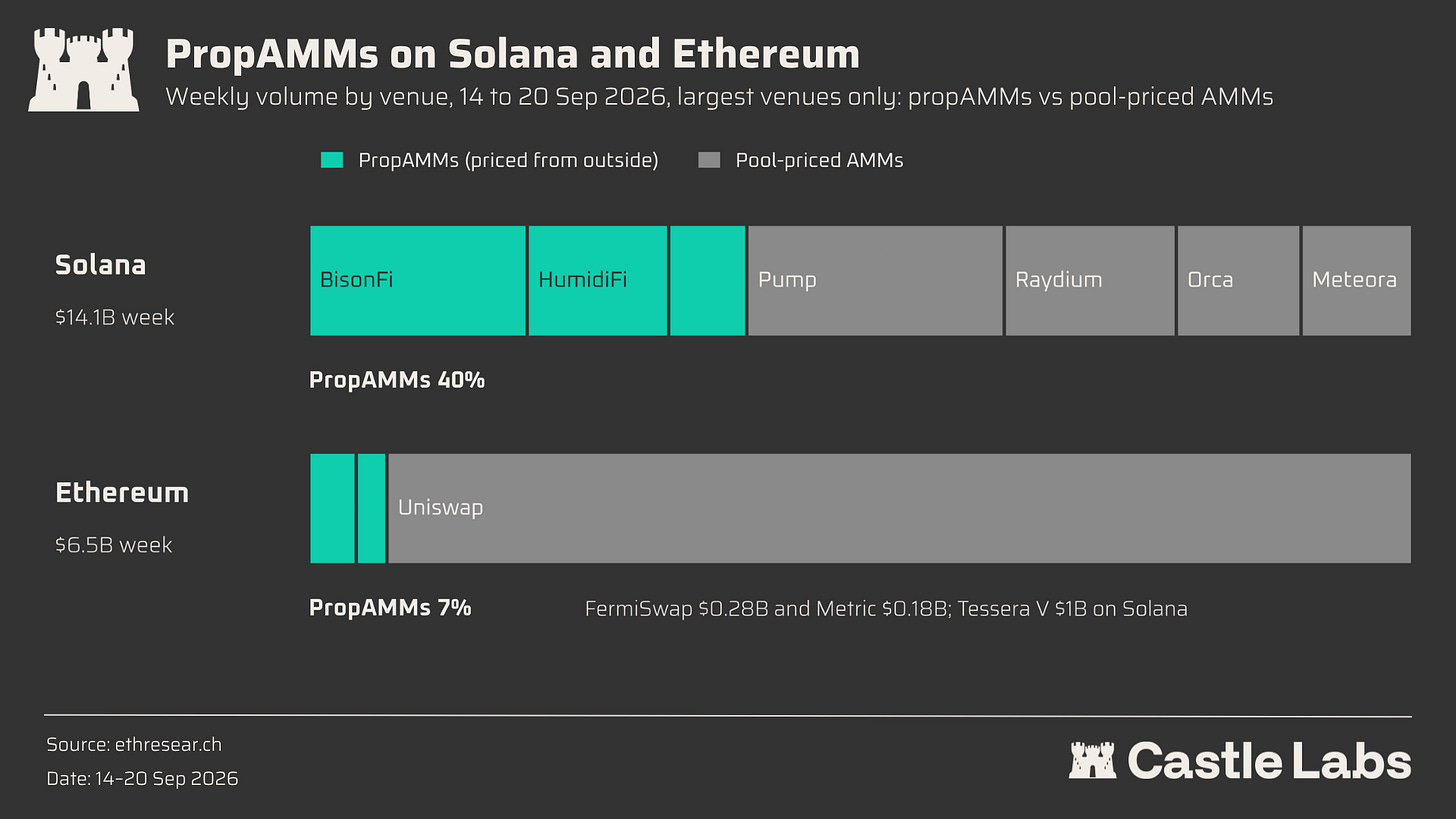
PropAMMs: Proprietary AMMs also avoid most LVR because they quote using external venue prices and hold offchain inventory, enabling better fills for users. For this reason, PropAMMs have grown as a major source of liquidity on Solana today, with ~40% of swap activity coming from PropAMMs, and on Ethereum, nearly 7% and growing. Because they use their own inventory, retail LPs can’t earn yield.
The latest effort to solve LVR comes from Metric, an oracle-guided DEX, which introduces active pools that price using an external venue and keep liquidity moving with the market, reducing the need for active rebalancing.
In this piece, we explore what Metric is, how it works, some of its associated risks, and how to position for the potential airdrop.
Introducing Metric and its Architecture
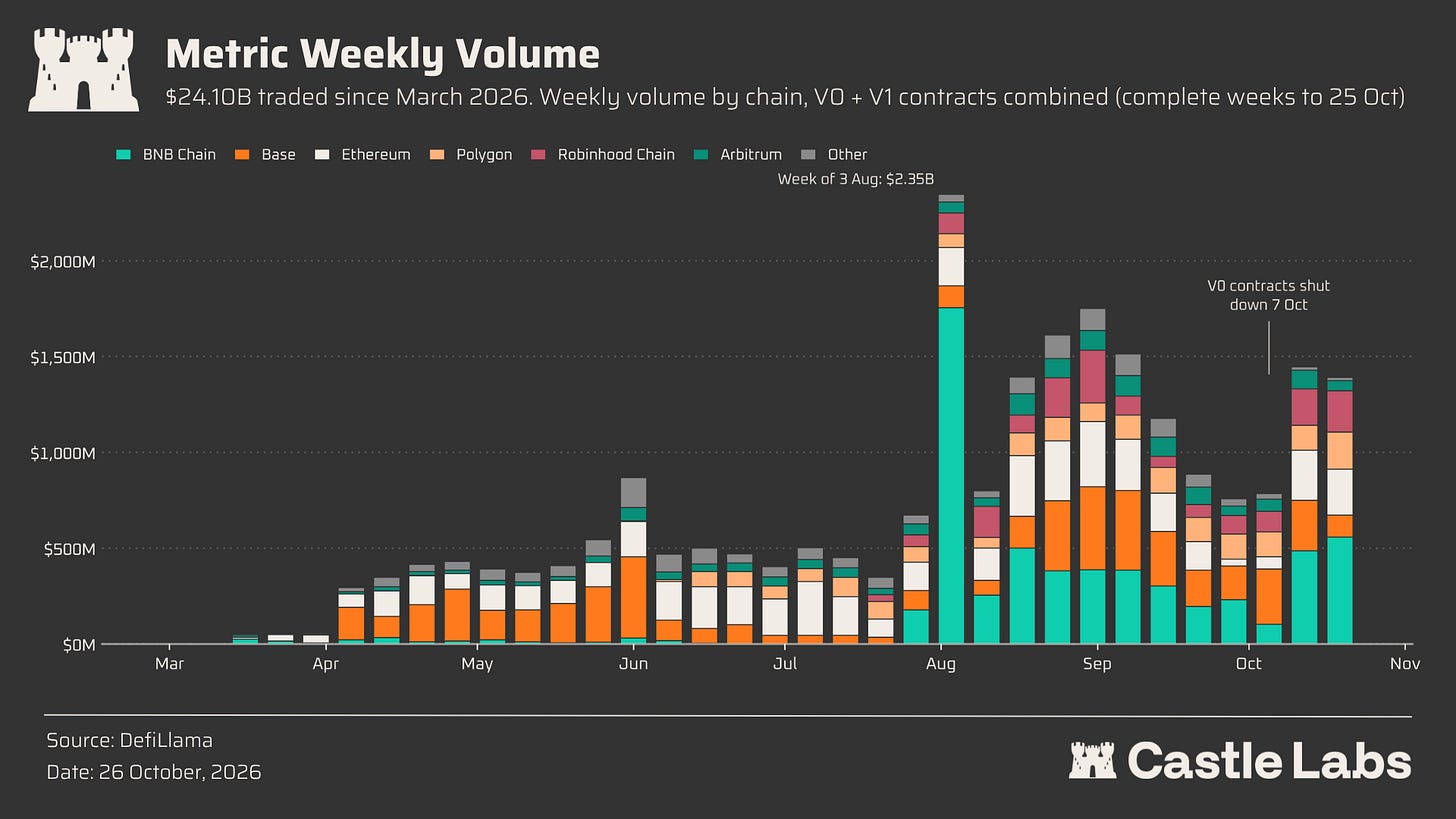
Metric launched in March 2026 and ran in stealth mode for the first 7 months.
As part of the initial strategy, the Metric team deployed $2.5 million of its own capital as liquidity and connected its pools to aggregators, routing over $20 billion in cumulative volume across multiple chains.
They recently went public on October 15th, 2026, as a DEX on Ethereum, BNB Chain, and Robinhood Chain.
The core offering of Metric is its active pools.
An active pool on the platform uses an external source to set the price, holds the LP liquidity, and fills trades around that price, with a curator managing the pool.
The key benefit of this design is that the pool doesn’t perform price discovery; instead, it takes the price from an external source, minimising stale prices and reducing LPs’ arbitrage losses.
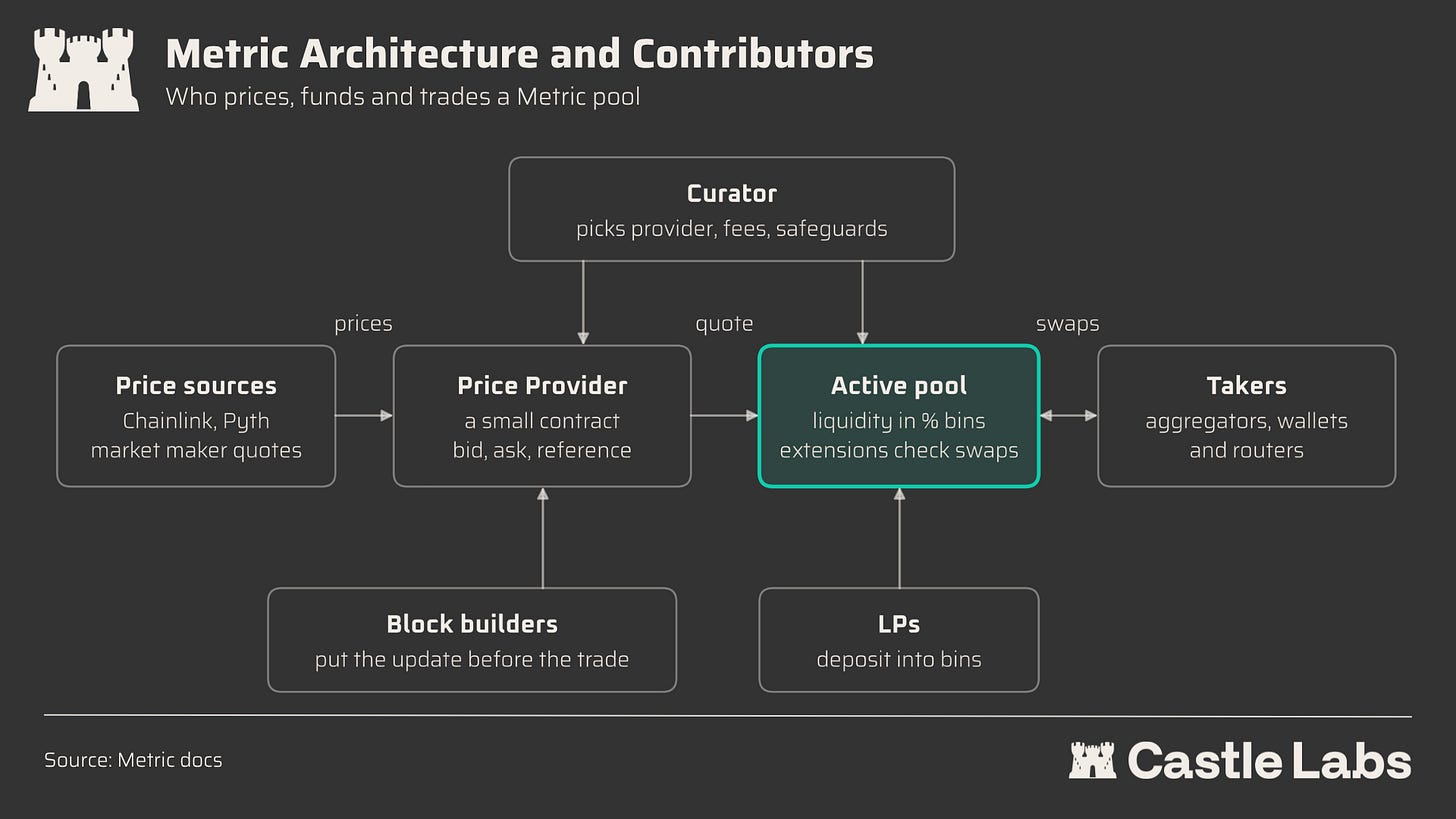
To understand how it works in practice, let’s look at the different contributors to an active pool.
A price provider is an external source of reference price for the pool from Chainlink, Pyth, or a market maker’s streamed quotes. Each pool reads this contract and gets a bid, an ask, and a reference price between them. If it cannot produce a valid quote, the pool stops trading while LPs can still withdraw.
A pool holds liquidity in bins around the reference price. Each bin is a percentage range around the reference, such as +1% to +2% (deviation, generally much lower).
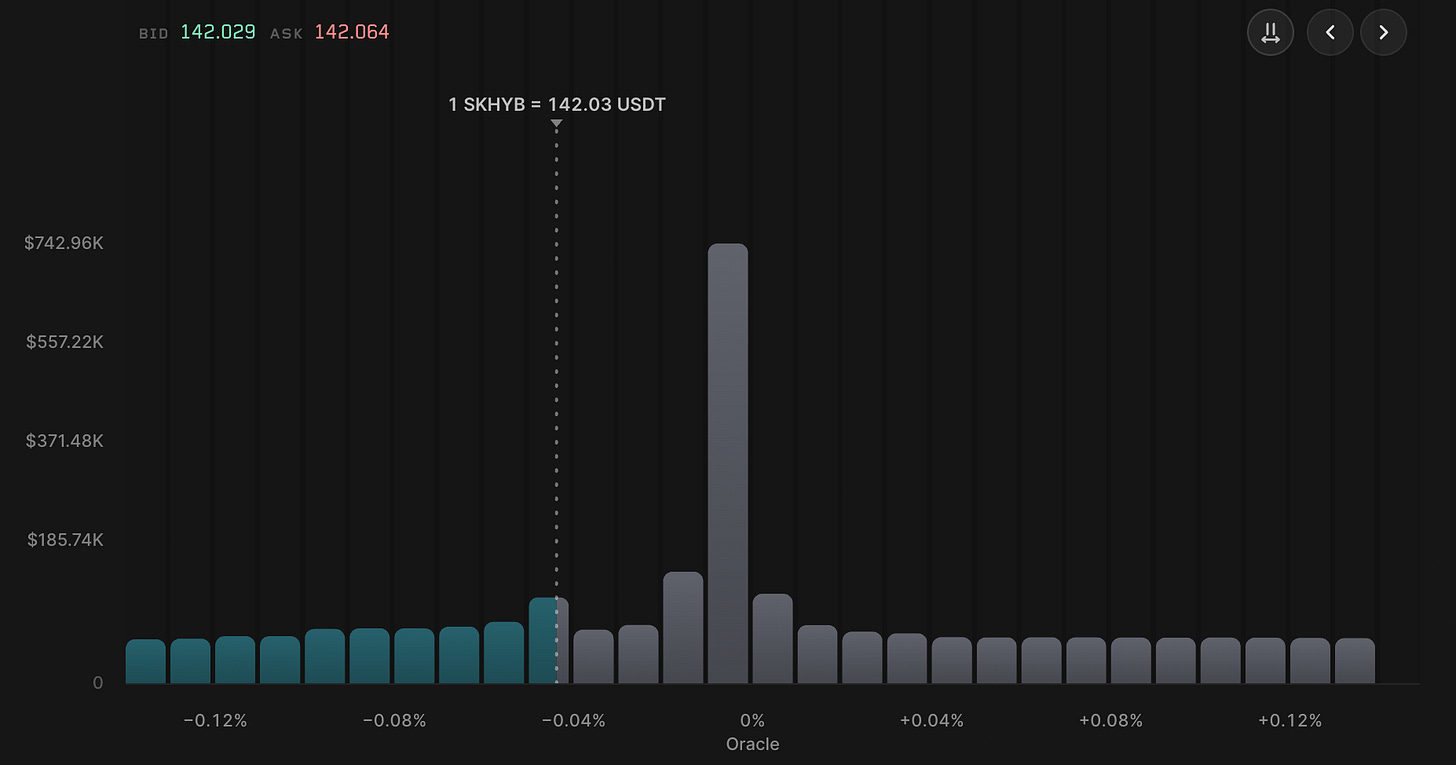
https://app.metric.xyz/pool/56/0xee90641E7c3b4d6338Ab7f1c23Dfb979FAb5f096
LPs deposit liquidity into bins, and the pool calculates the price before the spread as: reference * (1 + deviation). For example, when a price provider reports a $100 reference and the deviation is +1%, the pool quotes $101 before the spread.
This deviation helps drive price discovery at the pool level. On Metric, pools don’t rebalance, so if traders rush to buy a certain asset, they consume liquidity across several bins, and the pool might remain single-sided. With this deviation, arbitrageurs have an incentive to sell that asset back to the pool at a higher price, capturing value from the localised flow.
Additionally, trades on the pool move the deviation: buys push it up, sells push it down, and large trades cross several bins at worse prices.
When the reference moves, the bins move with it, requiring no active management, unlike CLMMs like Uniswap V3, where liquidity is concentrated around a range from the reference price but must be actively repositioned to capture value from flows.
Because liquidity moves, it also enables capital efficiency by concentrating it around the reference price, which in turn generates higher volume from a small pool of capital.
This also enables true “passive yield” for LPs because they don’t need to constantly reposition their liquidity across the range; they can simply choose a set of bins to provide liquidity to, which moves with the reference price.
However, this isn’t risk-free, and Metric removes most stale-price arbitrage but not inventory risk: when flow is one-sided, the pool can end up holding more of the asset that is falling.
As established, pools are managed by curators. They pick the Price Providers, the bin width, the fees and the safeguards, and keep price updates flowing. LPs choose which bins to fund and can deposit a single token.
The curation process is permissionless, but there are certain constraints to protect LPs which also help set the risk profile of a pool:
The price provider sets hard limits on bids and asks, so a curator cannot quote a wider spread than the established limit.
A stop-loss extension rejects swaps that take a bin more than 15% below its recent peak.
Know-your-business (KYB) verification is an option for curators that affects their ranking from high to low risk.
If an oracle returns stale prices, the pool halts trading to prevent damage to LP capital.
LPs, curators, and Metric split the earnings from the spread inside the quote, and traders pay no separate fee. Metric takes a default 7.5% cut, and curators are responsible for adjusting the rest of the share between LPs and themselves (varies based on pool), with LPs earning most of the spread.
The curator-led model also introduces certain risks. Despite multiple constraints, curators still manage the price reference source, its update frequency, and spread, making it closer to a trading-strategy allocation. Moreover, the terms can also change after you deposit. On every pool, the curator and Metric can change their share of the spread at any time with no time lock.
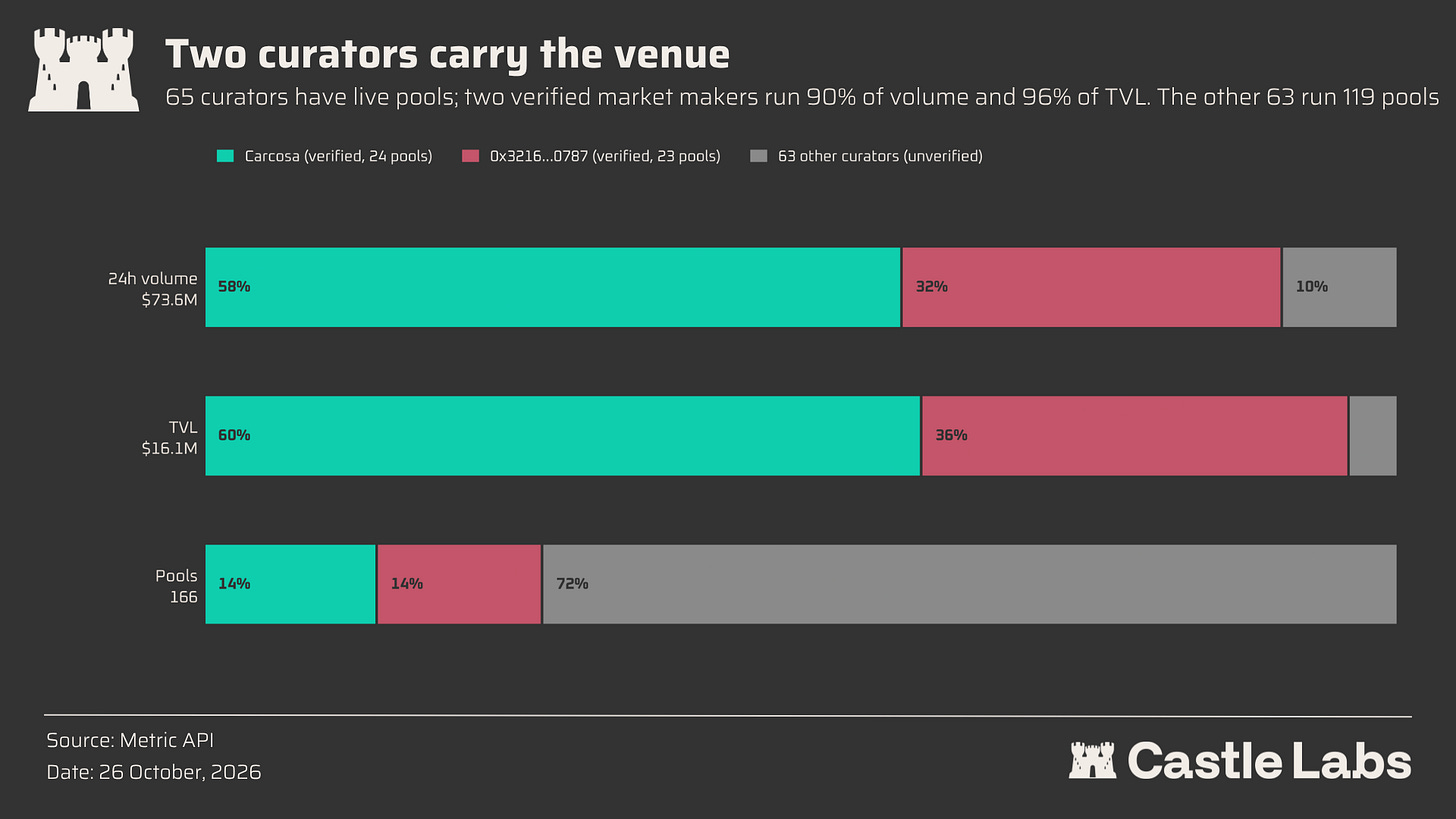
This is why most of the volume is attracted by the top 2 verified curators that have done KYB and are relatively more trustworthy.
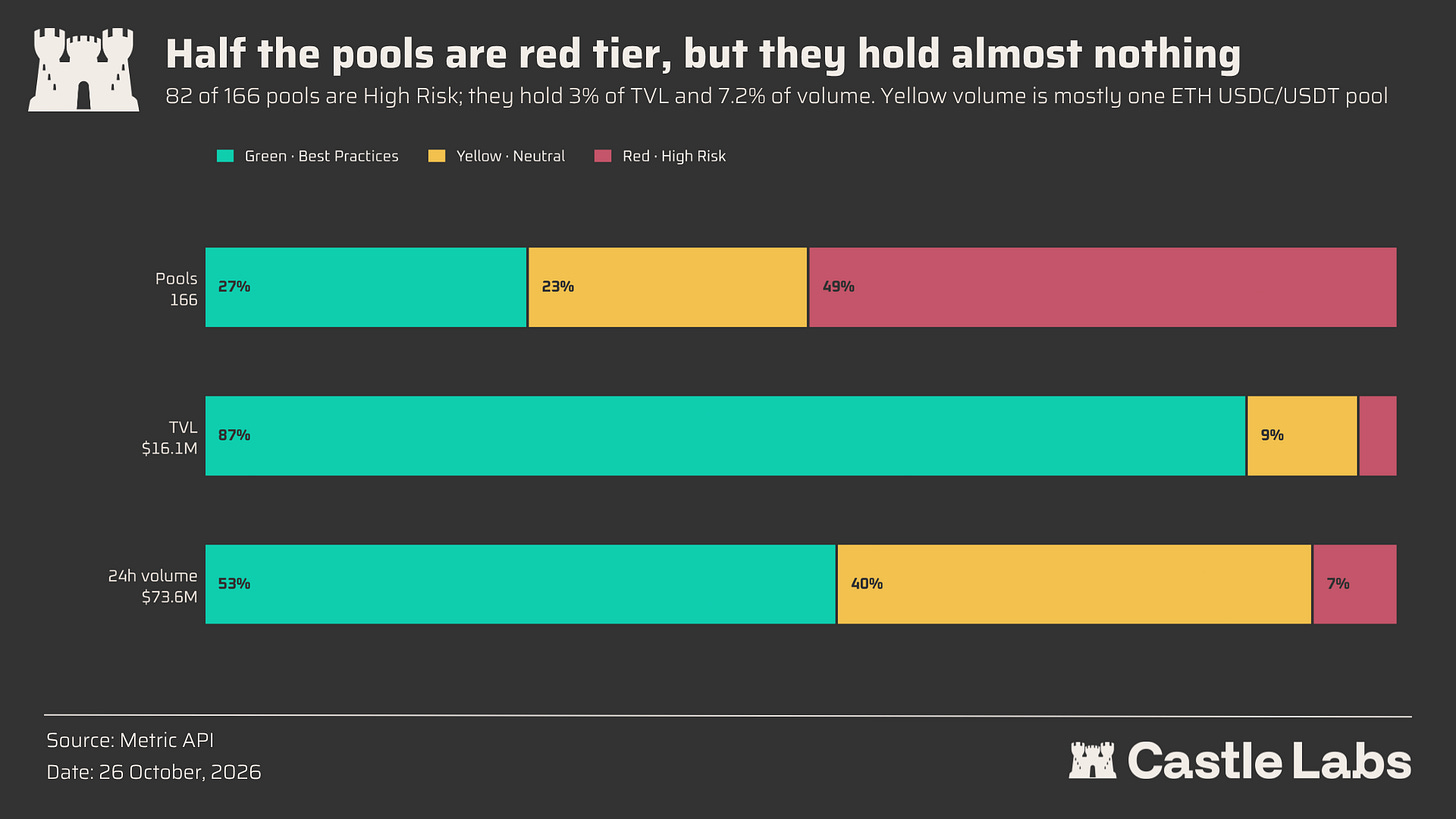
To protect users, the platform runs risk checks on pools and categorises them by risk, making it easier for LPs to allocate. Remember the constraints we mentioned earlier; the pools that follow all of them are green.
Currently, ~87% of TVL is in pools that follow best practices, while high-risk pools make up about 49% of the pools by count. This also shows that in an open system like Metric, where external curators are involved, depositors should be cautious and do their own due diligence when allocating to a pool.
We expect more curators to be verified in the upcoming time since the platform went live to the public very recently. Also, the current top 2 curators attract ~90% of the platform’s volume, but they are not well known; as more established curators join the platform, pool quality will improve, attracting more flows.
Quantitative Analysis of Metric: Capital Efficiency and Top Pools
Metric has already attracted over $20 billion in trading volume routed to it through aggregators.
However, aggregators route volume only if the platform can provide better fills.
To assess whether the platform is better for traders, we compared the median trader cost for the WETH/USDC pool on Metric and Uniswap, weighted against the Binance price between 15 and 26 October, so a negative cost means traders got a better price than on Binance.
On Uniswap, traders pay a flat fee (5 bps in our comparison) set by the pool; on Metric, traders are quoted a variable spread over the live oracle price, and because of the external price source, fills are generally better.
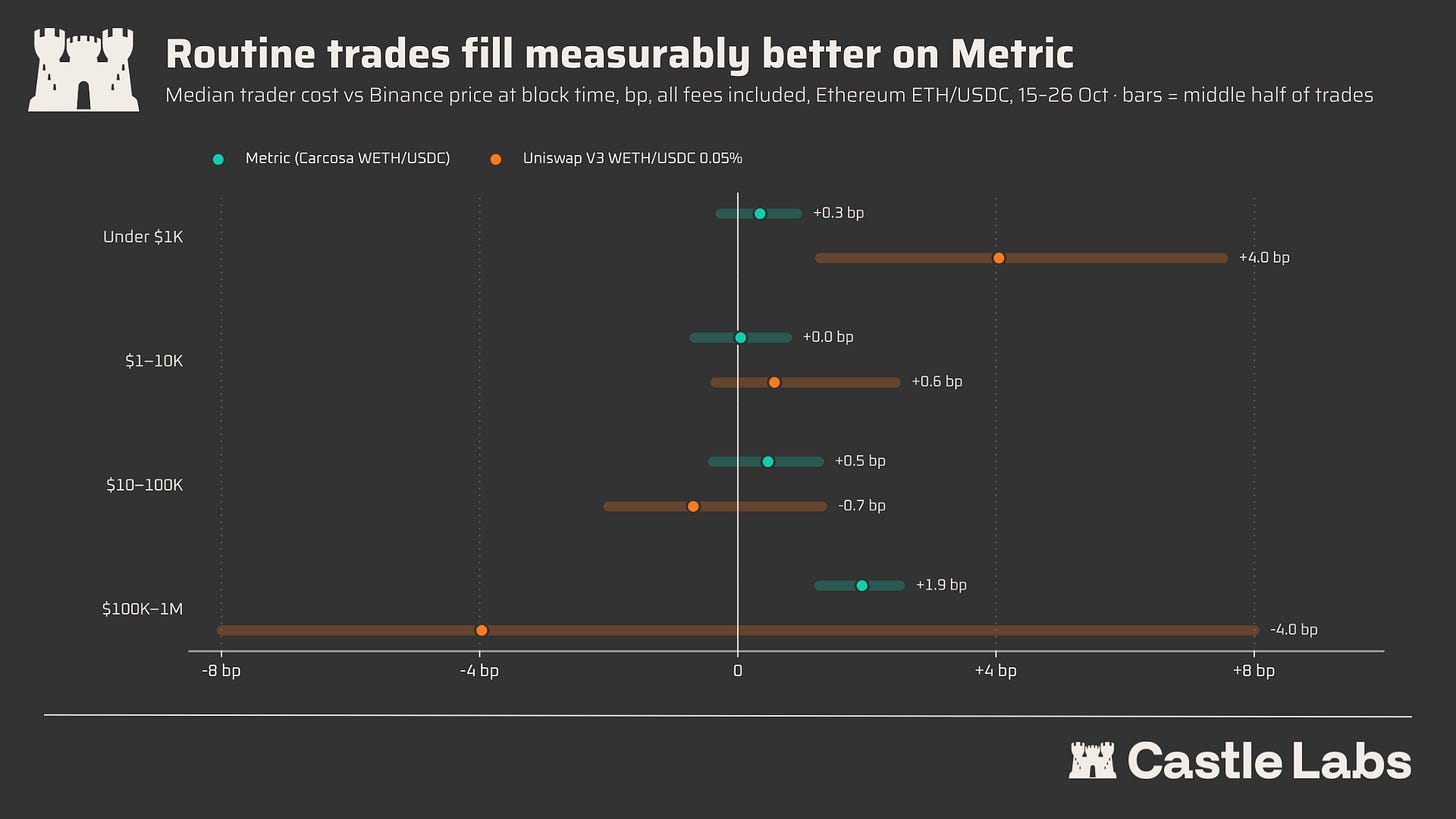
As the chart above shows, Uniswap was cheaper for larger trade sizes ($10k-100k and $1 million), and the negative cost means traders bought below the market price, overlapping arbitrage activity. At these sizes, Uniswap costs varied from -16 to +24 bps (-4 bps average), mixing arbitrage with genuine size.
Also, large trades on Metric cost a median of +1.9 bps (slightly higher than smaller sizes) because of lower liquidity, as these orders consume liquidity across several bins.
From an LP perspective, we also analyse whether Metric LPs earn more yield than Uniswap LPs.
Compared with the same pool and test window above and measured one minute after each trade, Metric WETH/USDC LPs earned +0.44 bps per dollar traded, while Uniswap V3 LPs lost 1.01 bps. Uniswap LPs earned about $150k in fees but lost $162k to arbitrage.
Retracing the same analysis through liquidity rather than volume, Metric LPs made roughly +78 bps (about $3k on $351k) against -5 bps for Uniswap (-$41k on $82.5 million).
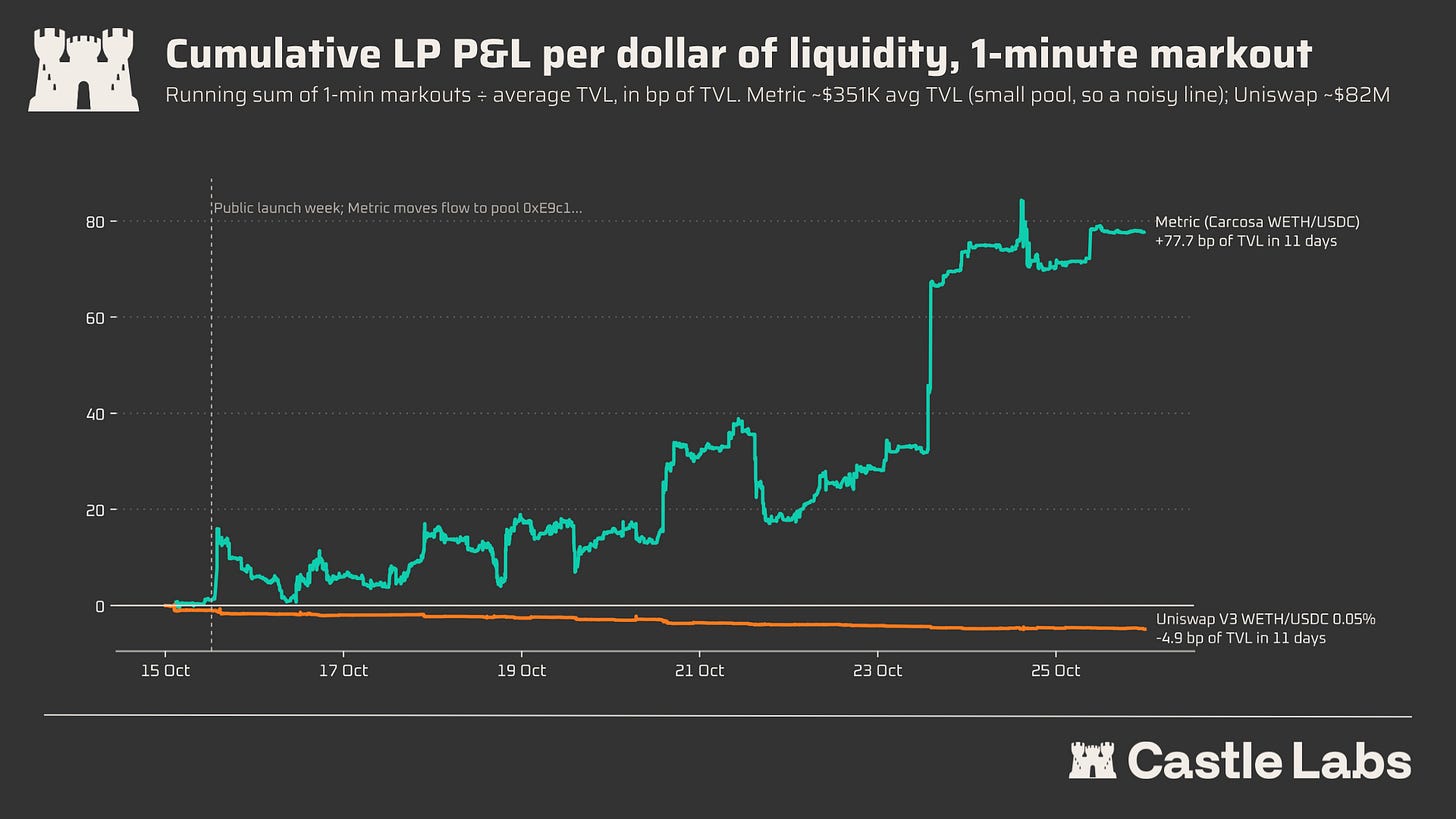
While Metric LPs performed better and LVR is removed, it doesn’t reduce impermanent loss.
Within the same data context, Metric’s pool ended up holding 13.9 more ETH, and ETH fell 3.8%, reducing their liquidity value.
Also, this is a thin sample and may not reflect long-term pool performance.
Metric currently averages $150-200 million in daily volume with a current TVL of ~$17.3 million, which means 8-10x turnover.
Turnover measures a pool’s capital efficiency and is calculated by dividing daily volume by liquidity, showing how much volume $1 in liquidity can support. So a turnover of ~8x here means each dollar deposited on Metric on average powers $8 in volume.
For contrast, Uniswap across chains have a TVL of $4 billion and an average daily volume of $3 billion (turnover <1). This provides a concrete data point on the DEX’s capital efficiency: on Metric, the same liquidity can drive much higher volume, highlighted by its high turnover.
So far, the data suggest the launch didn’t create new demand; TVL grew while volume fell. Also, given the existing liquidity, Metric should now be able to support much higher volume.
At its peak turnover of 58x and current TVL of $17.3 million, it can support over $1 billion in daily volume, ~8x the current weekly average range.
However, that peak reflected scarce capital and could be pretty hard to achieve.
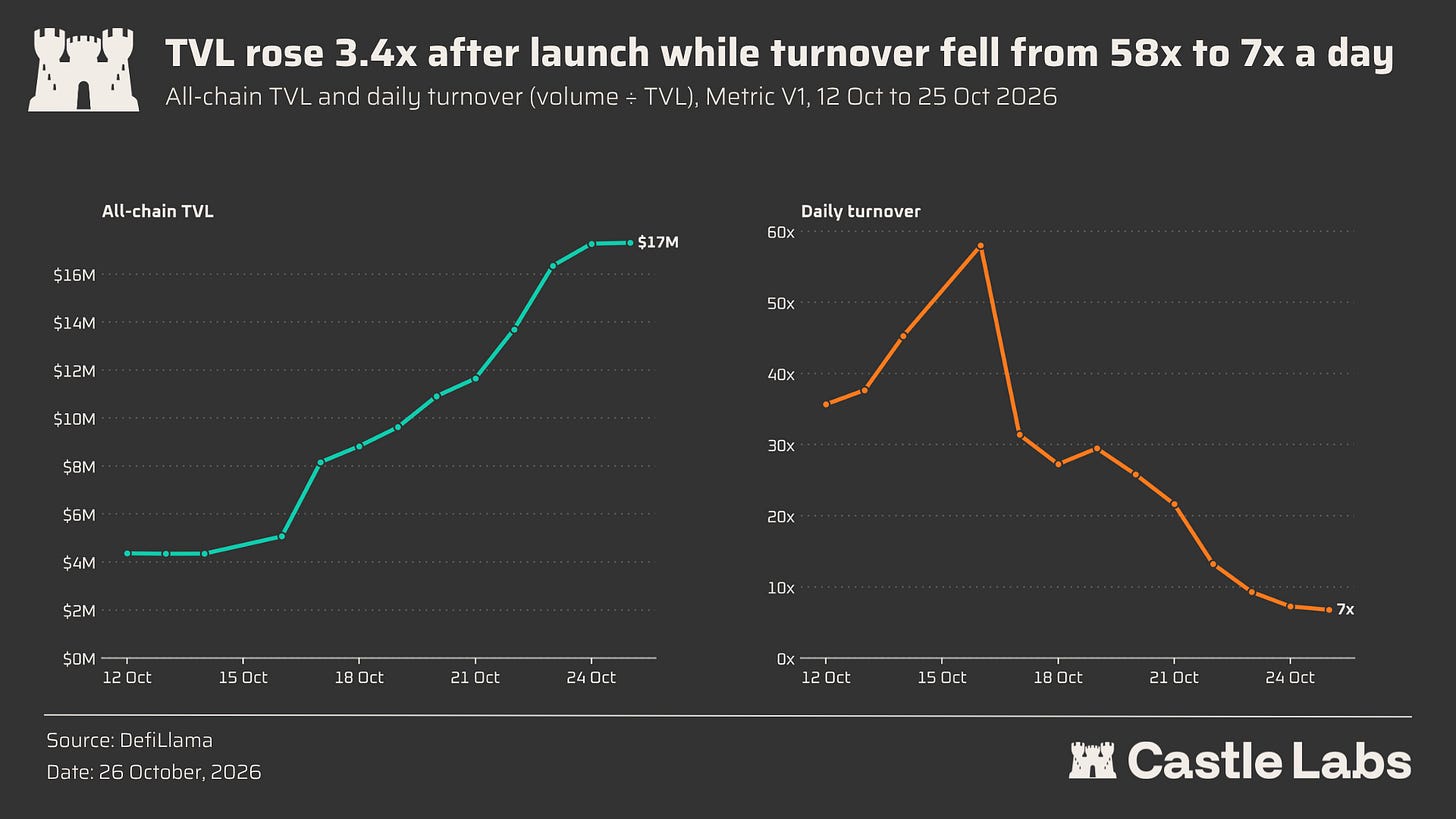
Additionally, if volume doesn’t grow, it will dilute the yield for existing and upcoming LPs.
To illustrate, we measure LP yield at different turnover levels to show how LP yield can fall if volume stays at current levels while liquidity keeps rising. For example, at peak turnover, the pool could yield up to 92% APY, while at 5x turnover, it could drop to 8%.
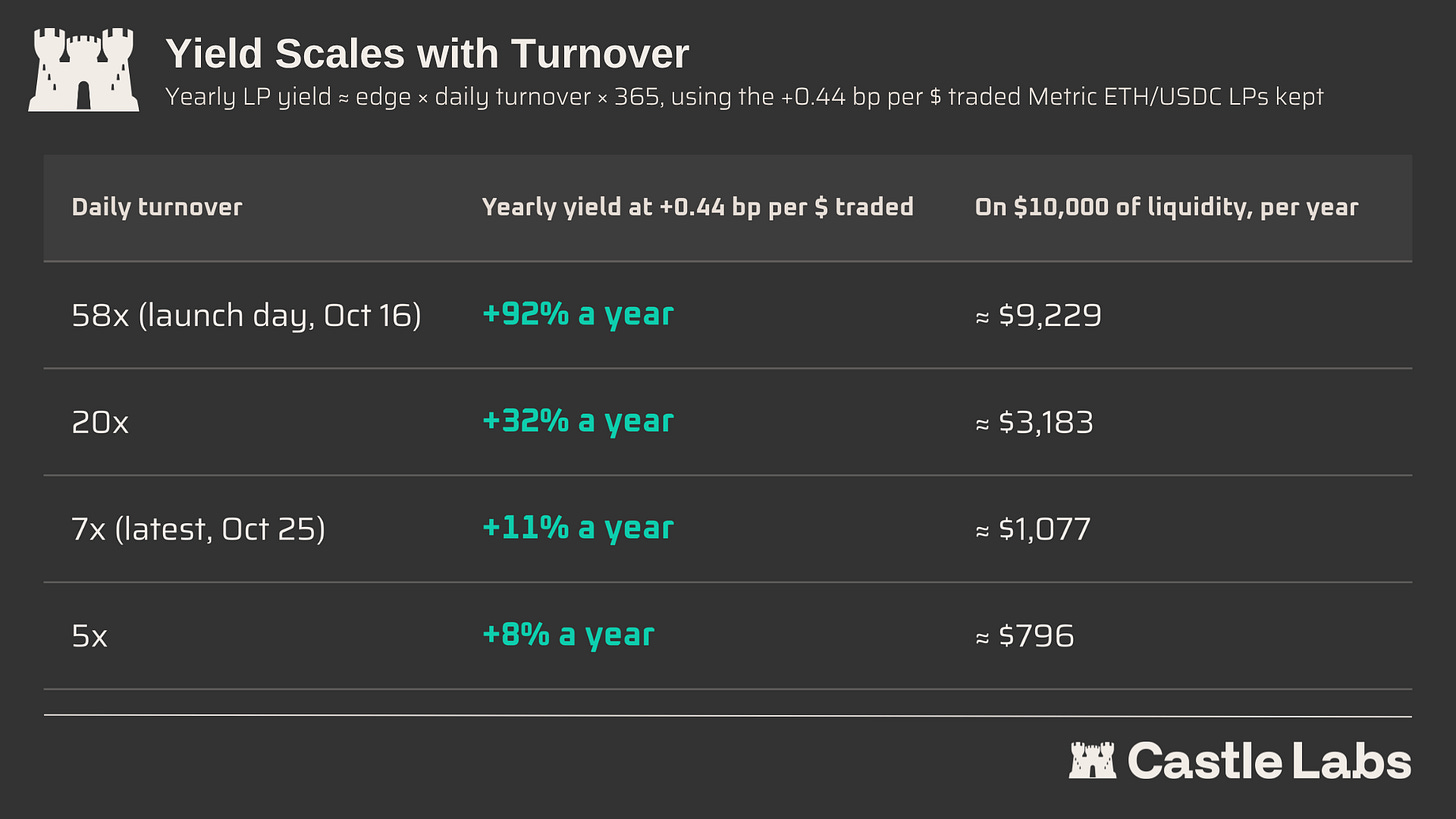
View the data above with caution, as it uses a single ETH/USDC measurement and ignores inventory price moments and impermanent loss.
After analysing flow sources, tokenised stocks and stablecoin pools drive most of Metric’s current volume.
One key reason is that Metric uses external price sources, which suits tokenised stocks best because the most liquid venues are in TradFi, with price discovery happening offchain.
These stock pools provide 24/7 access to spot trading, but on weekends, when markets are closed, they rely on internal price discovery because they lack an external price source.
In that case, if a news breakout or major geopolitical event occurs, the pool attracts flow, and without an external price source to arbitrage against, LPs might end up on the wrong side of the pool, with trades eating liquidity across all bins.
As noted, most of the current volume comes from tokenised stocks and stablecoin pools; the other pools attract little volume because of lower liquidity.
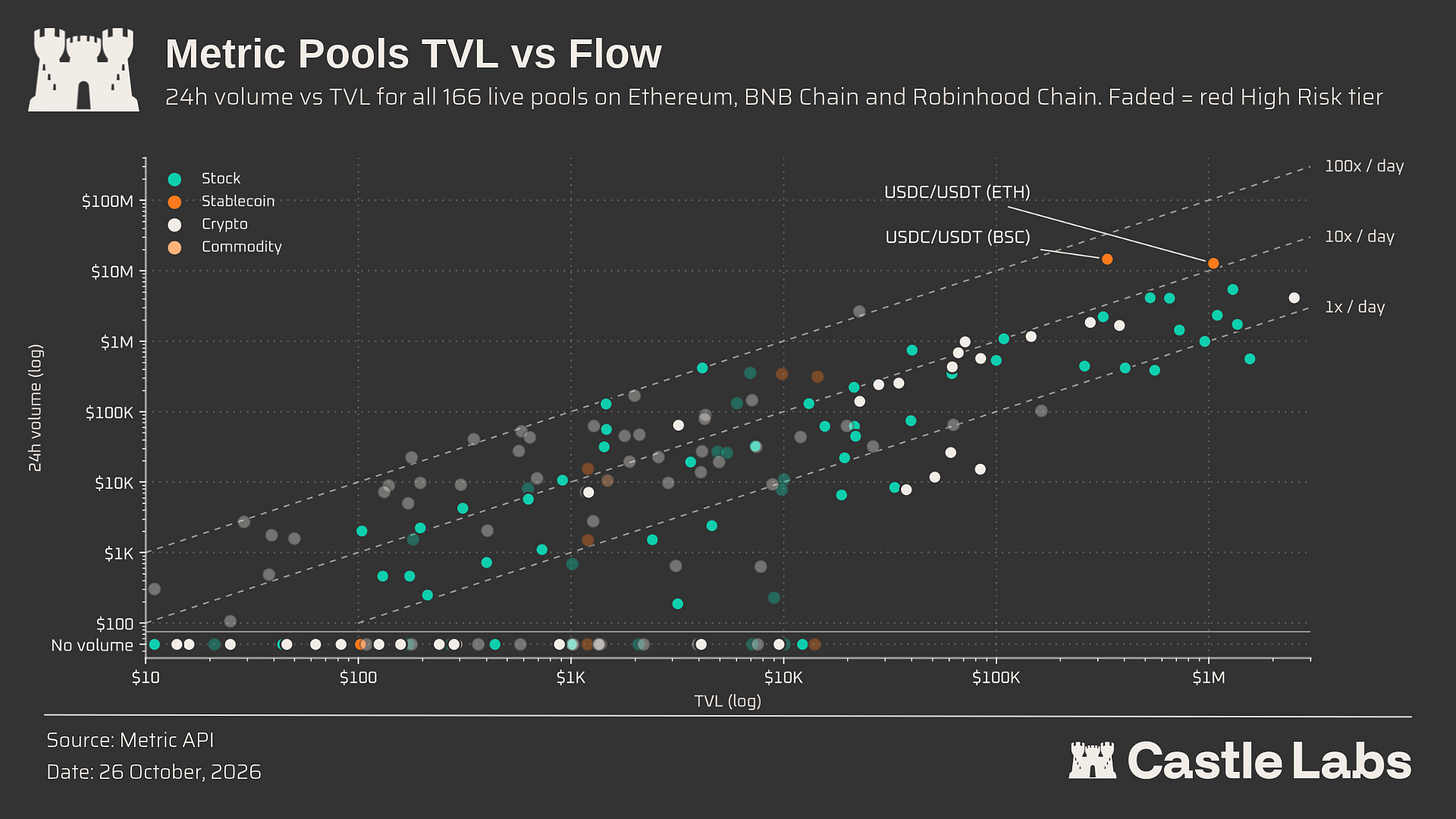
We believe Metric offers enough value for an LP to explore as a platform because its capital-efficient design can deliver better yields, and because the platform is relatively new, early activity could lead to rewards. Additionally, the team hasn’t raised so far, and the product is bootstrapped, leaving more room for potential community distribution, which makes the next section important.
How to position yourself for the Metric airdrop?
Key contributors to the Metric design include Curators/Market makers, LPs, and traders.
While it is not yet clear how each will be rewarded, we can get a rough idea based on each participant’s work and the value it provides to the platform’s growth.
The first one is curators.
Curators run the pool, and it can be profitable as they configure the pools and decide the spread split between LPs and themselves, but it will attract flows only if you perform KYB, since unverified curators attract only a fraction of flows, as our analysis above shows.
Additionally, it requires significant management, which is difficult for individual curators, and even with successful KYB, attracting genuine flows can take time.
If you are a normal onchain participant, LPing and trading on Metric is the best choice.
For LPs, it is as simple as providing liquidity on the platform, and you can start earning yield today.
It requires providing liquidity either in one token or in both of the pool’s tokens.
Currently, LPing in tokenised stock pools seems like the best choice, as they generally yield better; even if you end up holding one side of the pool, stocks are generally less volatile than crypto, so choosing a blue-chip stock and a green-tier pool that yields well is an efficient strategy.
It is hard to say whether traders have an advantage, since platform fees are zero, which can attract tons of volume targeted at farming the platform.
However, every fill spread goes to LPs, curators and the platform, so they create value, making it the lowest-risk option in the category and the cheapest to perform. For reference, generating $1 million in volume costs about $16 on stablecoin pools.
Given the platform’s newness, Metric can offer strong returns, with a potential airdrop while you keep doing daily onchain activities like LPing and trading.
Nomatic from Edge Pod weighs the opportunity even more heavily, calling it the Biggest Opportunity Since Hyperliquid.
Closing Thoughts
DEXs are a pretty diluted category with multiple DEXs and designs competing for the same flow.
However, this hasn’t stopped innovation. Over the years, multiple design approaches have emerged to improve the onchain trading and LPing experience, including Uniswap V3 CLMM, V4 hooks, CowSwap batched execution, and now Metric, an oracle-guided DEX mixed with a propAMM-kind experience.
In the first 10-11 days of Metric’s public launch, it has attracted over $17 million in TVL, and its capital-efficient design makes it more ready than ever to support large volumes.
The opportunity to allocate to Metric can’t be ignored, and there’s room for everyone. Curators can create their own pools and create value from the existing flows. LPs can earn lucrative yield, and traders can get better prices.
If you have read the piece till here and choose to use Metric, you can use our referral link: https://app.metric.xyz/r/castle
Originally published in the Castle Labs newsletter. Subscribe at research.castlelabs.io/subscribe.