Re and the Case for Reinsurance Yield Onchain
Most onchain RWA yield today comes from short-dated US Treasuries (T-bills), wrapped in over 100 tokenised treasury products, including BlackRock’s BUIDL, Circle’s USYC, Ondo’s OUSG, and Franklin’s BENJI. Cumulatively, they represent $14.7 billion, or 38% of total onchain RWAs, and are among the mos

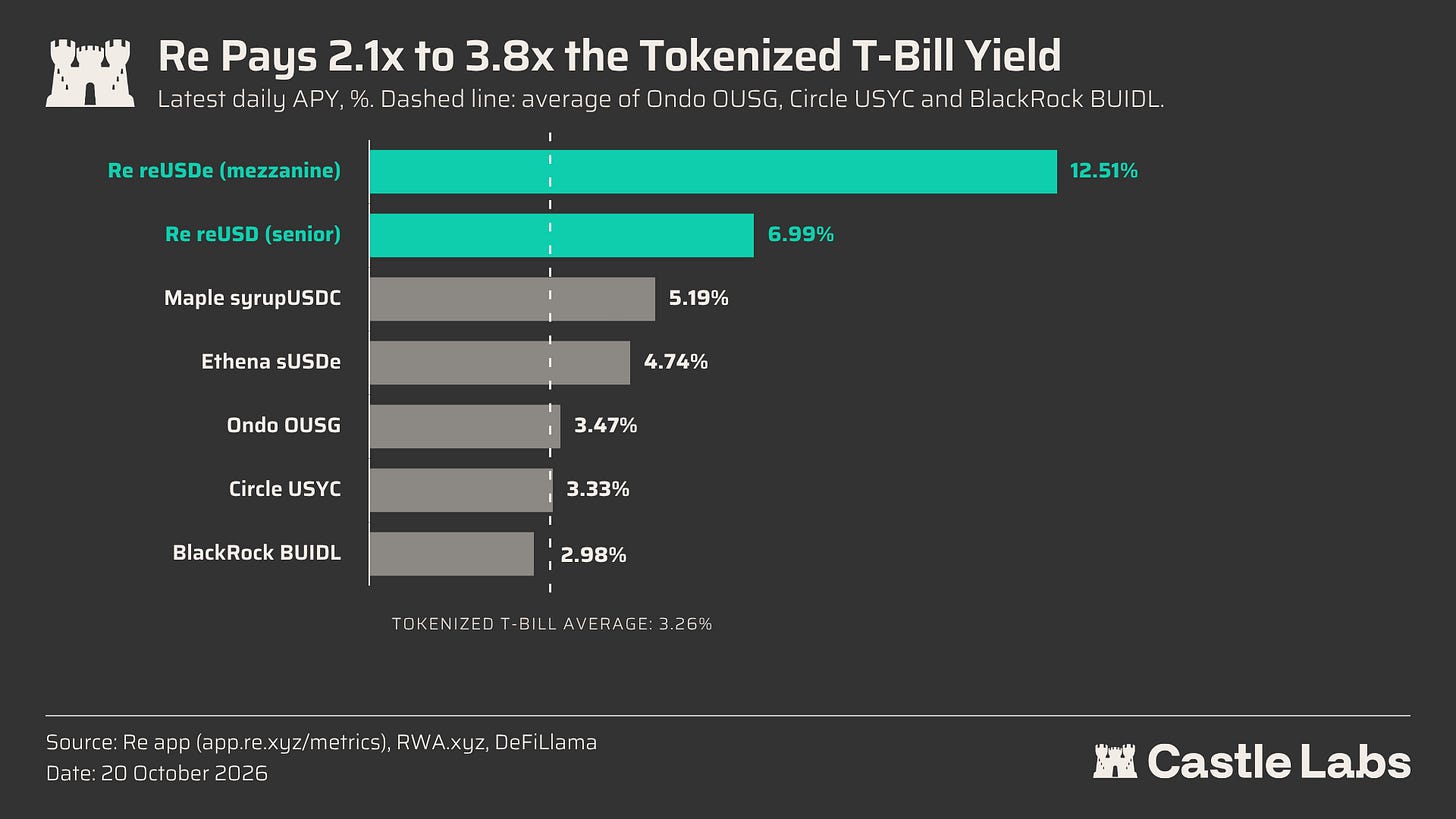
Similarly, we find private credit, with Maple’s syrupUSDC at an average ~5.1% 30-day APY, and crypto funding rates, DeFi, and institutional lending, with Ethena’s sUSDe at ~4.7%.
Nonetheless, while different in scope and product, interest rates, borrower credit, and demand for crypto leverage are highly correlated and tend to move together.
That is, if rates fall, credit tightens, which in turn affects perps volume and funding rates.
To research additional yield-bearing RWA assets, this article looks at a different, largely uncorrelated source of yield: reinsurance.
We do so by using Re as a case study. As of October 20th, 2026, it reports over $375 million in deposits and $12 million in cumulative yield paid to its depositors.
We cover why reinsurance is an attractive asset class for RWAs, how Re works and how the yield is generated.
The Case for Insurance Yield
Reinsurance is insurance for insurers, a $760 billion sector as of October 2026.
The concept is less clear than with other RWAs, but it works like this: whenever you buy a policy, your insurer bundles your risk with thousands of others. To reduce risk and smooth earnings, the insurer sells part of its portfolio risk to a reinsurer. That reinsurer can decide to further sell a portion of it to other reinsurers (retrocession).
By offering unique risk exposure, reinsurance markets have also become an appealing source of largely uncorrelated yield that doesn’t depend on the broader market volatility and generates yield through real reinsurance activity. Some traditional finance reinsurance products, such as the Re Global Catastrophe Bond Index, returned 11.40% in 2025.
Transitioning these products onchain delivers three core benefits:
Broader Access: It democratises access to what are traditionally highly restrictive markets.
Radical Transparency: It enforces operational visibility through daily verification of offchain capital, public reinsurance books, and frequent audits.
Instant Liquidity: It unlocks idle capital. While funds backing reinsurance risk are traditionally locked offchain, an onchain representation keeps the capital liquid and accessible throughout the entire reinsurance lifecycle.
Keeping this in mind, we now explore Re, which brings reinsurance onchain.
Re: Onchain Reinsurance Capital
Re is an onchain reinsurance protocol that lets depositors supply their stablecoins, which are used to underwrite regulated reinsurance contracts.
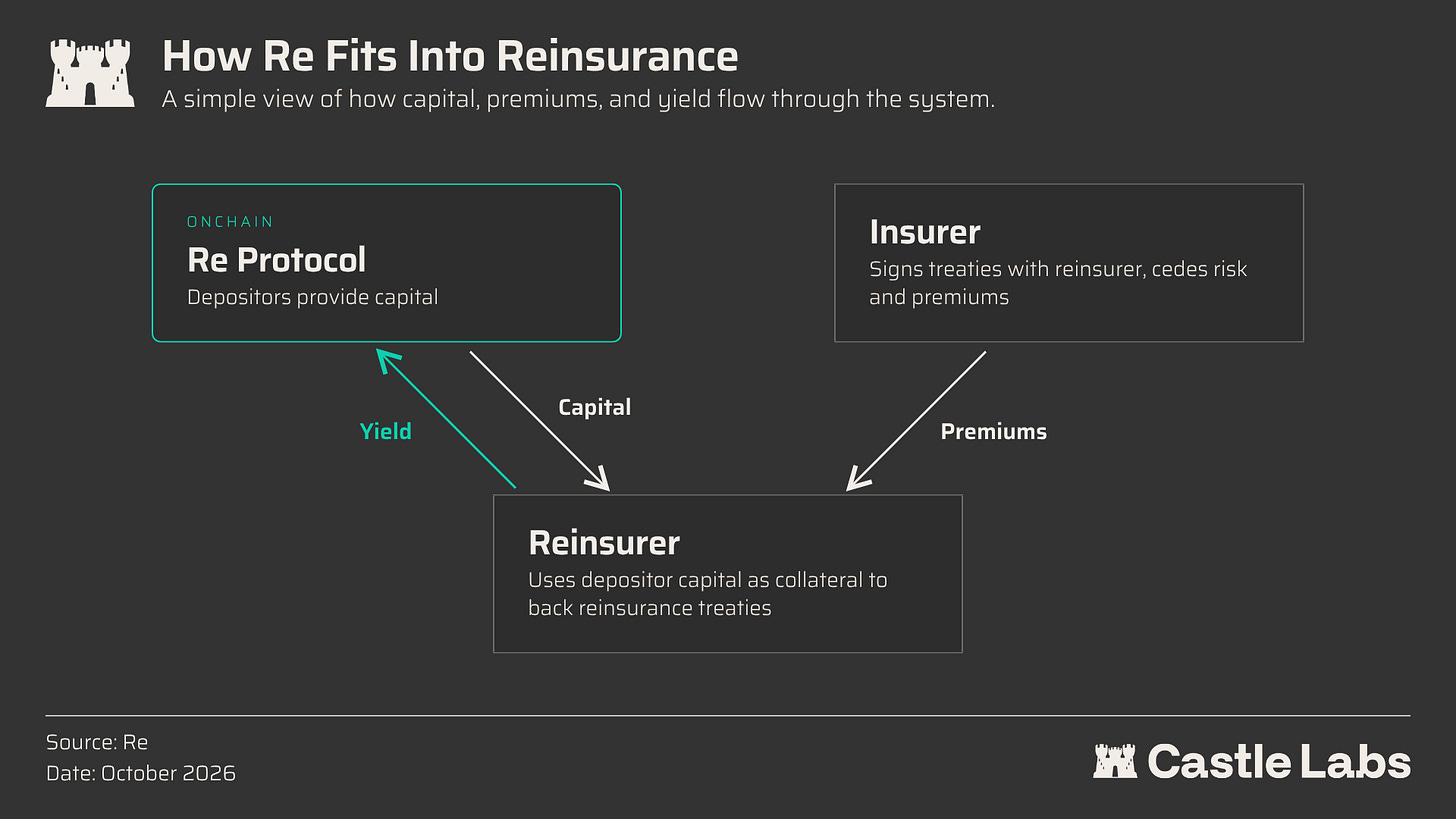
Part of the deposited capital is deployed as collateral in US trust bank accounts to secure the reinsurer’s obligations. Before a reinsurer can write a treaty, it must post collateral that meets both CIMA obligations and the insurer’s requirements. The rest stays onchain as a liquidity buffer to fund redemptions. The portfolio’s performance (underwriting profits) supports token yield by increasing token NAV. For Re, in fact, NAV is a measure of yield accrual rather than total asset value.
Re currently has over $375M in total deposits, up 45% since September, making it the largest onchain reinsurance protocol by deposited capital.
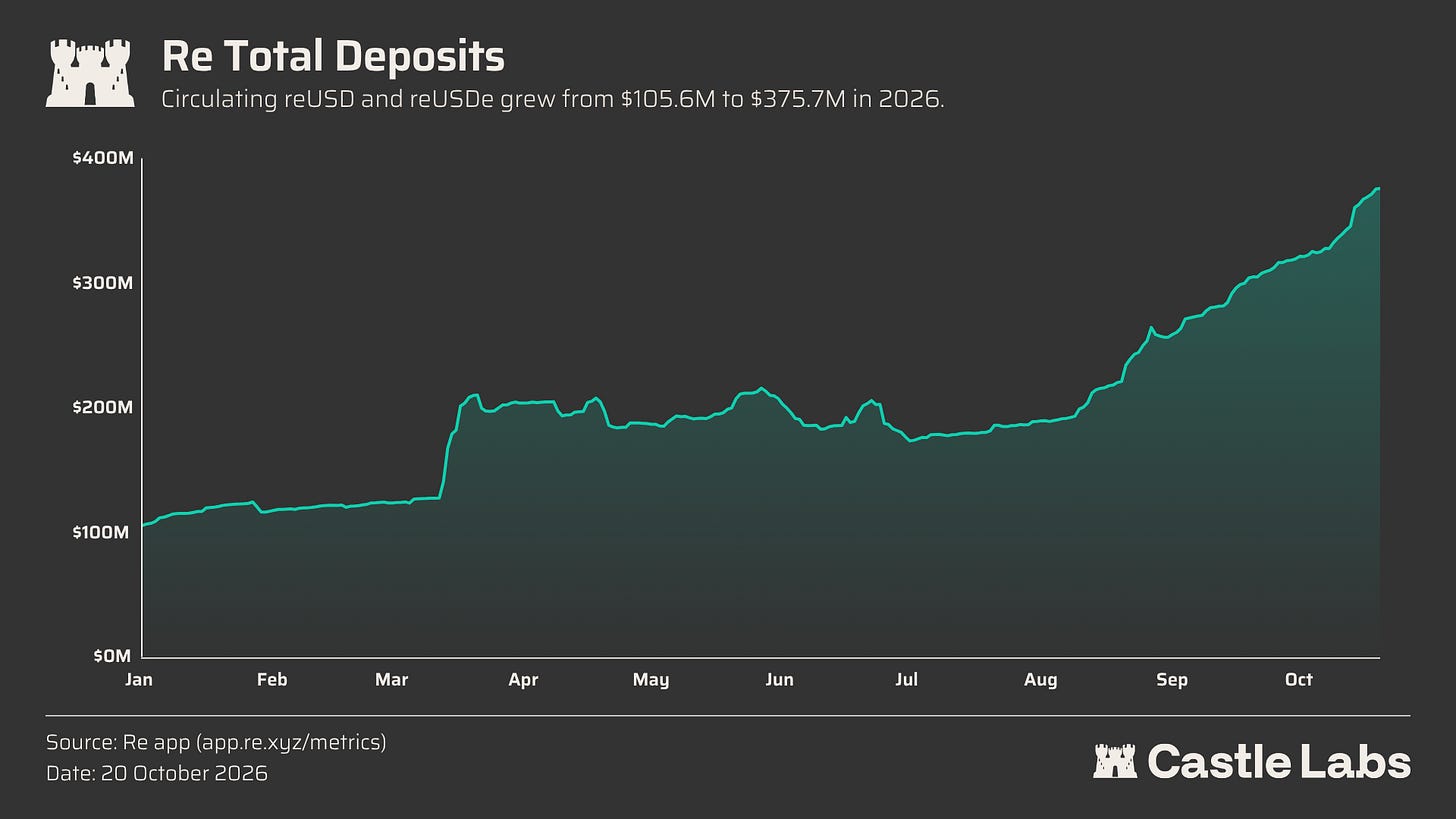
All metrics can be tracked on: https://app.re.xyz/metrics
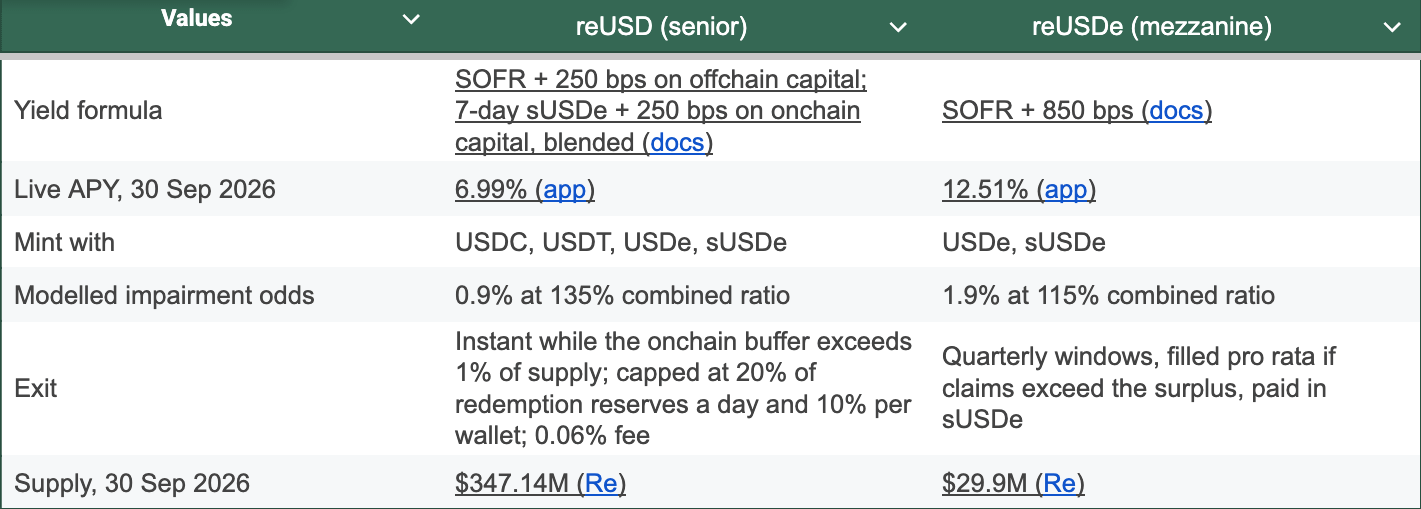
To attract depositors of distinct risk appetites and effectively manage risk, Re utilises a three-tiered, tranched system to absorb potential underwriting claims:
Re’s capital and reserves (The Junior Tranche): At the bottom sits Re’s own capital, which acts as a first-loss layer to absorb any potential underwriting losses before user capital is touched.
reUSDe holders (The Mezzanine Tranche): If underwriting losses compromise the junior tranche, this tranche absorbs any further losses before the senior tranche, accepting its place in the loss waterfall and lower liquidity (quarterly redemption) in exchange for a higher yield.
reUSD holders (The Senior Tranche): At the top sits the reUSD, which earns a conservative yield, is insulated from losses, and has high liquidity (instant redemptions).
The protocol uses deposits in the senior and mezzanine tranches differently.
The reUSD deposits serve two functions: providing the onchain redemption liquidity and serving as offchain collateral deployed to reinsurance.
Whenever capital is deployed offchain, at least 50% of reUSD’s peak all-time deposits stays onchain to fund instant redemptions. This capital is primarily held in sUSDe, which earns yield expected to increase as USDe backing expands to equity-basis perps, boosting sUSDe yield and benefiting Re depositors.
The remaining capital can move offchain into trust accounts that use capital to collateralise reinsurance contracts.
As of October 2026, the offchain portion of the capital earns the risk-free rate (SOFR) plus a 250 bps spread determined by the protocol and funded by reinsurance activity, while onchain capital earns the 7-day trailing average sUSDe yield plus a 250 bps spread.
reUSD provides instant redemptions as long as the liquidity buffer has capacity. As of October 2026, onchain capital available for redemptions has never dropped below 40% of outstanding supply.
In contrast, reUSDe capital is allocated offchain and deployed only as reinsurance collateral. It earns the risk-free SOFR rate plus an 850 bps spread sourced from reinsurance.
reUSDe redemptions are planned to be quarterly, based on collateral requirements and cash flows from maturing reinsurance contracts.
Up to this point, Re focused on safer underwritings, with “little to no catastrophe exposure” in order to establish a safer portfolio and strategies. This is reflected in their portfolio allocation, which includes small business commercial property and liability, commercial vehicle coverage and liability, homeowners insurance (property coverage), workers’ compensation (injury coverage), and commercial property and personal vehicle coverage.
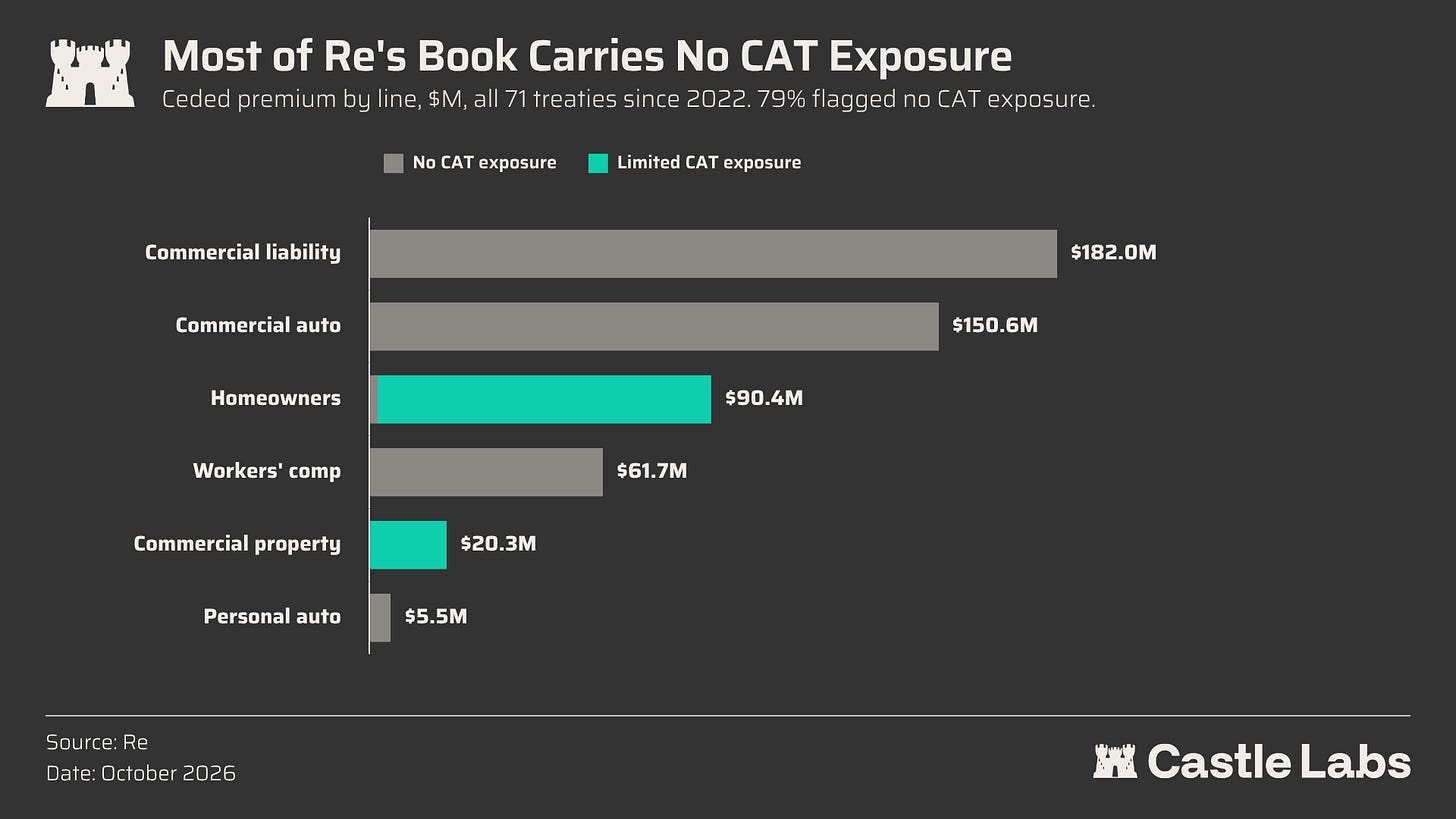
Now they are ready to slowly expand the areas covered, starting to write catastrophe risk as well.
Where the Yield Comes From
Re’s yield comes from a base rate plus a protocol-defined spread funded by reinsurance activity: 250 bps for reUSD and 850 bps for reUSDe.
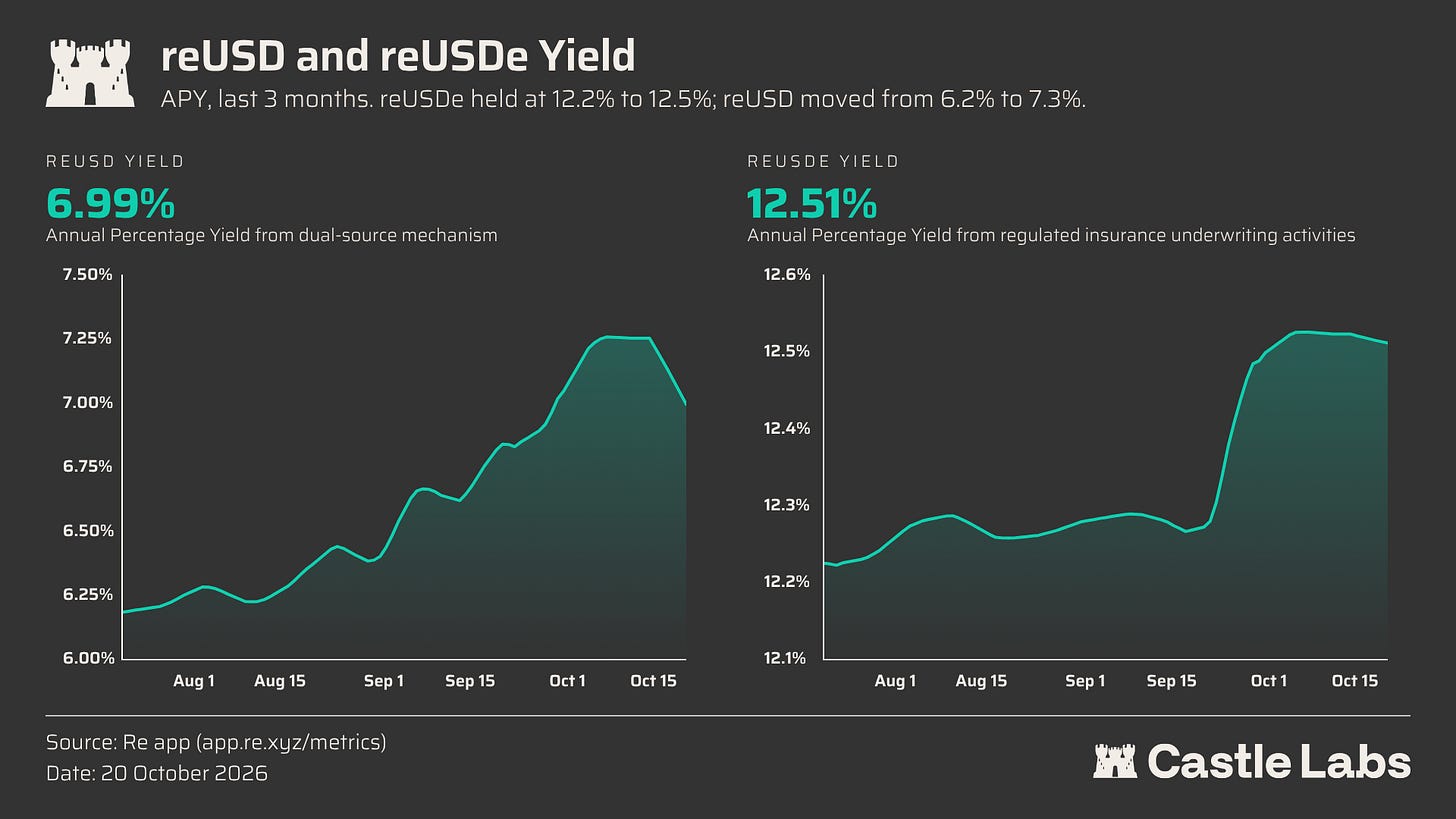
Once brought onchain, these returns are much higher than Treasuries (3.7% on average), private credit (5.1%), and funding rates (4.7%). reUSD stands about 300 bps above tokenised T-bills and reUSDe about 800 bps above in terms of APY, as of writing.
The base yield
Offchain capital earns roughly the SOFR. The onchain buffer has been held mostly in sUSDe, earning Ethena’s yield.
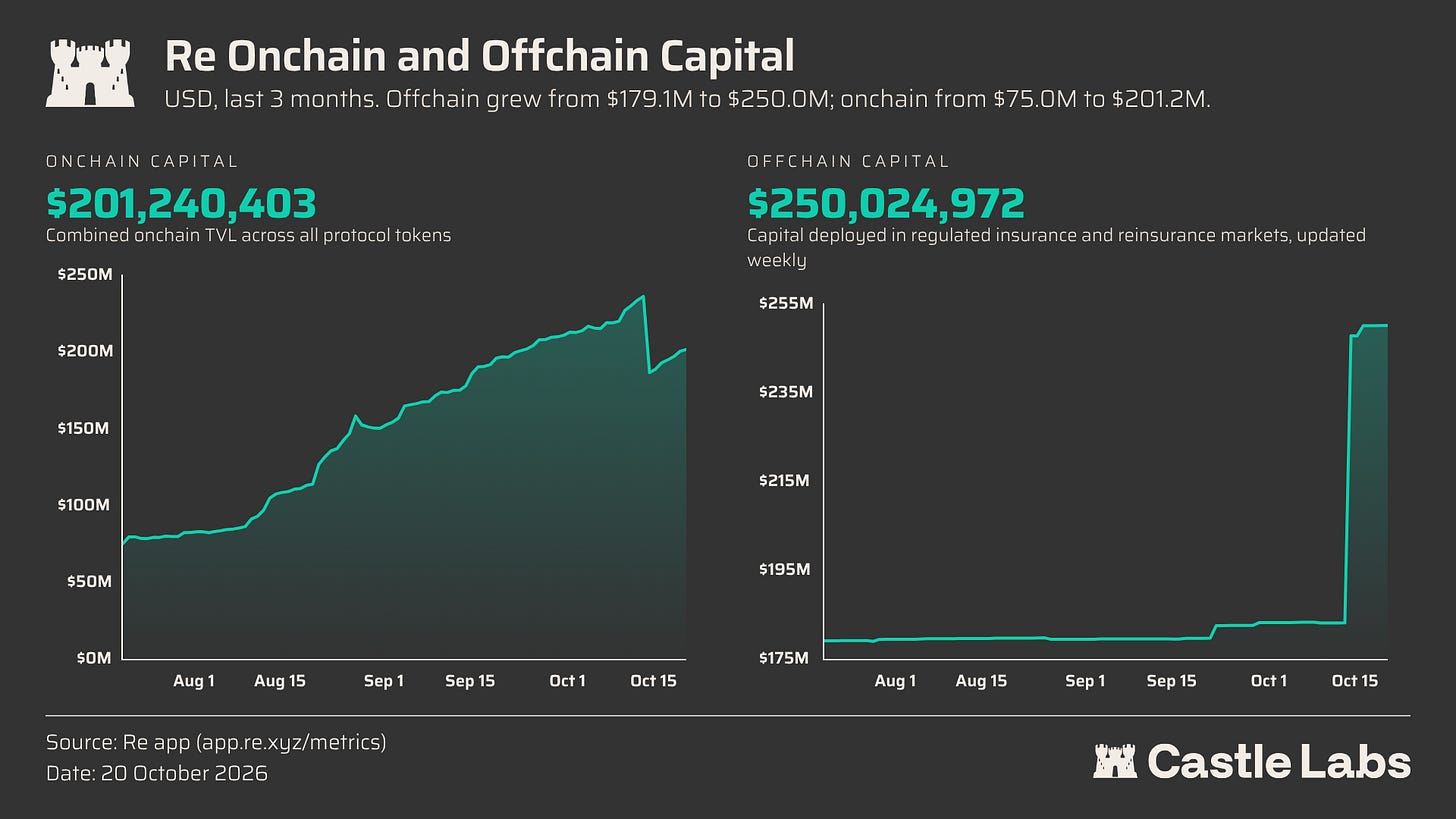
In October 2026, Re reports ~$200 million of onchain capital and ~$250 million in offchain reserves (comprising both reUSD and reUSDe deposits). The onchain/offchain split is determined by multiple factors and doesn’t only reflect the strategy. It is primarily determined by the maintenance of the reUSD liquidity buffer (50% of the high-mark deposits, covered above) and how long it’s been since capital was deployed to reinsurance. Furthermore, the first venue for capital flows is onchain, as stablecoins explain the imbalance in favour of the former, since Re rebalances periodically.
Traction and DeFi Integrations
At the core of Re’s strategy is making reUSD deeply embedded as DeFi collateral, as shown by recent integrations.
The expansion of Solana has been one of the most strategic developments for the team: Solana ranks as the 3rd chain by RWA assets and is naturally one of the biggest markets for Re.
In August, Kamino’s deployment reached $20 million just over a week after launch, while Jupiter Lend took $6 million in under three hours, showing appetite for this yield.
Due to its profile, reUSD fits well in the ecosystem as one of the most appealing sources of differentiated RWA yield.
Solana has been one of the fastest-growing RWA ecosystems, a bet they made early on, and the perfect environment for growing the usage of Re’s yield-bearing assets.
reUSD also backs Morpho-powered vaults, which recently crossed $100 million in supply: users with idle USDC can lend it against PT-reUSD for over 7% in APY.
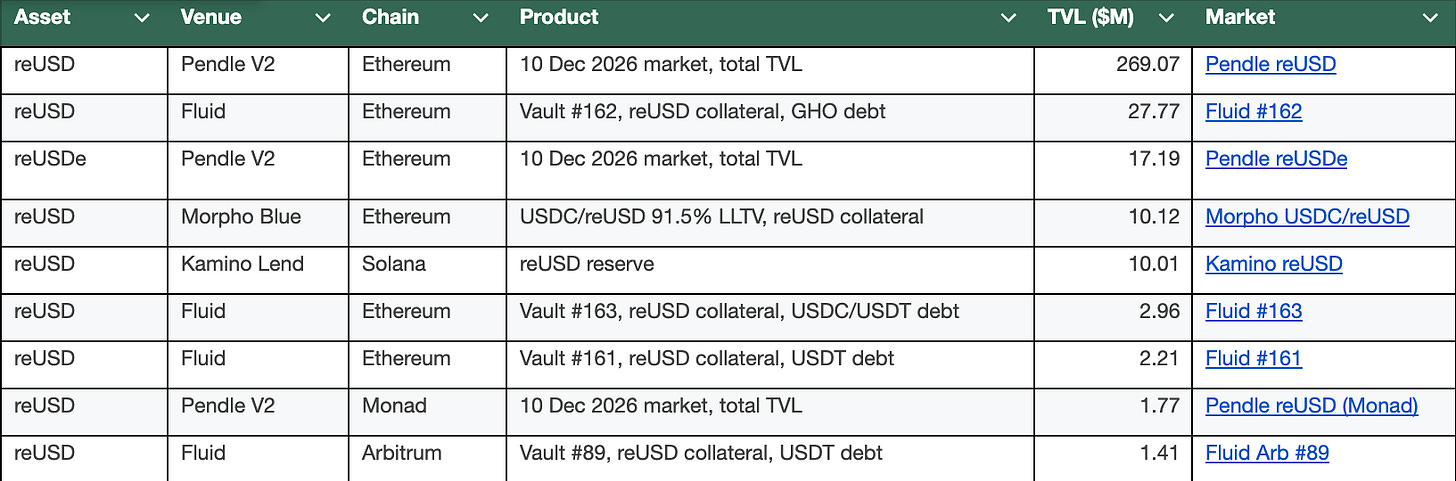
As of September 28th, reUSD was the top looping market on Pendle, with over 32% of the max looping APY for PT-reUSD maturing in December 2026, with over $200 million in TVL.
Additionally, three different reUSD vaults also launched on Fluid on Arbitrum:
reUSD / USDC
reUSD / USDT
reUSD-USDC LP / USDC
For a more detailed map of reUSD DeFi implementation, you can refer to the table below:
However, these DeFi deployments carry downstream risks.
If any lending market accrues bad debt, liquidators rush to dump the asset in the open market, exhausting onchain liquidity and potentially causing severe secondary-market depegging for reUSD.
For instance, leveraged PT-reUSD positions face oracle-related risks if third-party price feeds rely on volatile onchain pools, which could trigger mass liquidations.
This vulnerability surfaced recently, when a big YT-reUSD purchase pushed the PT-reUSD price down about 3%, triggering $36.4 million in liquidations on Morpho.
Although this incident did not stem directly from Re’s, and their own contracts and reUSD were untouched, it shows the importance of considering third-party risk on leveraged assets, such as oracle risk and market leverage.
Finally, because Re’s onchain liquidity is backed by sUSDe (53% of reUSD capital is invested in sUSDe), any downstream depegging or high-redemption stress within the Ethena ecosystem could immediately lock up or impair assets for Re depositors.
Conclusion and Food for Thought
This article introduced Re as an interesting attempt so far to bring a different yield source onchain. Its roughly $320 million in deployed capital is still tiny compared with a $760 billion reinsurance market, underscoring the size of the opportunity: Alternative sources of RWA yield have barely any adoption yet.
Using a tranched system, it created two tokens, each with a specific asset liquidity profile.
Beyond that differentiator, reUSD already works as collateral on Kamino, Jupiter Lend, and Morpho vaults, and can be traded on Pendle.
While these products offer double-digit returns, they carry downstream risks that can arise from DeFi deployments, as in the August Morpho incident.
So far, Re has never encountered any issues with regard to underwriting risk and has been consistently profitable every year since inception.
Re is taking a step in the right direction, leading to a future where RWA yields are differentiated and move beyond the current yield-bearing assets used (e.g. T-bills) by targeting reinsurance, a massive traditional sector.
Originally published in the Castle Labs newsletter. Subscribe at research.castlelabs.io/subscribe.