Revenue and Narrative Bias: The Minimalist Assets
Crypto money is concentrated.

Excluding stablecoin issuers, the 10 largest protocols earned 47% of all protocol revenue over the past 12 months.
Tokenholders’ returns are even more concentrated, with the top 10 protocols representing 73% of it.
Protocols that generate revenue tend to become better investments because of high cash flow.
This piece asks whether leading a category is a good predictor of token performance, and if not, what separates the leaders whose tokens performed from those whose tokens did not.
This is the third piece in our series. In A New Crypto Era: From Gambling to Investing, we looked at crypto revenue. In our second article, The Broken Link Between Protocol Revenue and Tokens, we looked at how emissions dilute tokens and should be viewed alongside revenue.
Here we connect the revenue that reaches token holders to how tokens performed, and two factors revenue cannot explain on its own: how much larger a protocol’s market can get and the narrative around the product itself.
Crypto Revenue Duopoly
Leaders in different crypto categories take most of the cash flow. In the trailing 12 months, crypto protocols made $13.7 billion across categories.
In each category, the top 2 protocols captured at least 52% of the fees, with some categories such as stablecoin issuers, prediction markets, basis trading and options, where they take over 90% of total fees.
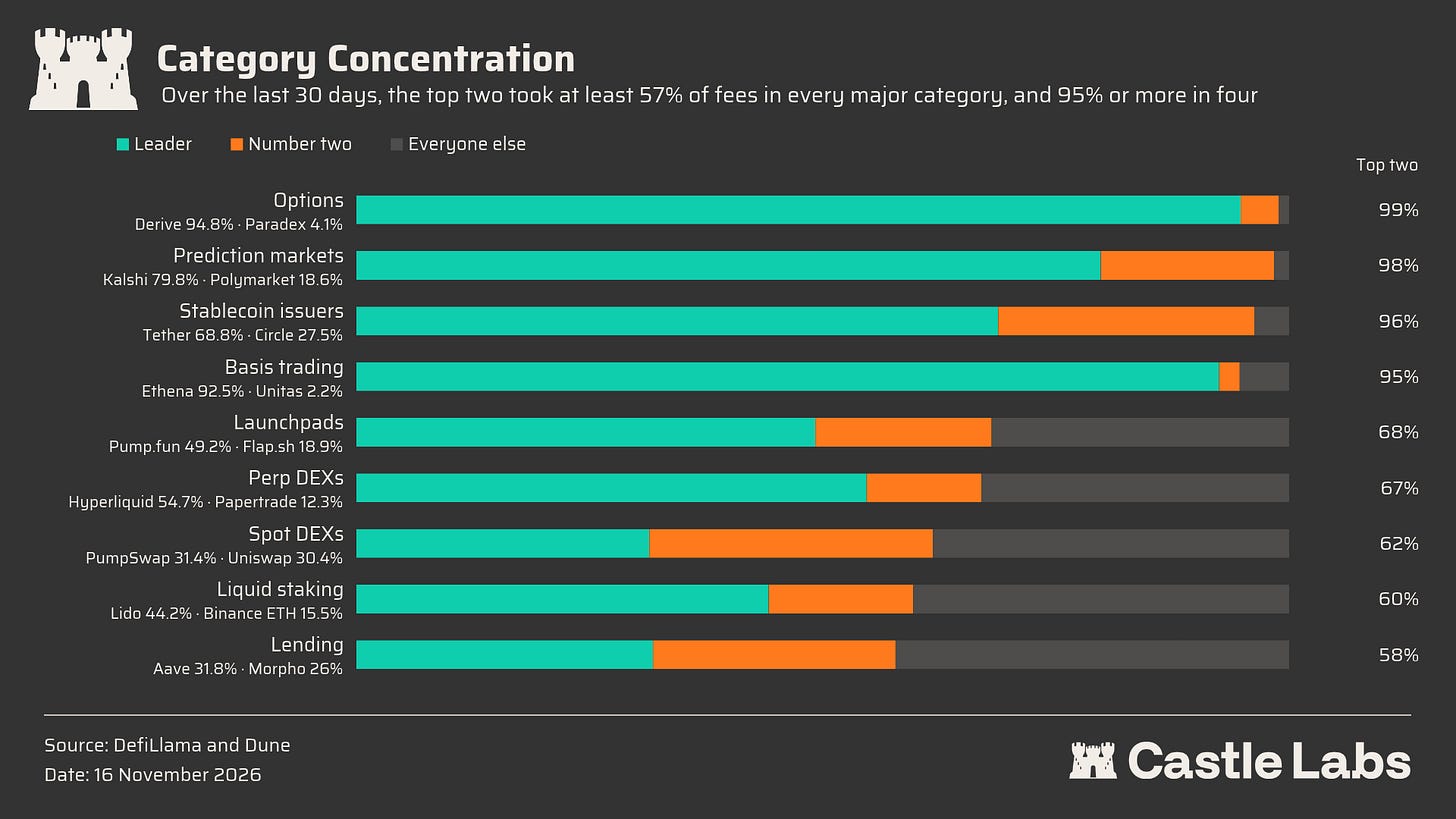
However, this concentration bias doesn’t apply to every category and can be contested when switching costs are low, or competition is high.
For example, launchpads and spot DEXs aren’t that concentrated because switching is low-effort and competition is high.
For a DEX trader, what matters is getting the best route and the cheapest venue, which an aggregator chooses based on liquidity. For DEXs, competition is strong, and no single venue can host the deepest liquidity pool and offer the best prices for every asset, so flow is distributed across venues.
For launchpads, on the other hand, the business can be cyclical and depends on how well a launchpad capitalises flow on a new or developing ecosystem. Pons got picked up during the peak of the Robinhood memecoin season and made most of its revenue then, and activity seems to be fading now.
Lending and Perp DEXs are more incentive- and liquidity-driven. So the flow depends on the mix of the two; better incentives attract value, and better liquidity helps sustain it. Liquidity helps the top protocol sustain and accrue its position against competitors, while some flow gets siphoned to better incentives.
Additionally, for the categories where the duopoly is much stronger, for example, Stablecoin and Prediction Markets, from a token standpoint, there is no way to invest in these. The only live equity is Circle, trading under the ticker $CRCL.
So the opportunity naturally flows back to less concentrated categories, but even if you had invested in these leaders, you wouldn’t have the best-looking portfolio, since most underperformed BTC.
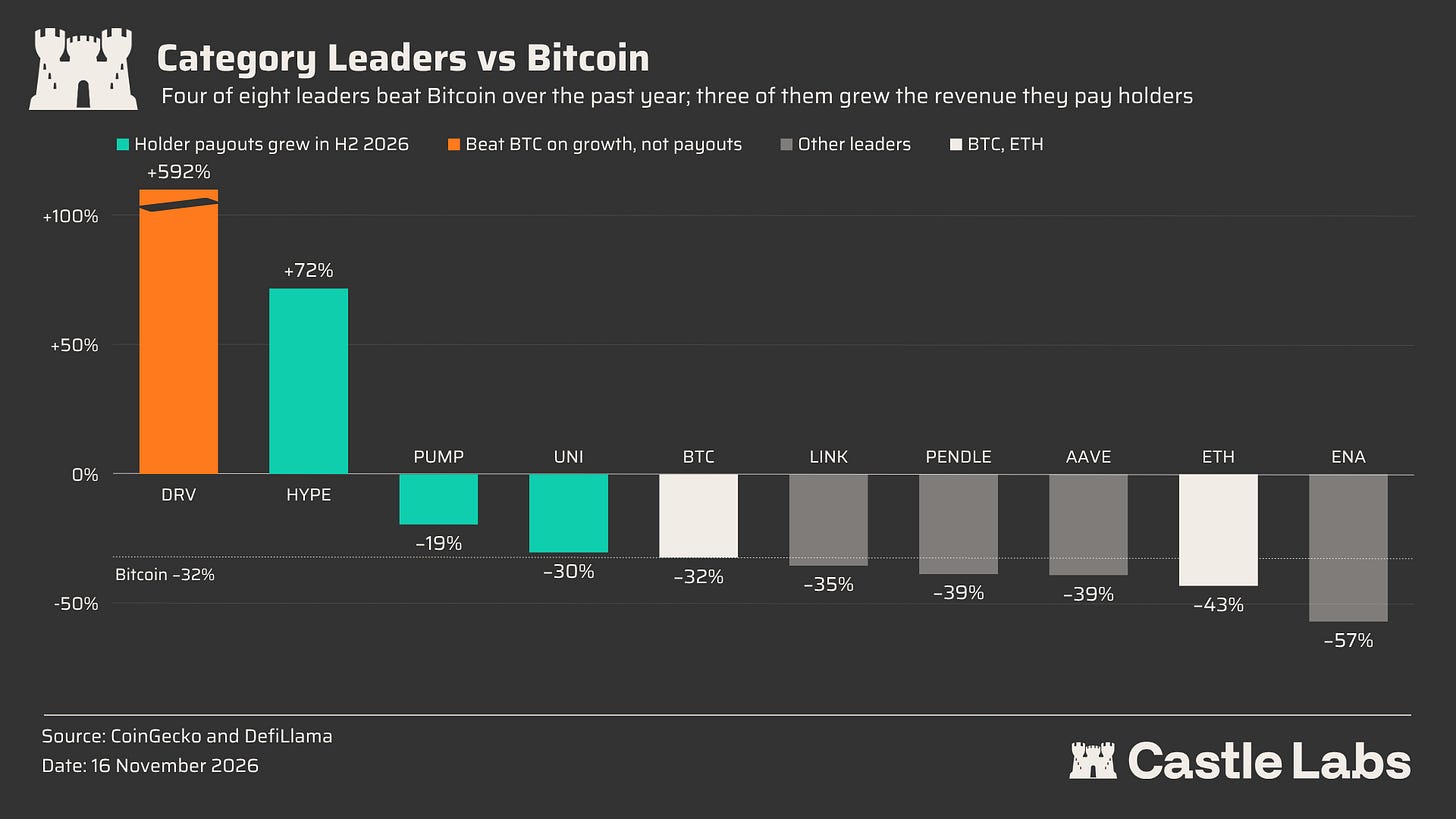
So why did these tokens underperform, even after the protocols behind them led their category?
The partial answer lies in the revenue data and how much tokenholders get.
Hyperliquid revenue rose from $38 million in July to $69 million in October as the protocol and its token accrued value from the project’s growth and Circle reserve yield.
Uniswap’s fee switch and UNIfication proposal took effect at the start of the year, and the protocol has been continuously buying back tokens with revenue.
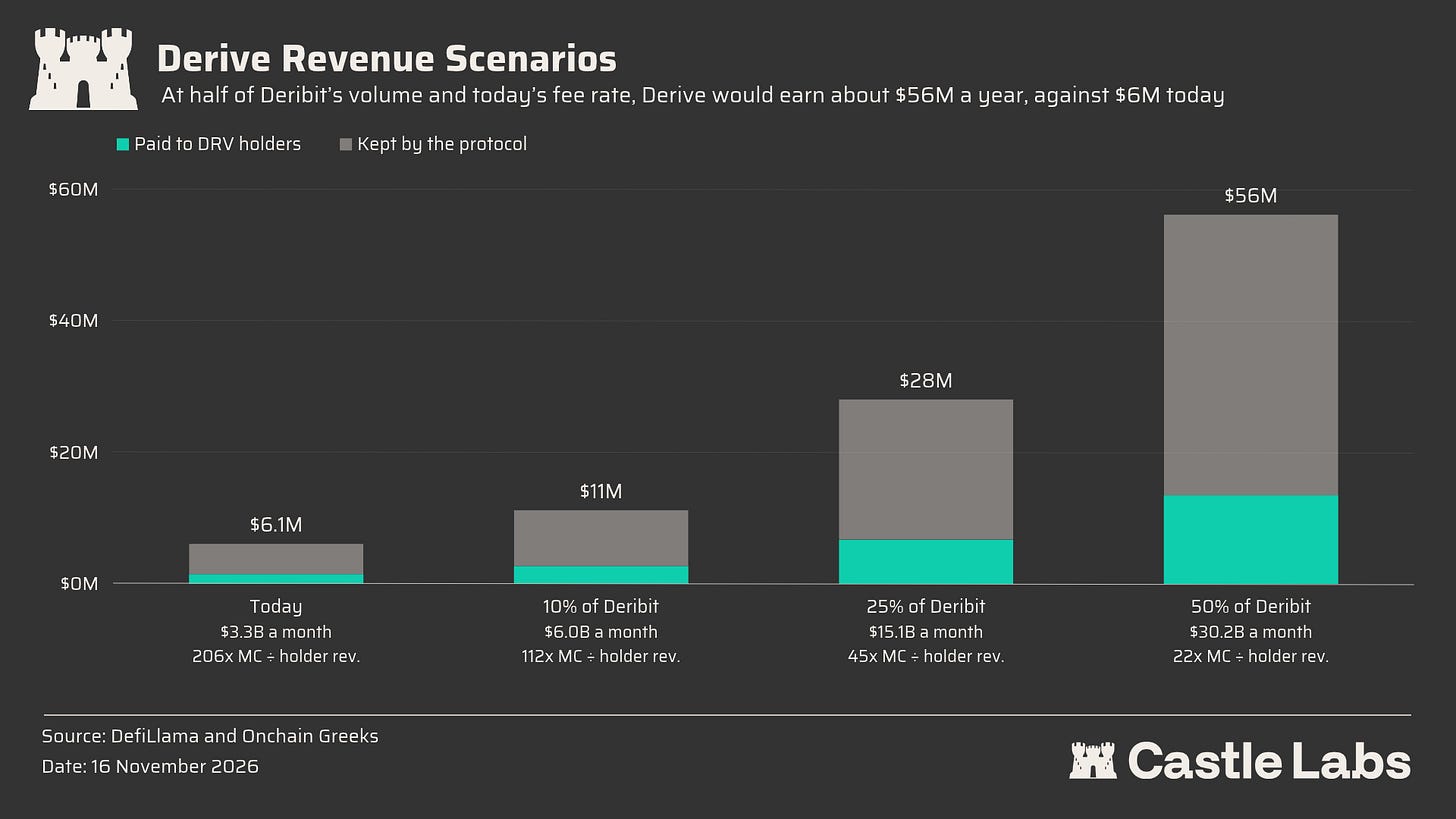
Derive rose 592%, more than any other leader, while Derive only paid its holders about $1.3 million last year. Its price doesn’t rest on holders’ revenue alone, but on how much bigger onchain options can get, which we cover in the next section.
Meanwhile, Aave stopped buybacks after the KelpDAO incident, and Pendle monthly revenue fell from $4 million to $500k in one year (October 2025 vs October 2026).
To see whether the market has priced these changes in, we divide market cap by holder revenue over the past 12 months, reflecting what the market pays for each dollar that reaches holders. Comparing it over the one-year timeframe also shows the market’s direction and whether the token has become more expensive or cheaper.
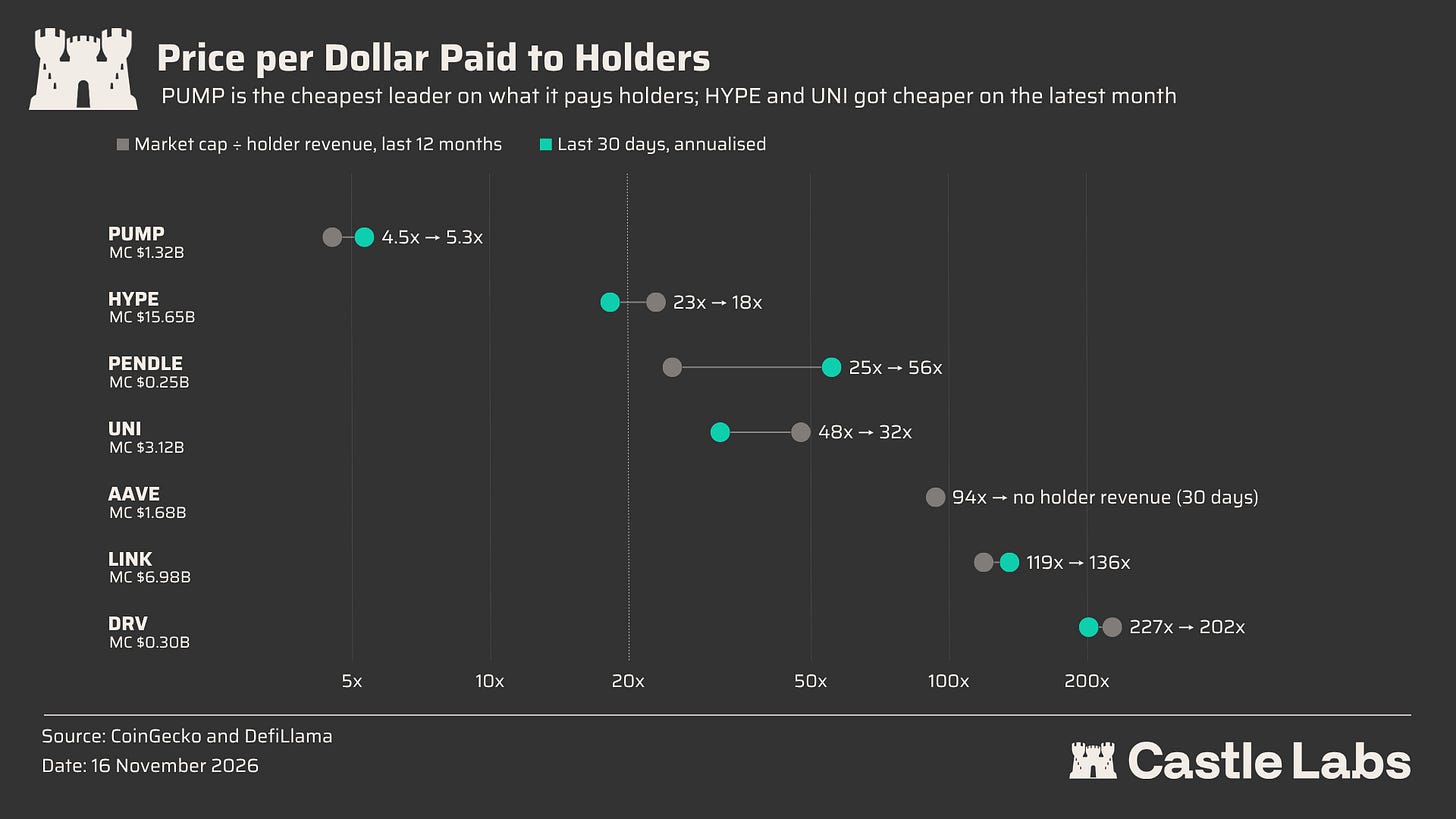
Uniswap and Hyperliquid got cheaper over the past 12 months, while all other tokens became more expensive, which also helps explain why these tokens performed better than others.
Derive is the most expensive token, making a clear case that its price is driven more by expected growth than by current holder revenue.
Pump is the cheapest of all and also has consistent cash flow and value reaching the token, but sentiment around the product hasn’t picked up yet because it is a launchpad that depends on speculative memecoin activity for revenue, which puts it in a negative-sum category for the space.
Additionally, the protocol still hasn’t done the airdrop to its users, which keeps more investors away due to uncertainty.
The growth of DRV and PUMP isn’t keeping up, suggesting revenue and holders’ revenue aren’t enough indicators.
Other important things to watch are narrative development and future-looking investments, which make or break token flow. We discuss this briefly in the next section and also cover some of the other interesting tokens which aren’t revenue strong but are narrative strong.
The Real Escape Velocity
DeFi and Tokenisation target markets measured in trillions, so for category leaders today’s revenue is still a fraction of the total addressable market.
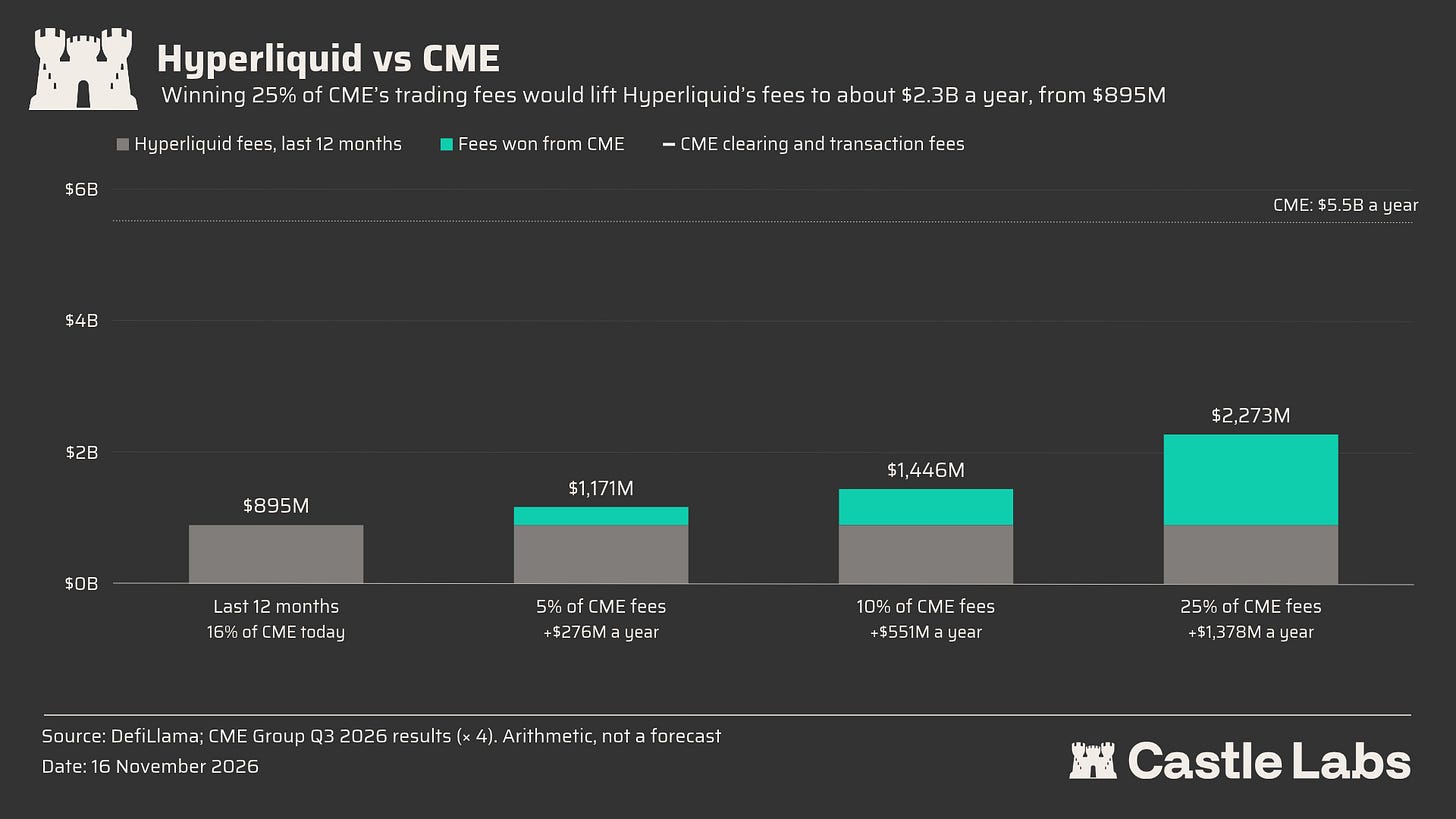
Let’s start with Hyperliquid. It already earns $895 million a year in fees, about 16% of the roughly $5.5 billion CME earns from clearing and transaction fees (Q3 2026 annualised). Hyperliquid does that without US users because of regulatory restrictions, but that is starting to change.
Recently, ICE, the owner of NYSE, has partnered with and invested in TradeXYZ to run US perpetual futures on Hyperliquid across crypto, equities, commodities, and FX. Payward, Kraken’s parent company, has also become the first CFTC-regulated HIP-3 deployer, via its Bitnomial exchange and NinjaTrader Clearing.
While both are still seeking approval, this shows how much of the market Hyperliquid is about to tap into by opening to the US.
Derive is to onchain options what Hyperliquid is to onchain perps.
Over the last 30 days, Derive handled ~73% of onchain options volume and holds 93% of open interest. Since the start of the year, the platform has cleared about $14.2 billion in notional volume in 2026, nearly 3 times its total for 2025.
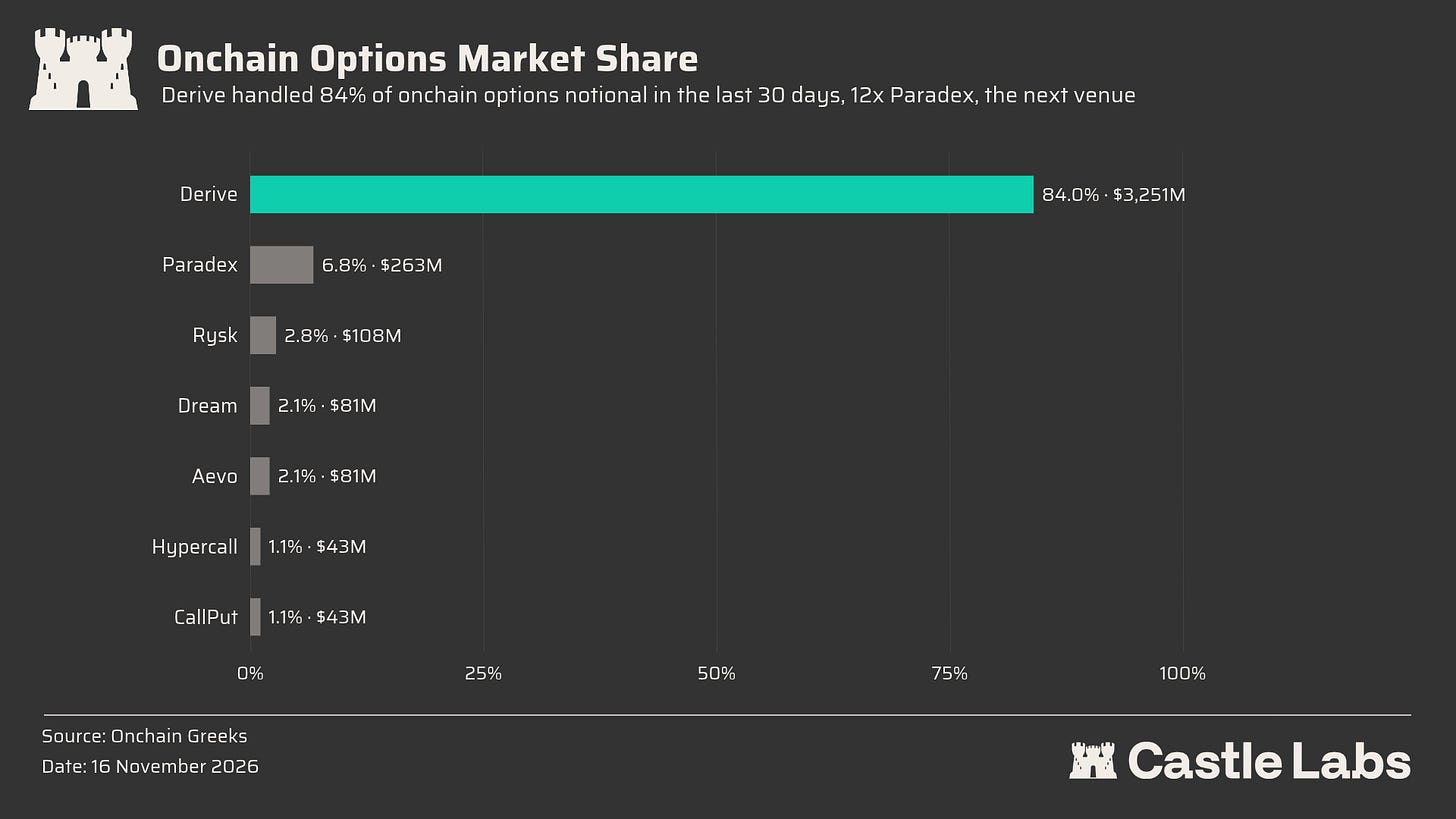
To further scale the protocol, they have developed Derive V3, adding multi-currency margin, vaults, institutional support, and more. The vaults in particular and integrations add a new source of distribution, an approach similar to Hyperliquid’s HIP-3 and builder codes, which have proven fruitful for its ecosystem.
These new distribution channels also make the product more retail-friendly, while institutional support helps attract larger flows.
Ultimately, the market to capture is traditional options, which Derive has already started with the upcoming launch of RWA options.
Its next biggest competitor currently, Deribit, an offchain options protocol, traded $60.4 billion of options notional in the last 30 days, 13.6x all onchain venues combined.
With the continued expansion of onchain options and steady growth, if Derive reaches 10% of Deribit’s notional, it could earn more than $10 million annually.
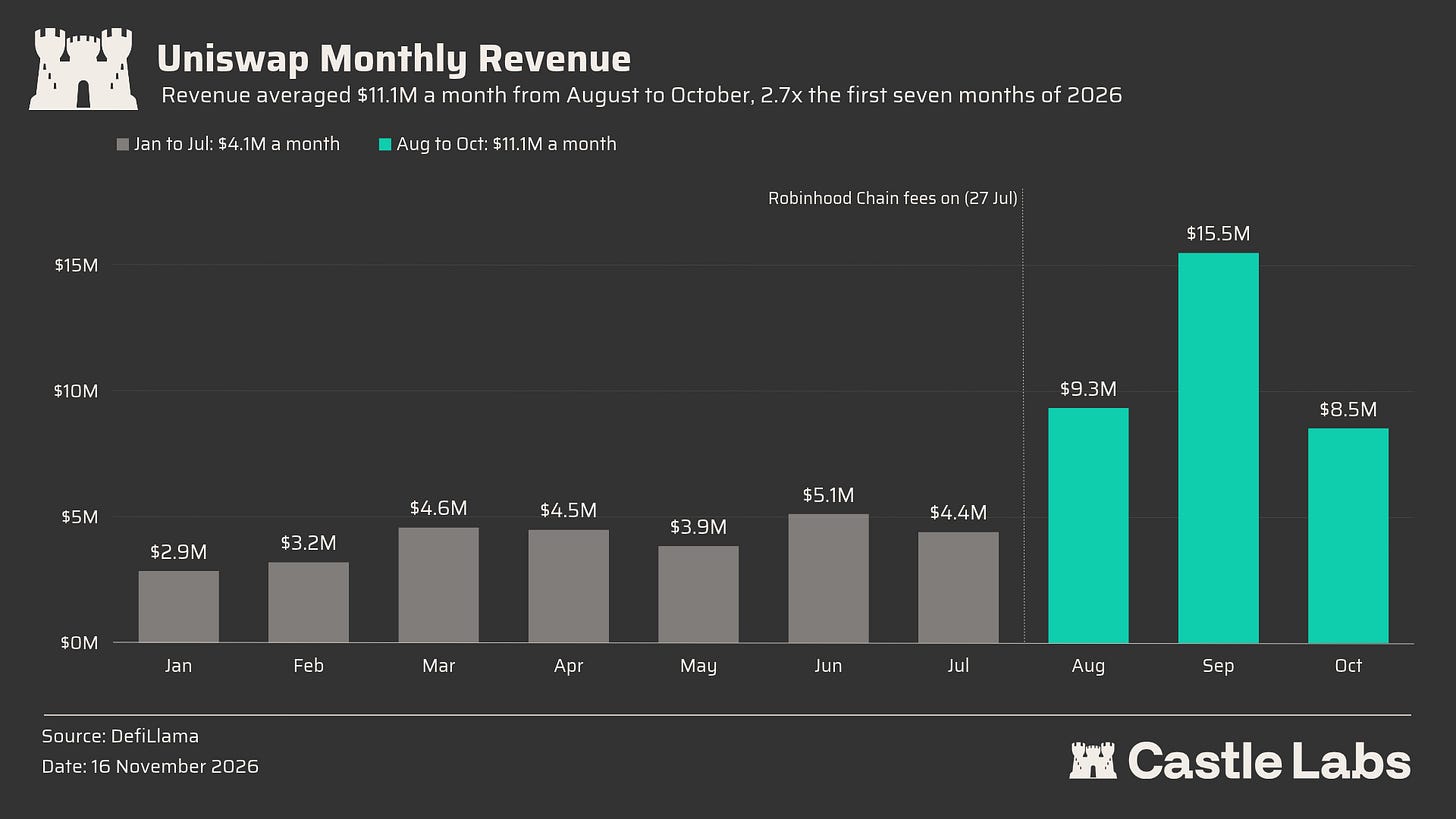
Uniswap leads spot DEXs with 25% of the last 30 days’ volume and 31% of net 12-month fees. Its revenue has increased in H2 2026 primarily due to a combination of tokenisation and Robinhood activity.
While Robinhood activity may be categorised as a one-time spike (though we expect a revival), more of the story lies in tokenisation, which has grown rapidly, with RWAs rising from $25 billion at the start of the year to ~$40 billion currently. On how big tokenisation can become, McKinsey forecasts it to reach $2 trillion by 2030.
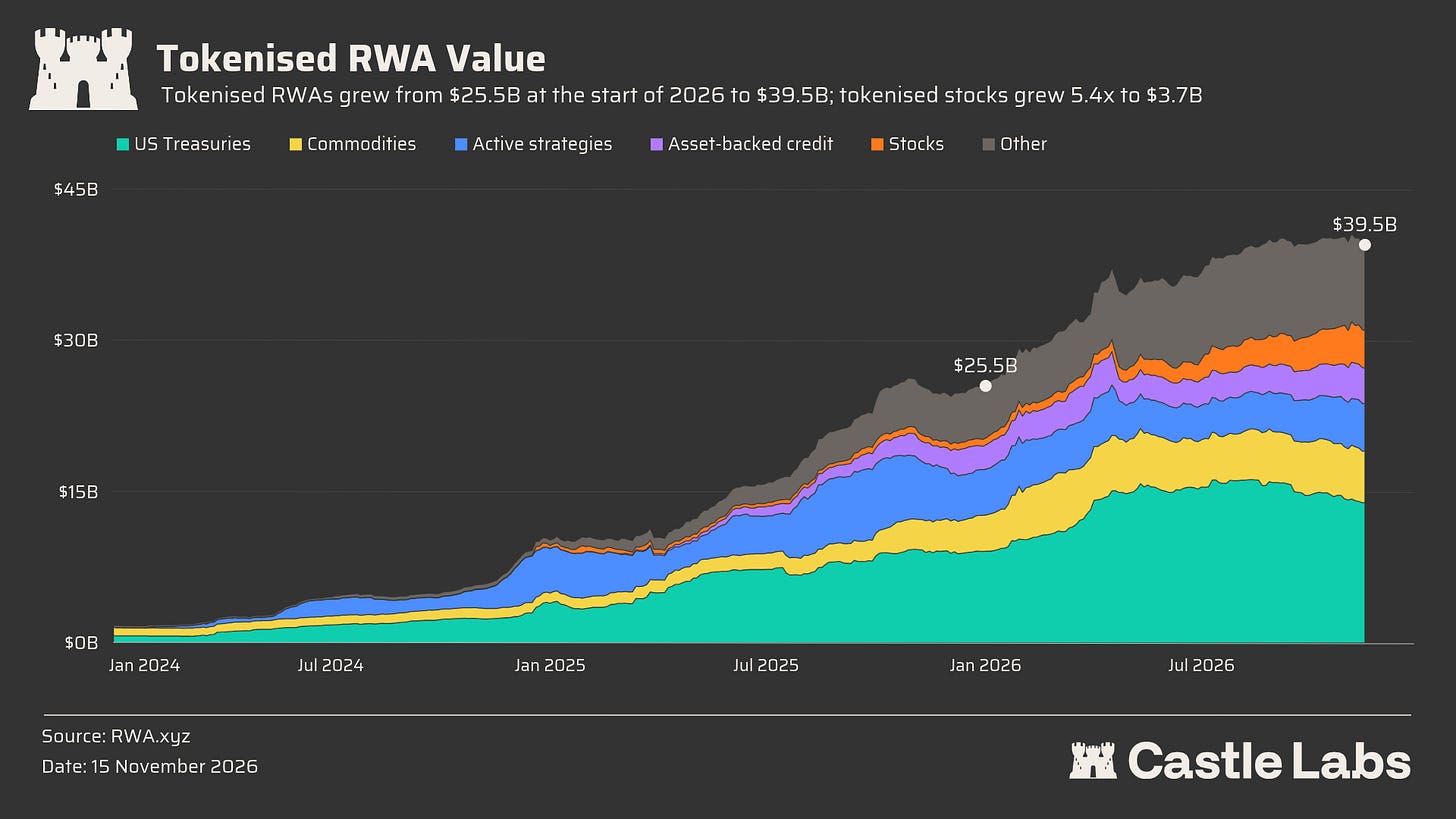
All these tokenised assets are set to trade on DEXs, which provide 24/7 liquidity, a direct growth correlation for any onchain DEX.
The main advantage of Uniswap architecture is its V4 hooks, which let anyone create permissioned pools, an advantage for transfer-restricted assets. More than that, V4 can support trading in restricted regions too; a recent example is OKXICE.
Another protocol which is benefiting from the growth of tokenisation is Pendle.
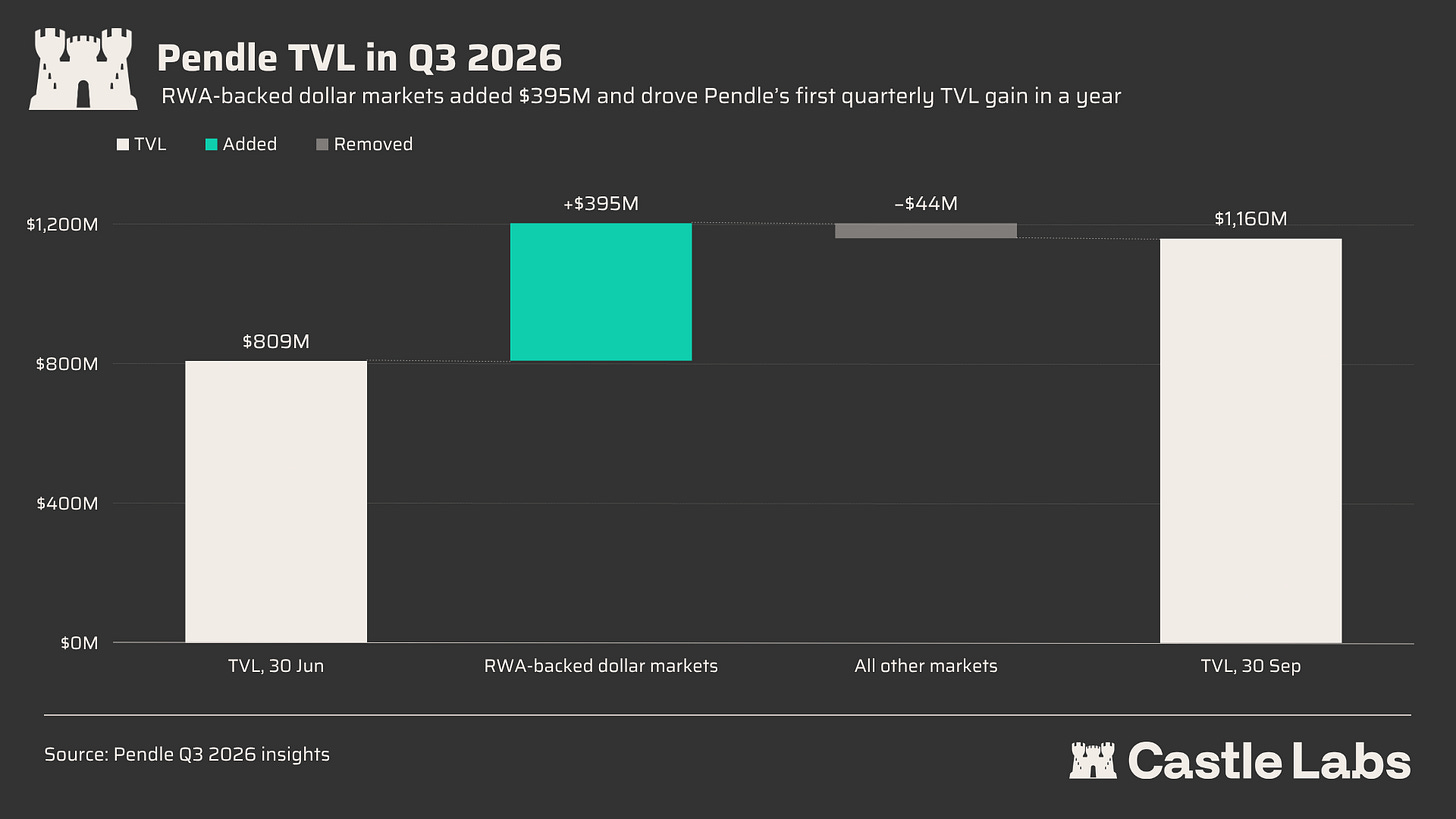
By the end of Q3 2026, RWA-backed dollar markets accounted for 82% of Pendle’s TVL, and TVL rose 43% in Q3. The markets include treasury-backed dollars from Agora and Global Dollar, reinsurance from Re Protocol, and GPU-backed loans through USDAi.
Every new yield-bearing RWA asset needs the Pendle market for better distribution and composability in DeFi; it’s increasingly becoming part of the go-to-market (GTM) strategy for tokenised assets, and as these assets grow, Pendle is set to benefit.
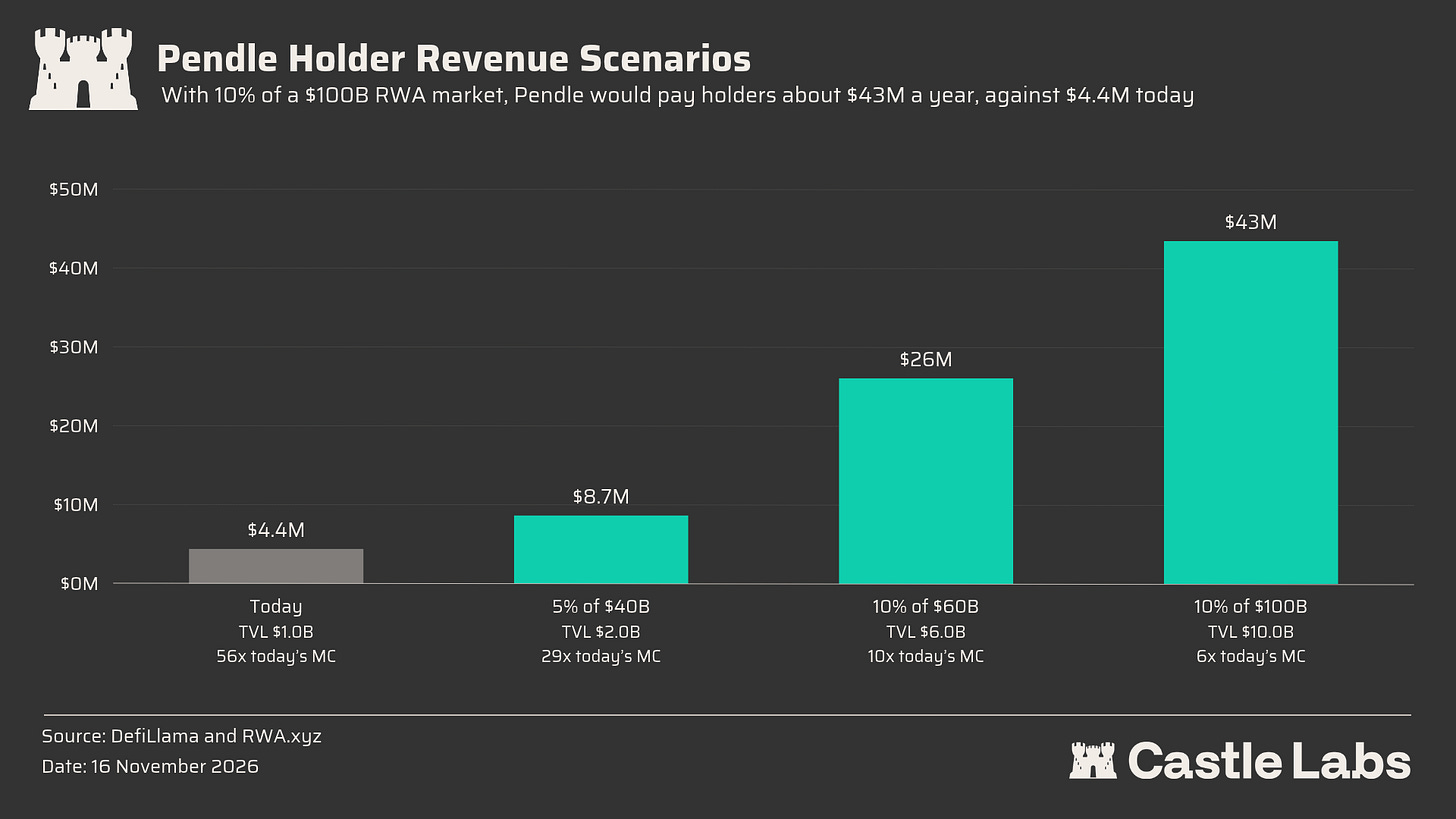
So how big could Pendle get?
Pendle’s current TVL is ~$1 billion, which includes both crypto assets and RWA assets, but as RWAs expand, the Pendle RWA TVL will expand with it and at the point where it reaches 10% of the RWA market, which itself is growing, Pendle can pay its holders upwards of ~$43 million a year.
Aave, while it hasn’t performed well on price action, sits at the intersection of tokenisation, consumer adoption, and core DeFi.
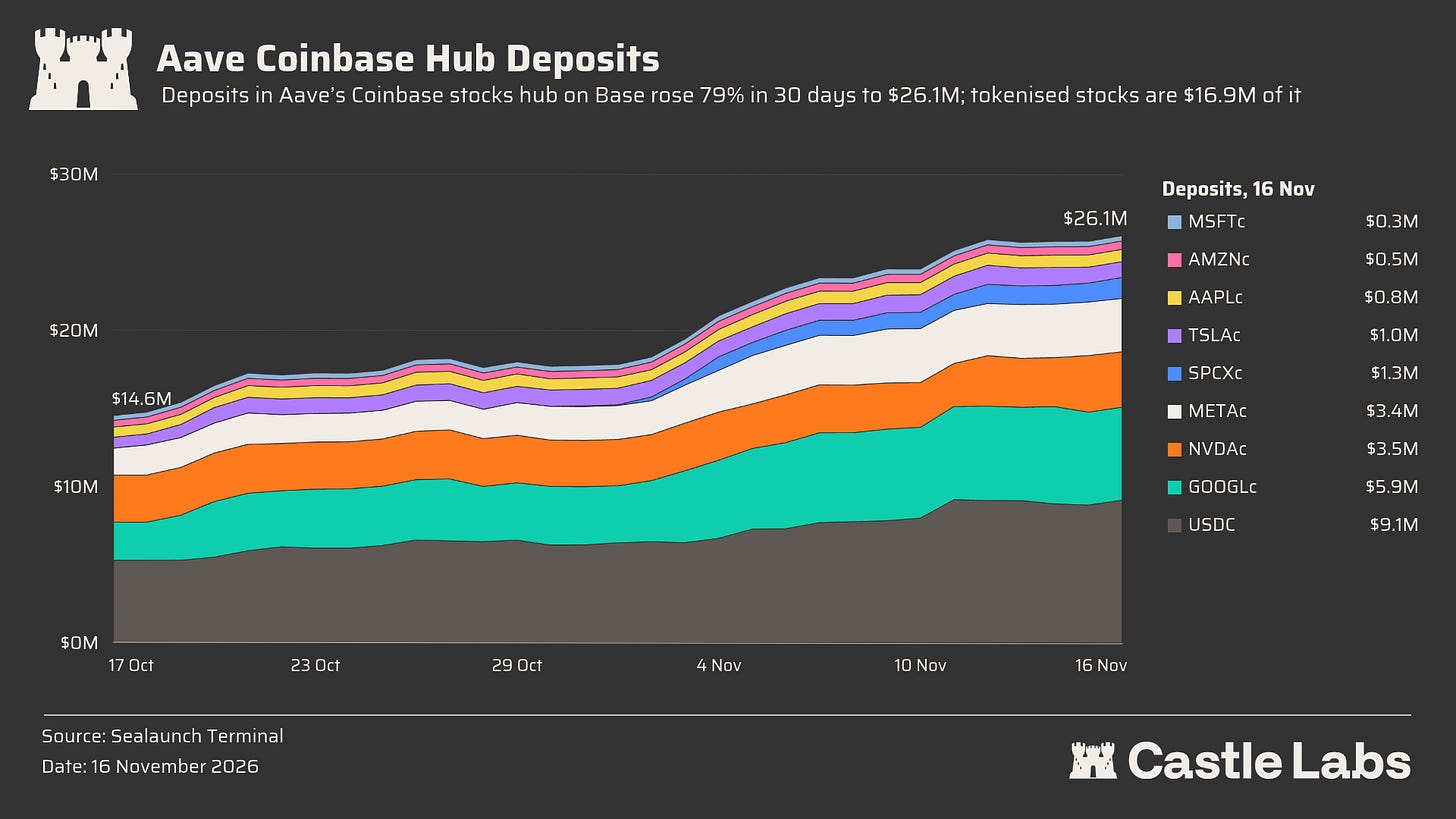
The growth of tokenised assets relates to Aave and Pendle, as Pendle’s PT assets are deposited as collateral for looping. Tokenised equities on base are growing, with net deposits exceeding $18 million, driven by incentives and carry trades from partner protocols like SuperForm and Dialectic Group Vaults.
The Aave app lets users earn DeFi-generated yield higher than T-bills, with balance protection of up to $1 million (4x the FDIC standard of $250k for US banks). EtherFi, a neobank, also runs its hub on Aave V4, with deposits of ~$350 million, and lets users borrow in the app itself, giving Aave new flow and positioning it as a consumer-forward infrastructure provider.
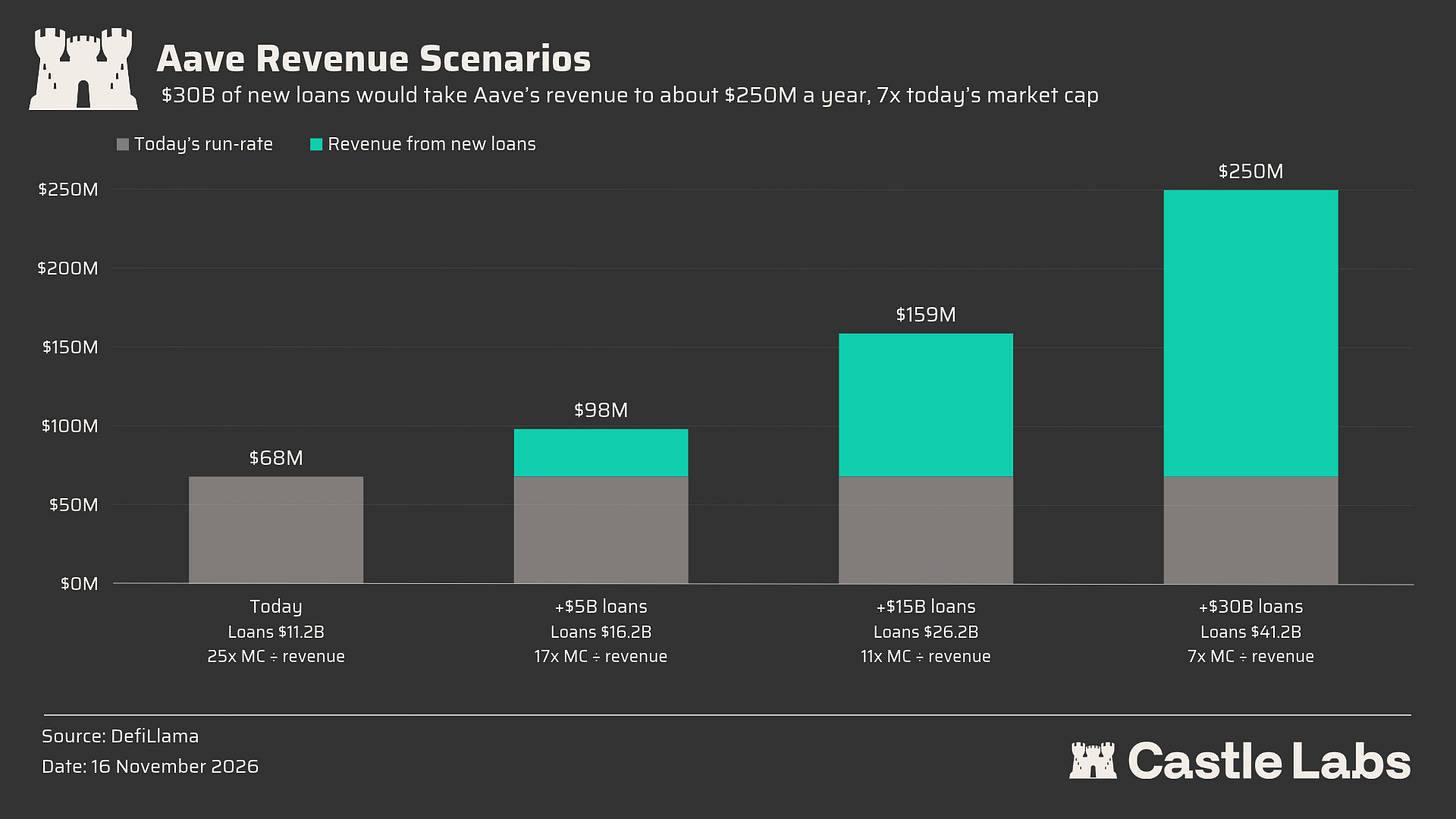
Different distribution sources and growth levers add more loans to the system, which increases revenue. The platform currently has ~$12 billion in active loans and $61 million in revenue YTD, and as more borrowing happens, we can expect revenue to track it linearly.
While it has all the necessary levers, it has stopped accruing value to its holders since April this year, so once that is enabled, we should see this growth come to fruition.
While these are core DeFi protocols and are genuinely interesting, we would also like to highlight products like Pearl and Venice AI, which have grown as “AI money”, and Zcash, which is “private money”.
Let’s start with Venice, because it generates revenue and isn’t purely future-looking.
Venice provides private, uncensored model access for its users, as an alternative to Claude and ChatGPT.
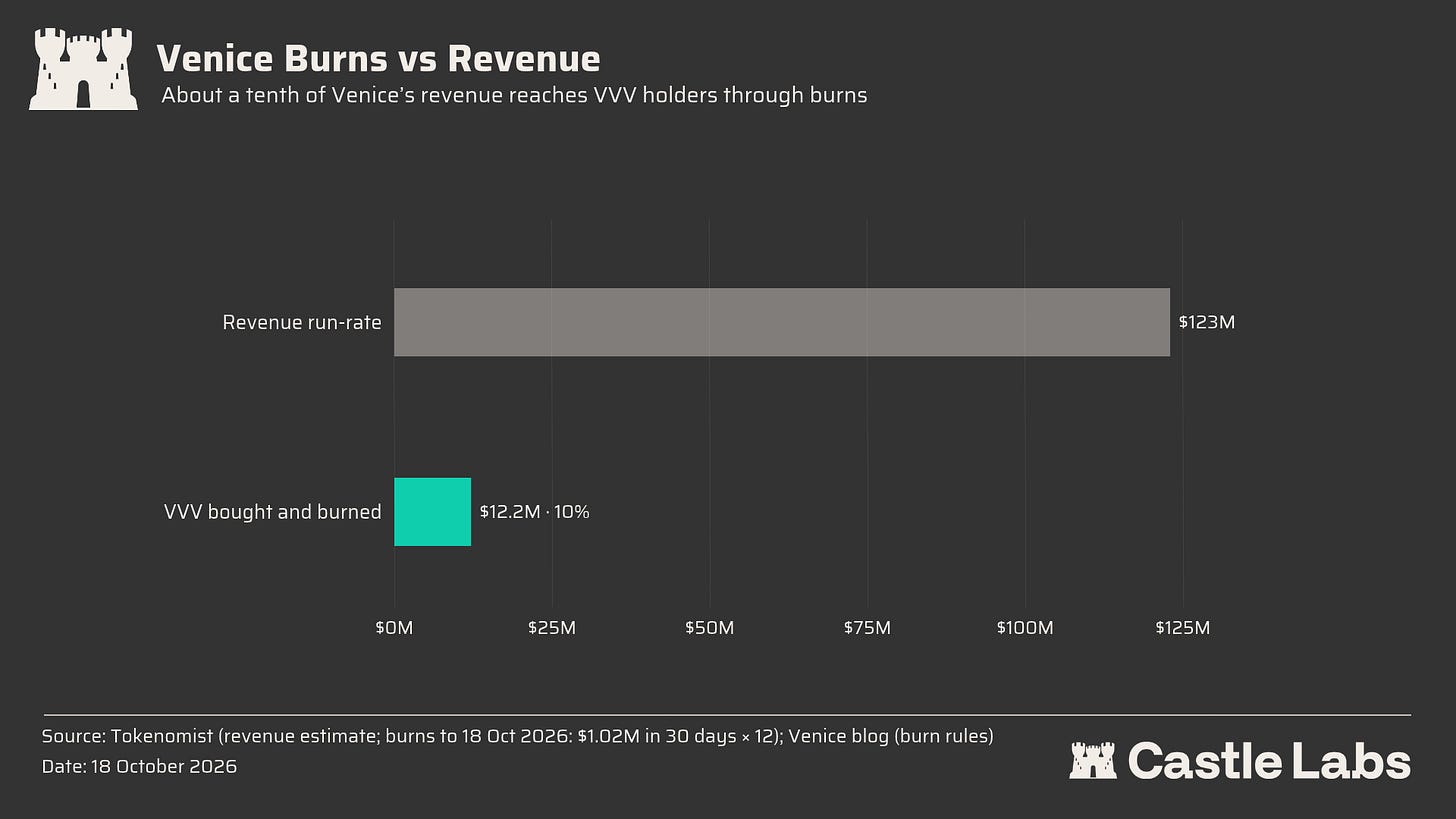
Its annualised revenue is $123 million, putting $VVV P/S at ~8 (based on market capitalisation) or ~12 based on Fully Diluted Valuation. However, $VVV doesn’t capture all this value, and Venice equity is involved too, creating a disparity between tokenholders and equity holders and raising questions around who gets the most value when the project succeeds.
To reduce the confusion around the token and ensure alignment, Venice runs discretionary and automated buybacks for $VVV (part of the sale returns to the token). In the last 30 days, these burns totalled $1.02 million, or $12.19 million annualised, putting the buyback revenue share at 10%.
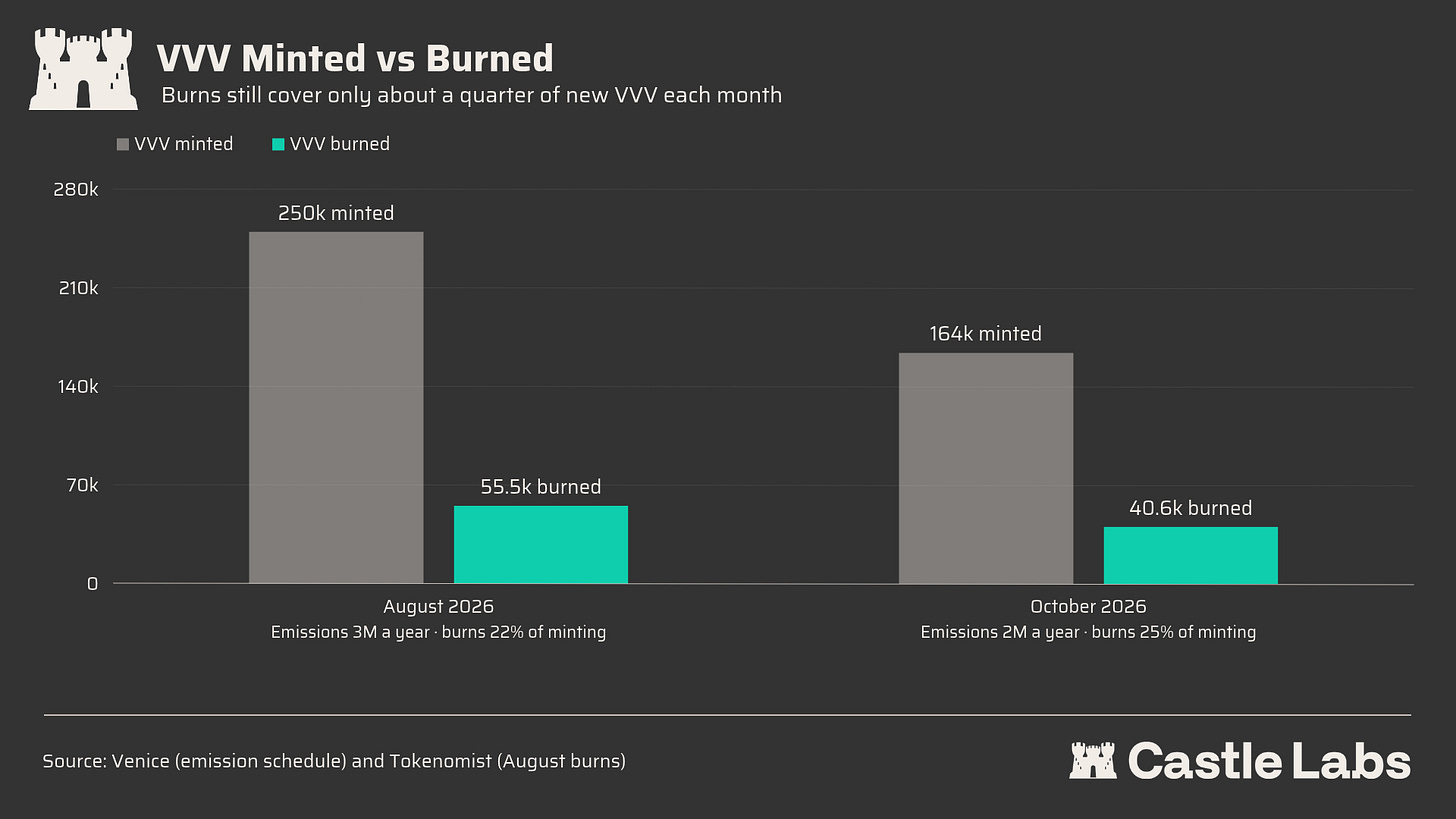
The team also reduced yearly token emissions from 2.5 million a year to 2 million this month, reducing net-new sell pressure on the token. At current rates, the burns remove only 500k VVV tokens from the supply, burning only 25% of the emitted supply, making the token inflationary. As the network grows, we expect revenue to increase and emissions to decrease, pushing the token toward a deflationary path.
The second token is $PRL, and it has caught everyone’s attention because of its design. On Pearl Network, miners perform matrix multiplication on their GPUs, the core operation behind every chatbot, termed “proof of useful work (PoUW)”.
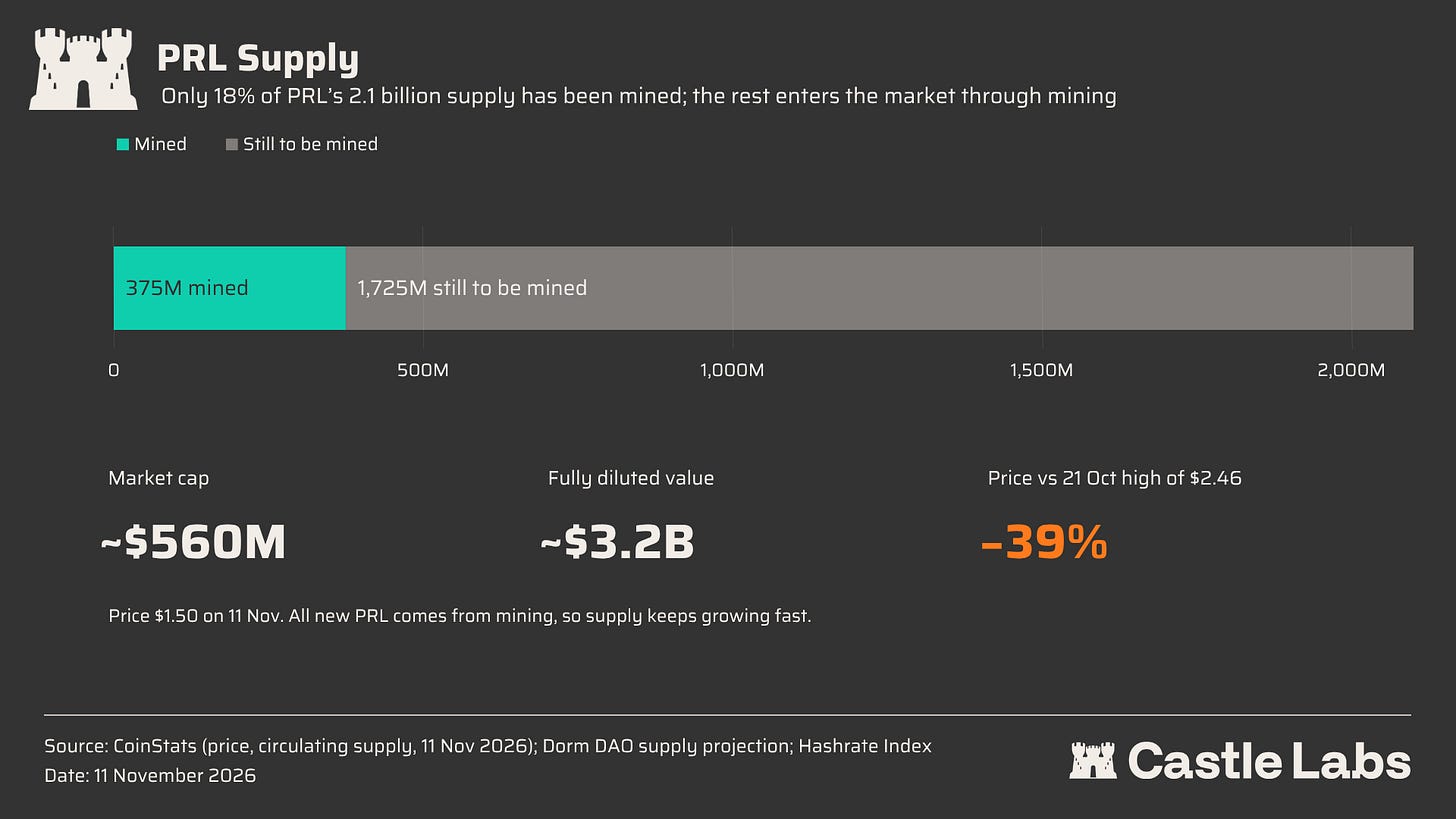
The network’s mainnet went live at the end of April, and $PEARL now trades at a ~$500 million market cap after hitting its October highs. We previously wrote a piece on Pearl, how the network operates, and the market it is trying to tap.
It is also important to understand that, in the current network, most mining compute isn’t paid-inference revenue; only one partner, Together AI, uses it to fund discounts on its services.
While this is worrying, the scope of this tech is much larger than many expect, and if multiple customers start using inference and paying for it, it helps build miner revenue through burns, as users can be charged in $PRL.
Also, while we are talking about $PRL, its launch was fair, and anyone can mint the token by mining the network or buy it on exchanges, and so far only 18% of the token supply has been mined.
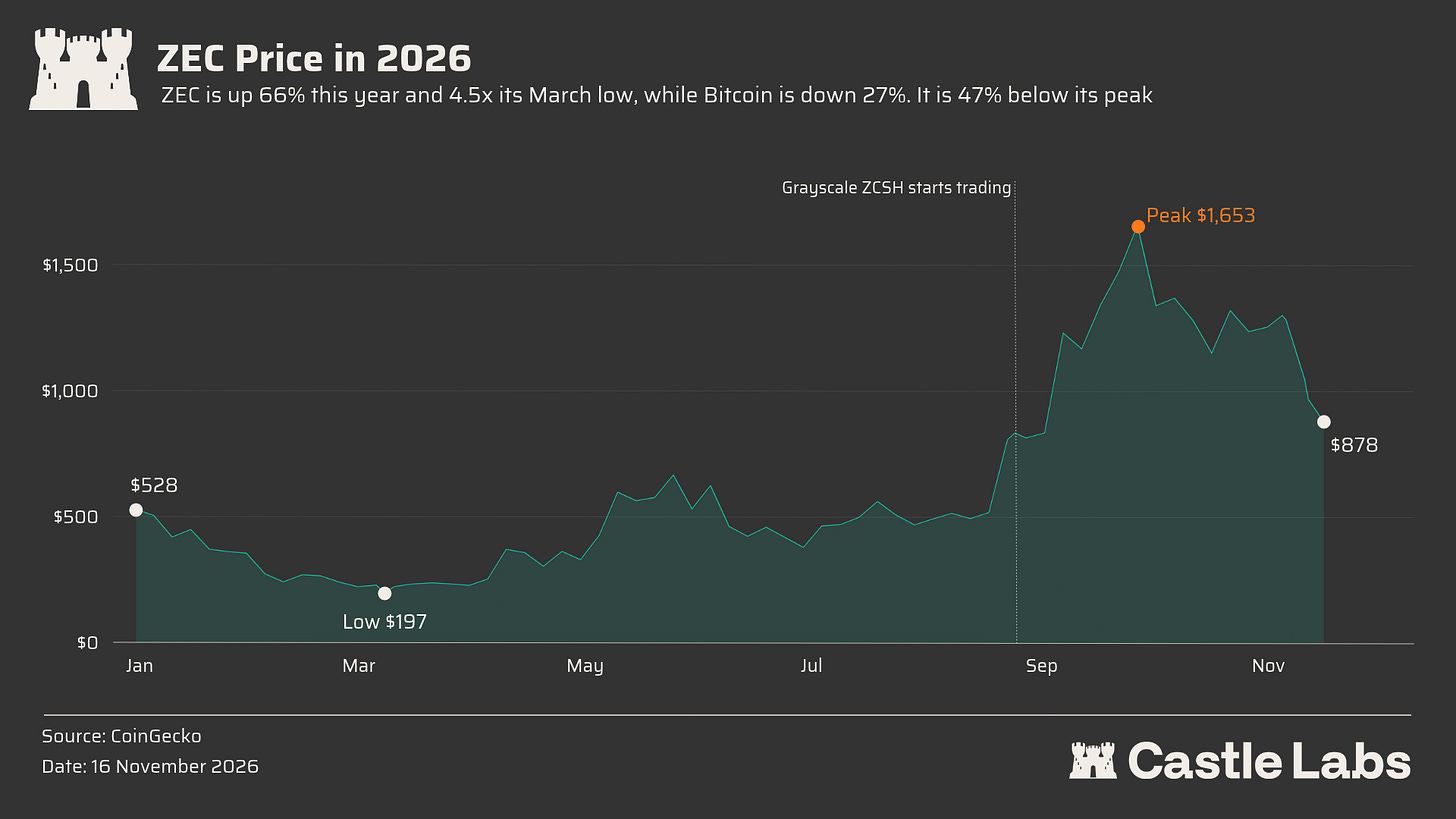
Zcash is another great example of a future-looking investment which is becoming a store of value (SOV). Zcash earns pretty little as a network, yet it is one of the best-performing large tokens of the year.
Wall Street got a way in through Grayscale’s Zcash ETF (ZCSH), which started trading on 25th August and gathered over $1 billion in deposits, putting it in the top 1% of ETF launches in the past decade.
Zcash is essentially private Bitcoin: a 21 million supply cap, 4-year halvings, and optional zero-knowledge shielding that makes it private. Privacy isn’t just a feature which sounds good on the surface; it is increasingly being used, with shielded ZEC up from 8% to 29.2% in 3 years.
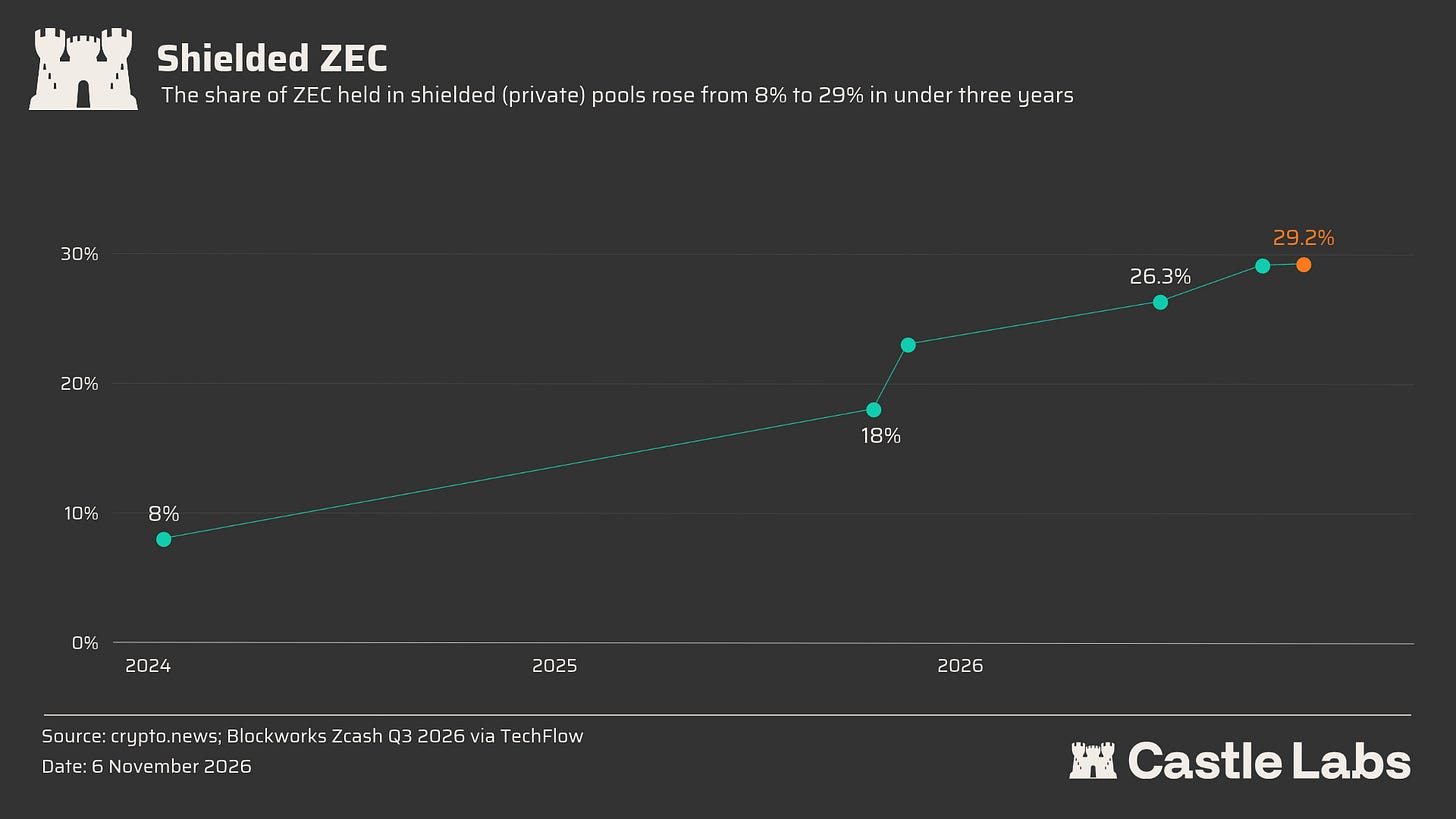
The privacy feature is what makes Zcash interesting; it recently rallied when Democrats won the mid-term elections because if they come to power in the US, we can expect increased scrutiny and an enhanced need for financial privacy, which is what Zcash can provide and should be viewed accordingly.
In this section, we covered two types of tokens: those with consistent revenue that provide value back to tokenholders and are set to tap into much larger markets through tokenisation, and those that are more future-looking investments with strong narratives.
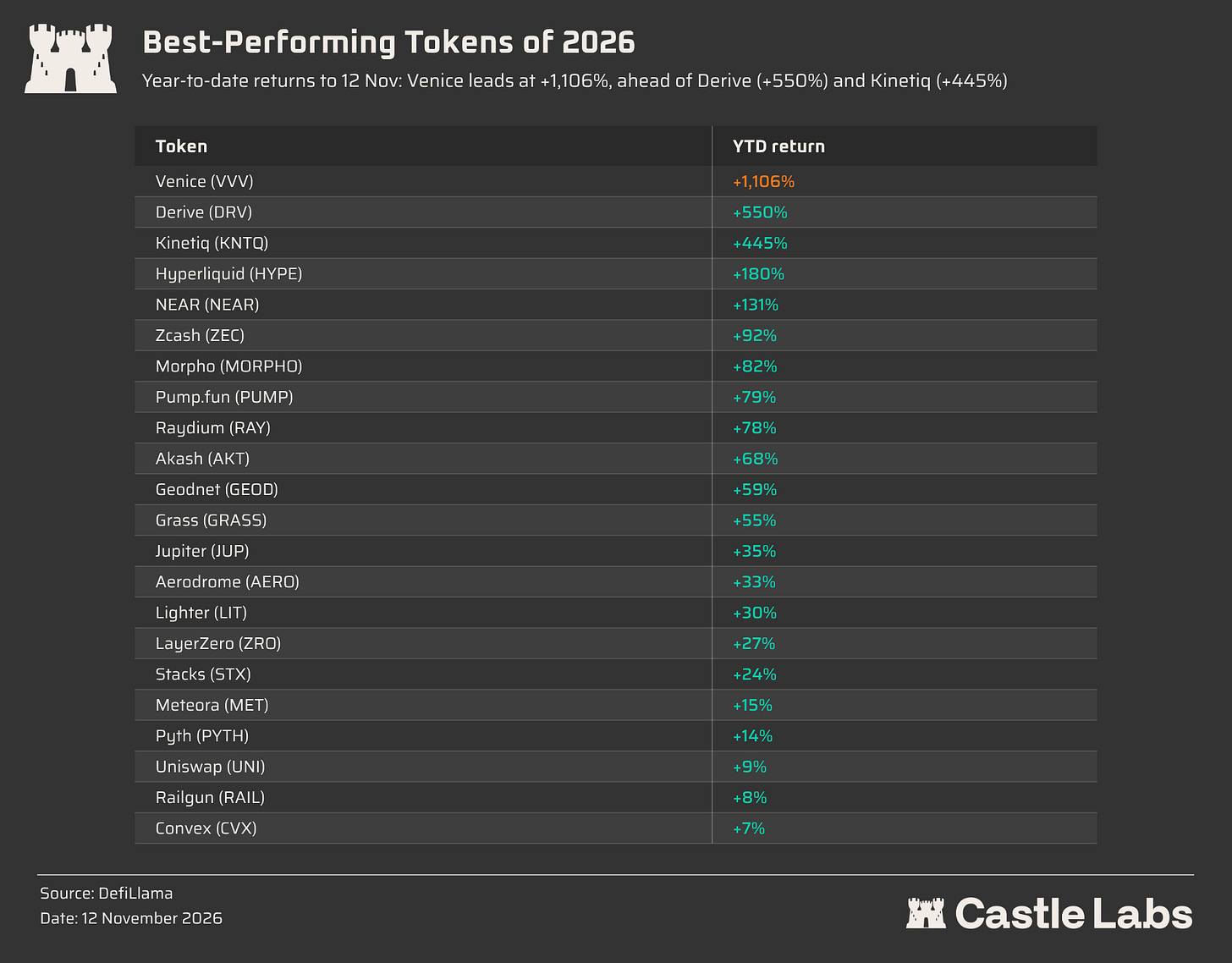
A good set of investments could combine both, focusing on fundamentals alongside what the future holds. If you look at the tokens that have delivered strong YTD returns, the answer becomes clearer.
Closing Thoughts
Looking back at the question we raised at the start of the piece: is being a token leader in its category a significant predictor of performance? The answer isn’t as clear as a yes because most of the category leaders haven’t performed well, so we need different lenses to make a decision around the token:
The current fundamentals of the product and how well it is linked to the token. If the token makes consistent cash flow, it is a good token, but it also needs to be paired with emissions to understand the net flow around the token.
The market the product is trying to tap into and how big that market can itself become. Tokenisation is a pretty large market which multiple onchain products are trying to tap into, if a product is directly linked
The narrative the product is built around and has mastered. A narrative-strong product gets demand based on the future growth it could tap into. For Zcash and Pearl, it is Private Money and AI Money, as the former is essentially private Bitcoin and the latter tries to meet the AI compute demand through its token and blockchain design.
The first test is essential for evaluating the token’s fundamentals; the second helps define market size and growth, while the third highlights what the market cares about most.
Originally published in the Castle Labs newsletter. Subscribe at research.castlelabs.io/subscribe.