Solana: Building the Full-Stack Onchain Economy
Solana is now the top chain by application revenue.
Over the trailing 30 days, it generated $193.1 million in app revenue, almost twice that of its closest competitor, Hyperliquid ($86.5 million), followed by Ethereum ($53.8 million) and Robinhood ($34.6 million).
This lead comes from consumer applications, which account for ~80% of application revenue, including apps like launchpads, trading terminals, collectables, and more. The rest comes from DEXs, Lending, and other DeFi protocols.
This revenue mix is often contested because it is essentially a cut of speculative memecoin volume, which is narrative-driven, so the consensus is that when attention dries up, volume and fees may leave with it. To test whether this holds for Solana, the report assesses how durable consumer application revenue is.
We then look at what is being built beyond the consumer app layer, spanning categories across Solana and analysing how they are growing. This includes Lending, DEXs, and, most importantly, RWAs, which have grown rapidly on Solana over the past year.
Solana Consumer Applications Have Reached Escape Velocity
Solana is a high-throughput blockchain that makes onchain activities fast, cheap, and smooth, which is a core reason it attracts consumer applications, as they generate high transaction volume and need a near-instant, low-latency experience. Moreover, they want to launch on a chain with strong liquidity and a user base that drives demand, and Solana can provide all of this.
The consumer applications on Solana can be mainly categorised as Launchpads, Trading Terminals, and Wallets.
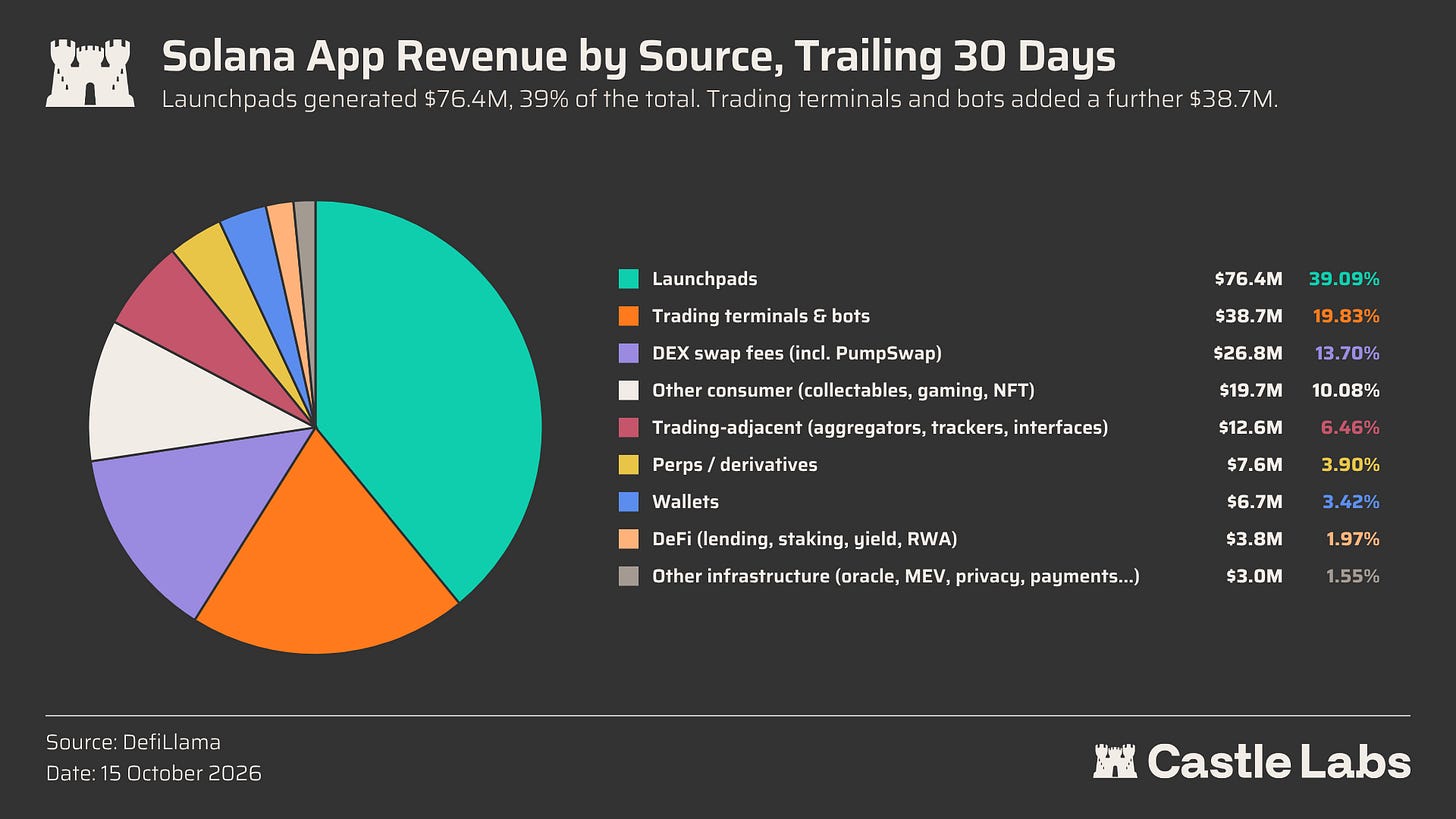
Launchpads currently represent the largest segment of app revenue, led primarily by PumpFun, which alone accounts for 20% of Solana’s app revenue with ~$39 million in trailing 30-day revenue from the launchpad business.
Solana had all the ingredients to host a successful consumer application, but it didn’t attract users until PumpFun launched in January 2024.
The app also serves as the distribution layer, enabling trading of all launched coins. Combined with Solana’s high throughput, this enabled over 20 million memecoins to launch on the chain and ultimately drive application revenue.
Trading terminals and wallets follow, including Axiom, Fomo, GMGN, Phantom, and others. An important aspect of these applications is that they have distribution, which they use to their advantage by offering social trading, perps, and prediction markets on the same platform, ultimately capturing a share of some of the top revenue-generating businesses, apart from their core offering, which is primarily being a wallet or a terminal to trade memecoins.
This also suggests their growth isn’t isolated: it carries across the space as they help drive additional user flow into the integrated application. For example, the fomo adapter routes purchases on their application to the most liquid DEXs on Solana, including Raydium, Meteora, and aggregators like Jupiter.
In PumpFun’s early days, they also graduated their memecoins and created a liquidity pool on Raydium to trade them further. However, in March 2025, they launched Pumpswap to expand their revenue base ($15 million in the last 30 days), largely because swap fees are a huge chunk of revenue.
PumpSwap’s strategy reflects how a launchpad would want to control the full lifecycle of the coins it launches and keep earning as they reach higher market capitalisation.
Similarly, a DEX would want to control the launchpad business because it keeps generating value as more coins launch.
This is what we are seeing actively happening in the Solana ecosystem.
Raydium, one of the major DEXs on Solana, launched LaunchLab in April 2025, a bonding-curve-based launch engine that other teams can build launchpads on and graduate tokens into Raydium pools.
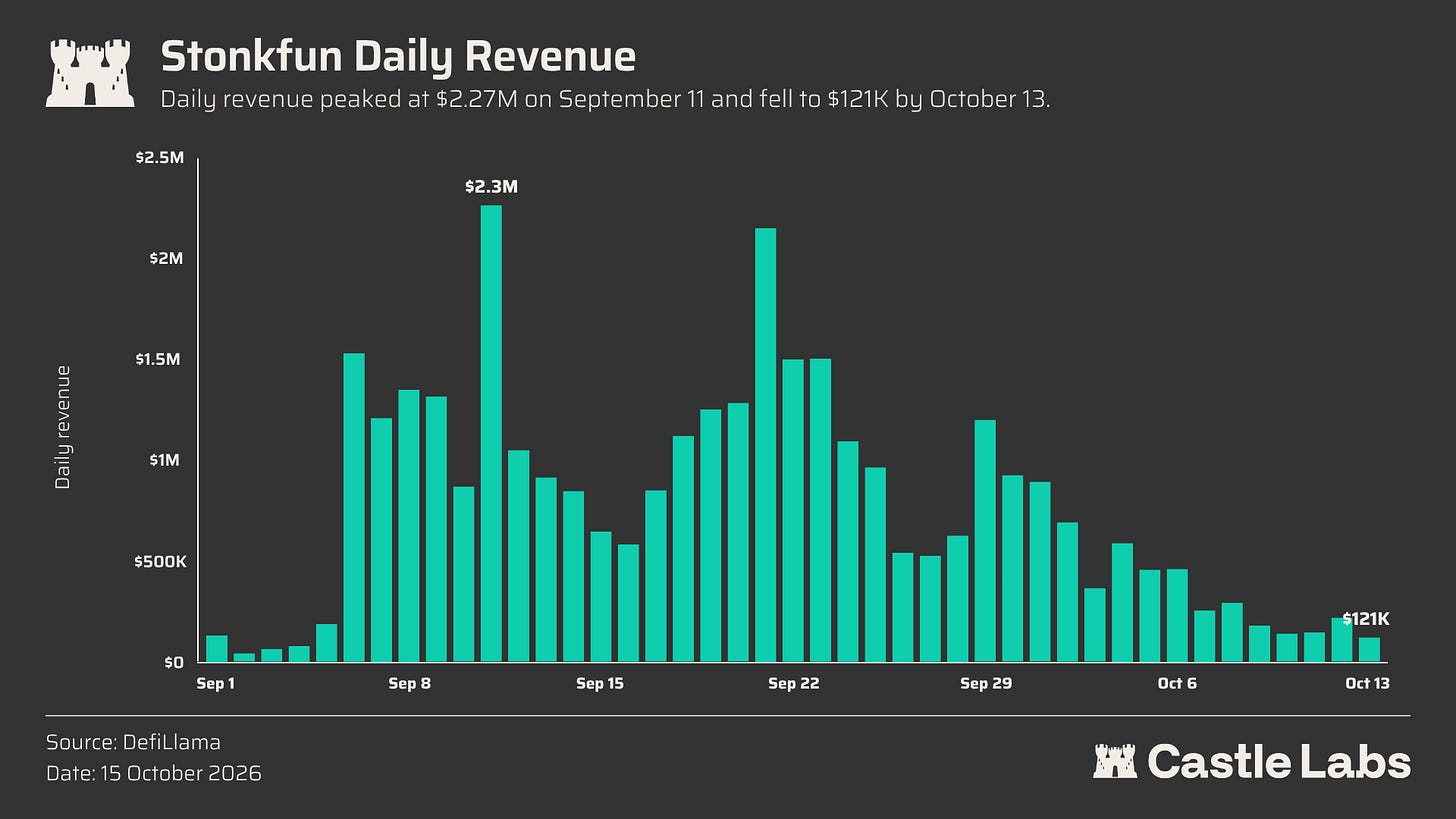
In September 2026, StonkFun moved its launches to LaunchLab. StonkFun quickly grew because it offers flexible quote assets like stocks and lets token creators set a custom tax rate on each transaction, which then buys the quoted stock and distributes it to memecoin holders, creating a flywheel that lets users earn a real stock by holding a memecoin. This also boosts the RWA holder count and volume, benefiting a whole category on Solana.
Beyond these obvious winners, protocols like Collector Crypt, a marketplace for Trading Card Games (TCG), have generated an average of $8 million in monthly revenue this year, showing the variety of interest in the Solana ecosystem beyond memecoins.
How Durable is Consumer App Revenue?
As established at the beginning of the piece, consumer app revenue can be categorised as narrative-driven and may not be durable, especially since it depends on memecoins.
To test this for Solana, we aim to answer the following questions:
The Floor: How far did weekly consumer app revenue fall in the one-year time span?
Retention of Apps: Are the applications that led the category on Solana still leading it?
Competitive Landscape: Are applications losing market share, and does that revenue go to other Solana applications or leave the chain?
The analysis ran these tests over a 1-year period from October 2025 to October 2026.
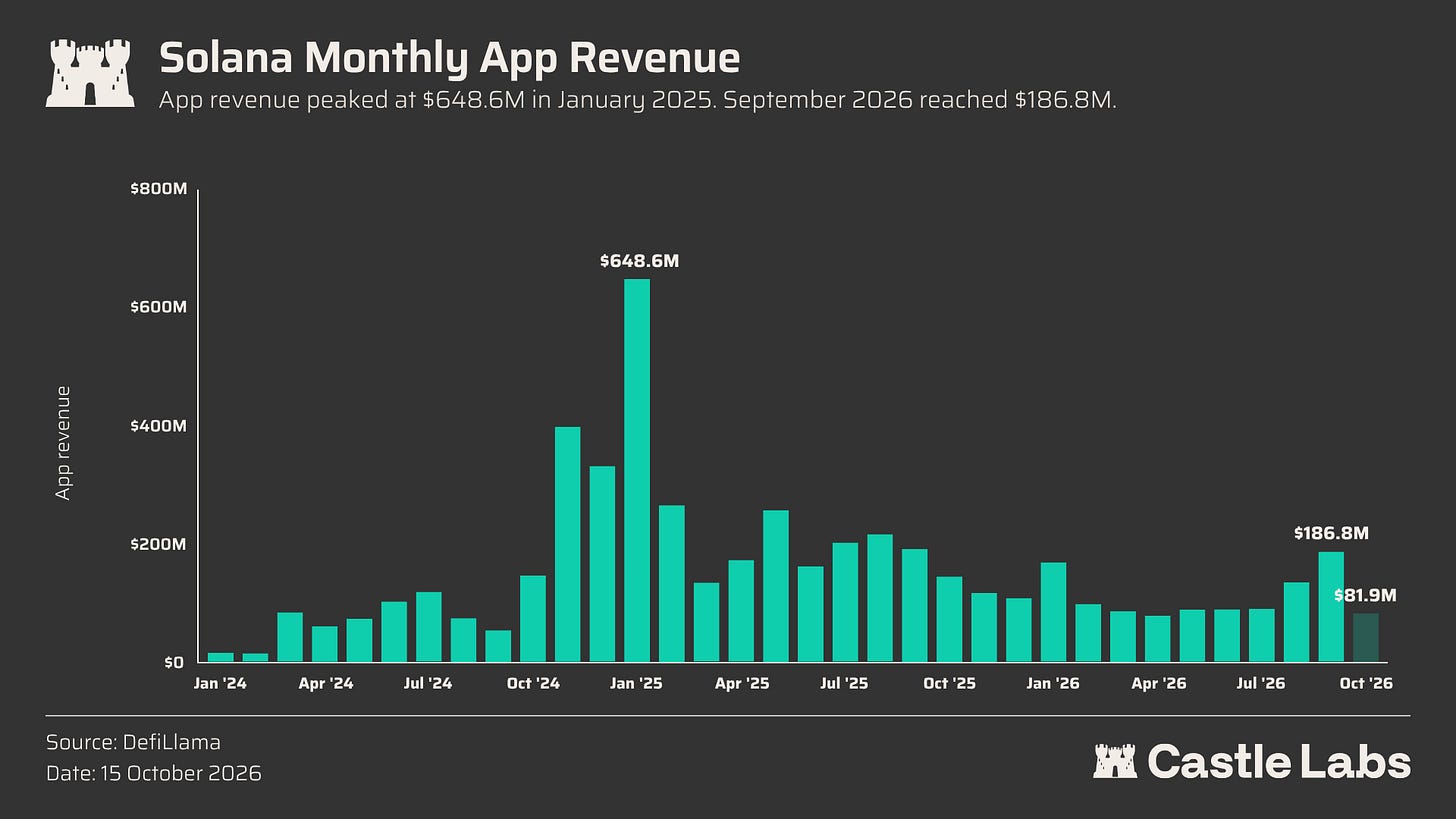
Weekly revenue from consumer applications ranged from $13.5 million to $42.6 million, with a median of $18.2 million. Most of the credit for maintaining this baseline goes to PumpFun because of its consistent revenue. As the chart below shows, the red portion is the most volatile and represents smaller consumer applications that launched but couldn’t capture enough market share. In Q3 2026, consumer applications started to grow at an accelerated rate, driven by new applications like StonkFun, which some days generated as much revenue as PumpFun.
This shows that Solana consumer applications have started generating a baseline of consistent revenue, answering our first question.
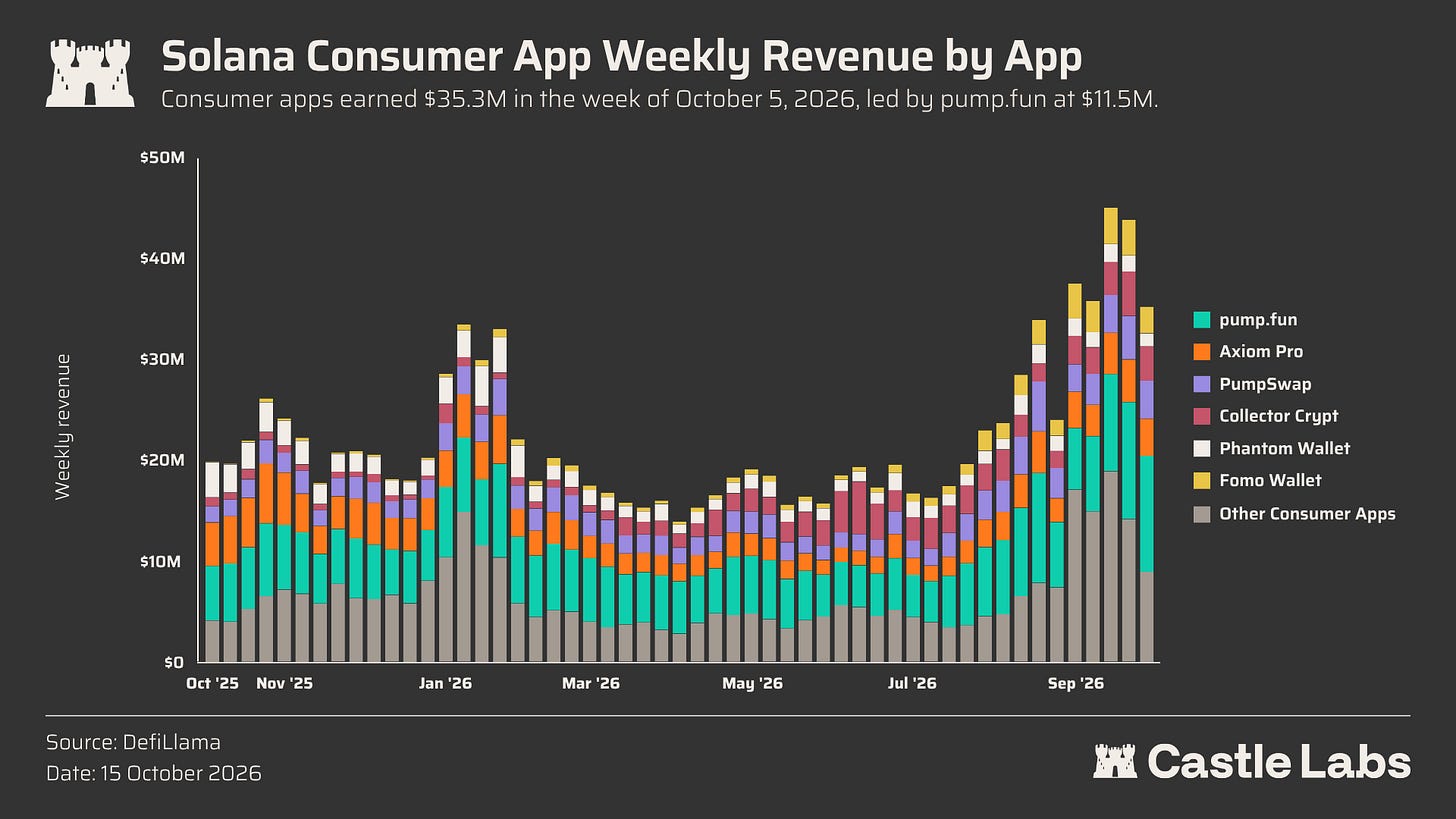
To understand application retention, we check whether the apps that led last year are still leading. The top 10 largest consumer applications by revenue in Q4 2025 earned $211.7 million and earned $261.3 million in Q3 2026, with 8 of 10 still in the top 10. This list includes apps like PumpFun, Axiom, and others.
In addition, revenue concentration among these applications has eased this year: the top 3 applications contributed 64% of consumer app revenue in Q4 2025 and now contribute 50.2%, showing the market continues to show an appetite for newer applications. The largest contributor to the new application subset is StonkFun, which made $27 million in September compared to $46 million for PumpFun.
However, StonkFun activity seems to be declining, with its 7-day average revenue at $490k/day, about 21% of its $2.3 million peak, suggesting that new products can succeed, but sustaining high activity is difficult and often falls to a lower, established baseline.
Solana consumer application revenue appears sustainable and growing, and much of the credit goes to launchpads, which account for most of the category’s revenue. Revenue isn’t highly cyclical, and ecosystem applications can draw consistent demand, making Solana one of the best chains to experiment with and launch new products.
The Maturation Test: Solana DeFi
The Solana DeFi ecosystem isn’t the chain’s primary driver of application revenue; however, it consistently taps new primitives, especially RWAs, and is accelerating faster than many assume. To highlight this, we plot the growth of different Solana DeFi categories against Ethereum over the past 30 days.
Most Solana categories posted more growth than Ethereum, partly because of Solana’s smaller liquidity base. But some categories, like synthetic dollars and yield, are where Solana took a real hit while Ethereum grew, likely because these categories are much smaller on Solana. For example, in the yield category, the only major protocol is Exponent, which saw a decline in value locked.
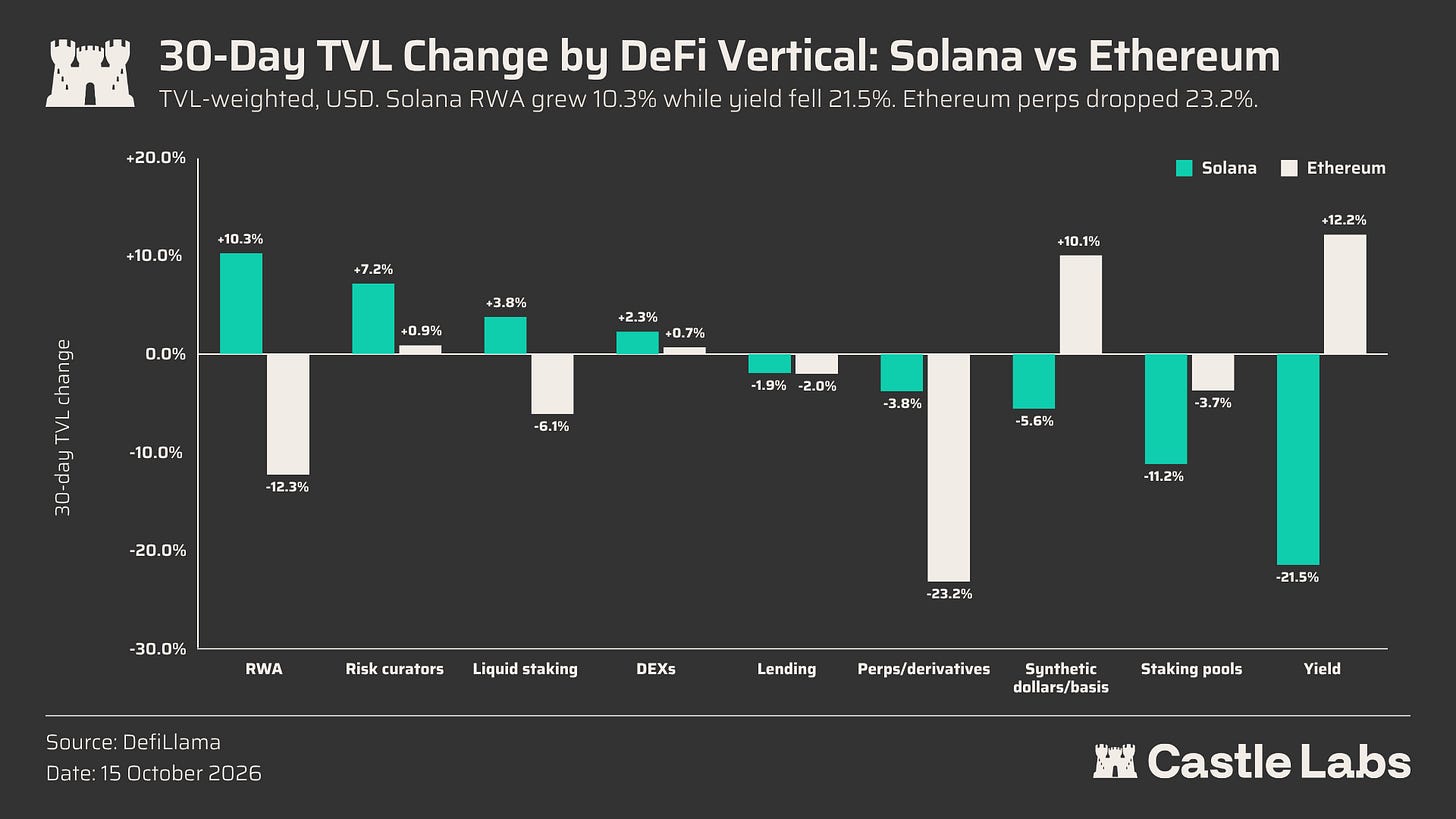
Earlier, we briefly discussed how DEXs accrue value from Solana consumer applications, as shown by their growth in the chart above.
In this section, we focus on applications generally considered independent of speculative volume and that are also huge on Solana, such as lending, which needs hard assets in the system that aren’t expected to drop to zero at any moment, consistent demand, and longer user retention.
The lending category on Solana is led primarily by Jupiter Lend and Kamino, each using different growth strategies, but before we go into more detail, let’s establish a lending protocol’s key growth levers by analysing what is happening on Ethereum.
On Ethereum, lending TVL is 11 times larger than Solana’s, with borrowing demand that can be boiled down to three key asset categories:
Liquid Staking Tokens (LSTs)
Yield-bearing Stablecoins (YBS)
Pendle PT assets
The first two asset categories are yield-bearing, and Pendle PT assets provide fixed yield at maturity, so users can also use them as collateral to borrow and execute a looping strategy.
In looping, users buy a yield-bearing asset like an LST or YBS, borrow against it, buy the asset again, and borrow again to increase leverage; the strategy remains profitable as long as the yield generated exceeds borrowing costs.
This looping generates borrow demand for lending protocols, boosting their revenue and lenders’ yield.
While Solana has LSTs, it doesn’t yet have YBS and PT assets at scale, but protocols like Kamino and Jupiter are actively working to bring them and better utilise existing ones.
Current YBS Liquidity on Solana comes from USDe and USDY deployments, totalling over $635 million in supply. USDe liquidity sits in both Jupiter Lend ($313 million) and Kamino ($190 million), but the remaining YBS liquidity, coming from USDY, isn’t deployed in these top lending protocols.
Users on these platforms can run looping strategies through USDe promotional rewards (since USDe itself isn’t yield-bearing, sUSDe is), enabling flywheel effects for lending on Solana.
To bring PT assets onto Solana, Kamino, for example, uses Chainlink CCIP to deploy them into Kamino markets and enable PT looping, but most of these assets have already expired. However, Solana now has its own Pendle-like protocol, Exponent, which contributes over $7 million in deposits and pushes PT looping on the chain. While PT assets aren’t big on Solana yet, once they scale, either through Pendle PT bridging or Exponent growth, it would be useful to run leveraged PT looping and increase borrowing demand on Solana.
The growth of RWA assets on Solana has also helped lending protocols by bringing in more liquidity. This composability also drives further RWA deployments as demand grows. Kamino and Jupiter Lend list multiple RWAs from issuers like OnRe, Hastra, and xStocks.
In the next section, we cover in detail how these assets can drive DeFi growth.
Ultimately, borrowing demand depends on the spread between an asset’s yield and the borrow rate.
Lending on Solana is soon facing another problem: the recently approved double-disinflation proposal, which would reduce net SOL emissions, lower staking yields on LSTs, and make these assets less attractive for borrowing. As yields on these assets fall, the market would eventually lower borrowing rates to sustain borrowing, which would also reduce a depositor’s yield.
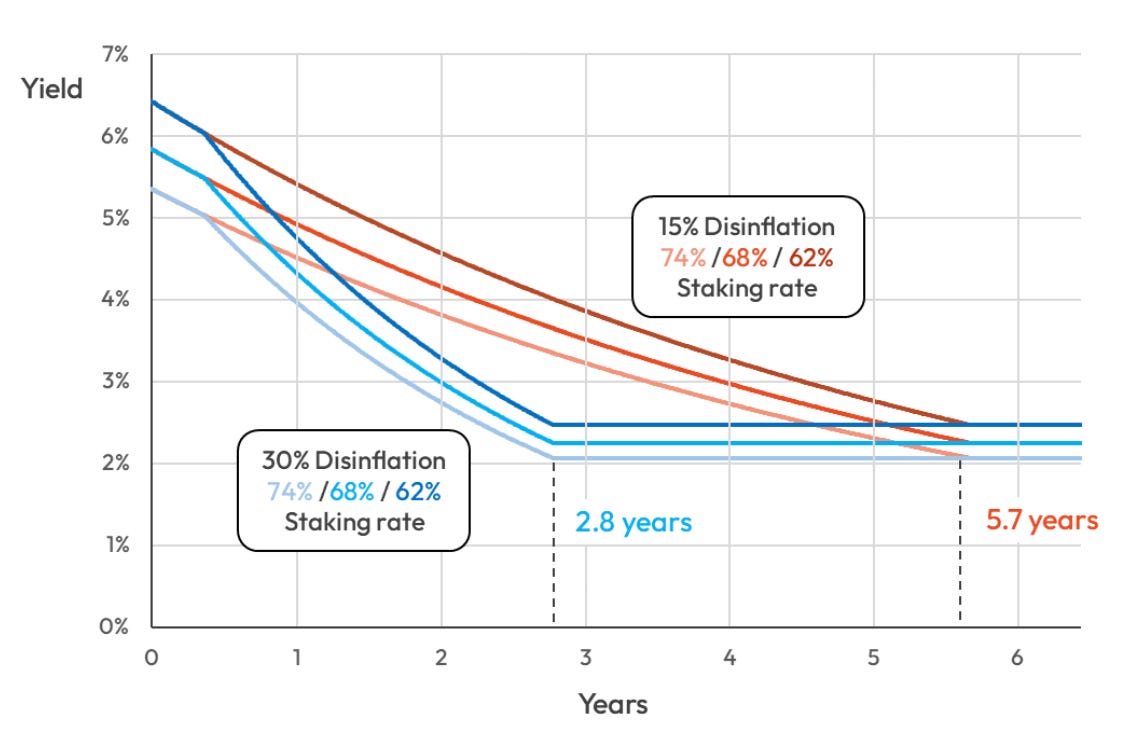
To keep this from affecting the broader DeFi ecosystem on Solana, especially lending, YBS and yield-tokenisation need to grow on Solana. Additional growth levers could help compensate by generating enough borrowing demand through higher yields and engaging both lenders and borrowers.
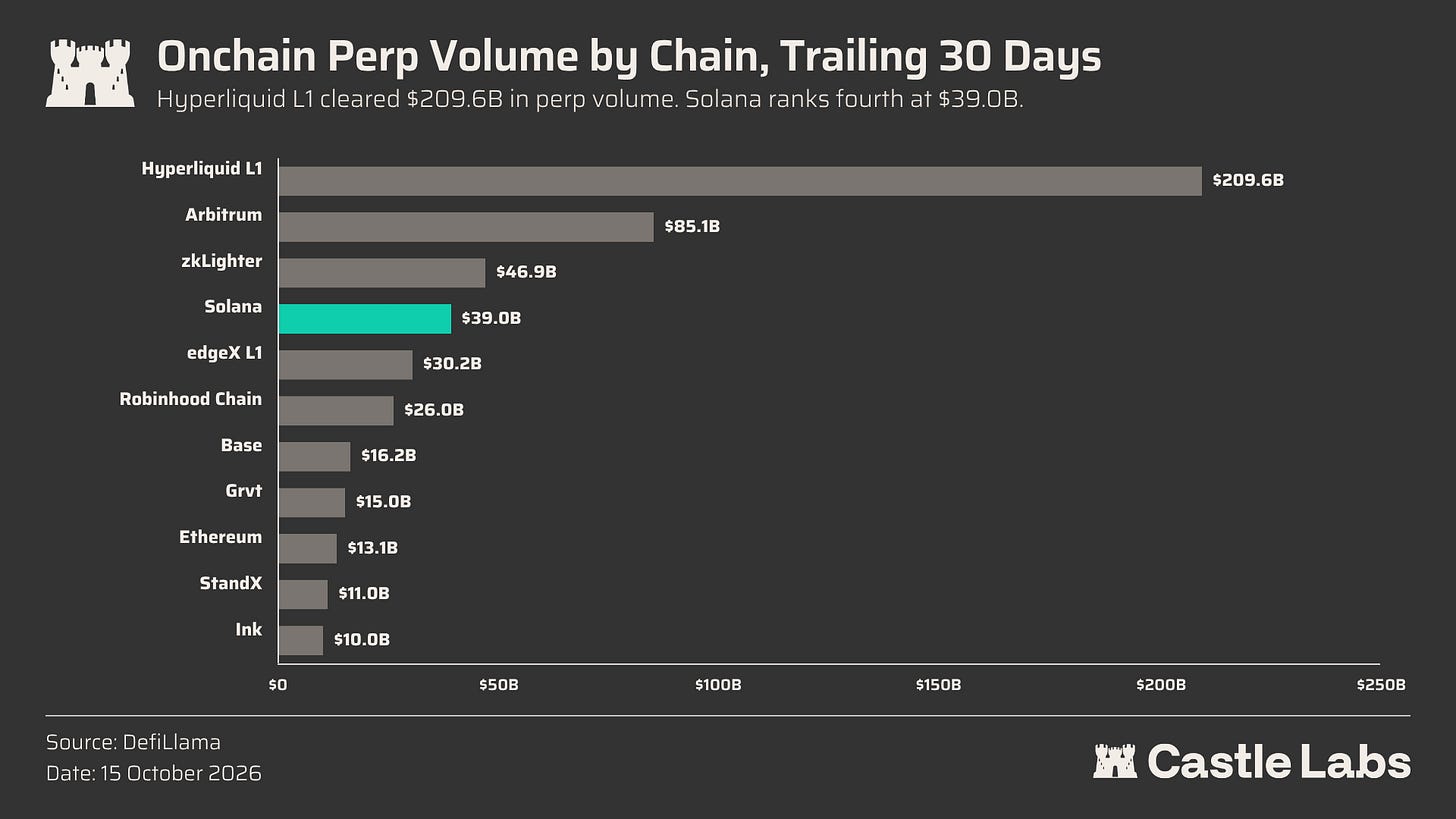
Turning to other categories like Perps on Solana, they generated $42 billion in perp volume over 30 days, 20.6% of Hyperliquid’s volume, making Solana 4th in onchain perp volume, with the main protocols being GMTrade, Pacifica, and Jupiter Perps.
The recent perps expansion came from GMTrade, a GMX V2 fork on Solana, and Pacifica, an orderbook-based exchange. They take different approaches: GMTrade is built specifically for RWA perp trading, while Pacifica attracts users with features like yield on resting orders, tap-trading, and AI tooling. We cover their detailed strategy and core functionality in our flagship research on perp venues here.
Additionally, Solana’s stablecoin supply has reached $16.3 billion, up roughly 6-7% YoY, while Ethereum’s has fallen 9% to $146 billion.
USDC supply on Solana fell by $4.2 billion, with its share dropping from 72% to 42%, as new issuers (USDGO, USD1, and BlackRock’s BUIDL) added $3.5 billion, showing market appetite for new stablecoins, but only about $5.6 million of this new supply is deployed into DeFi, which is fairly low. BUIDL is permissioned and cannot be directly deployed into DeFi. USD1 is deployed in Raydium pools but is a pretty small deployment, and USDGO isn’t deployed anywhere.
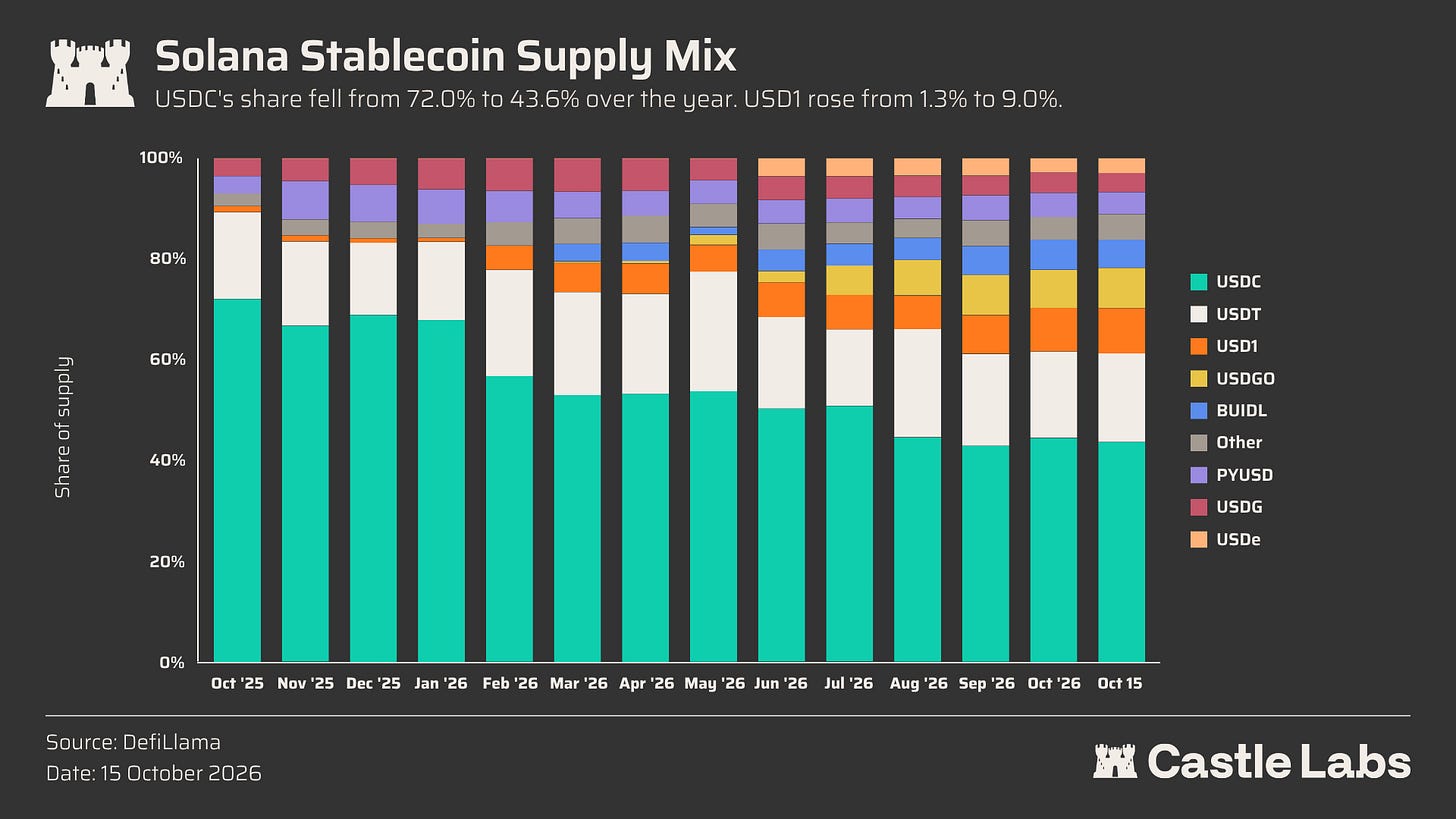
In terms of DeFi utilisation, USDC leads with $544 million in deployments and about $930 million in borrowed liquidity, but it has consistently lost market share on Solana. Next, USDe is the largest asset, actively deployed as liquidity in top money markets.
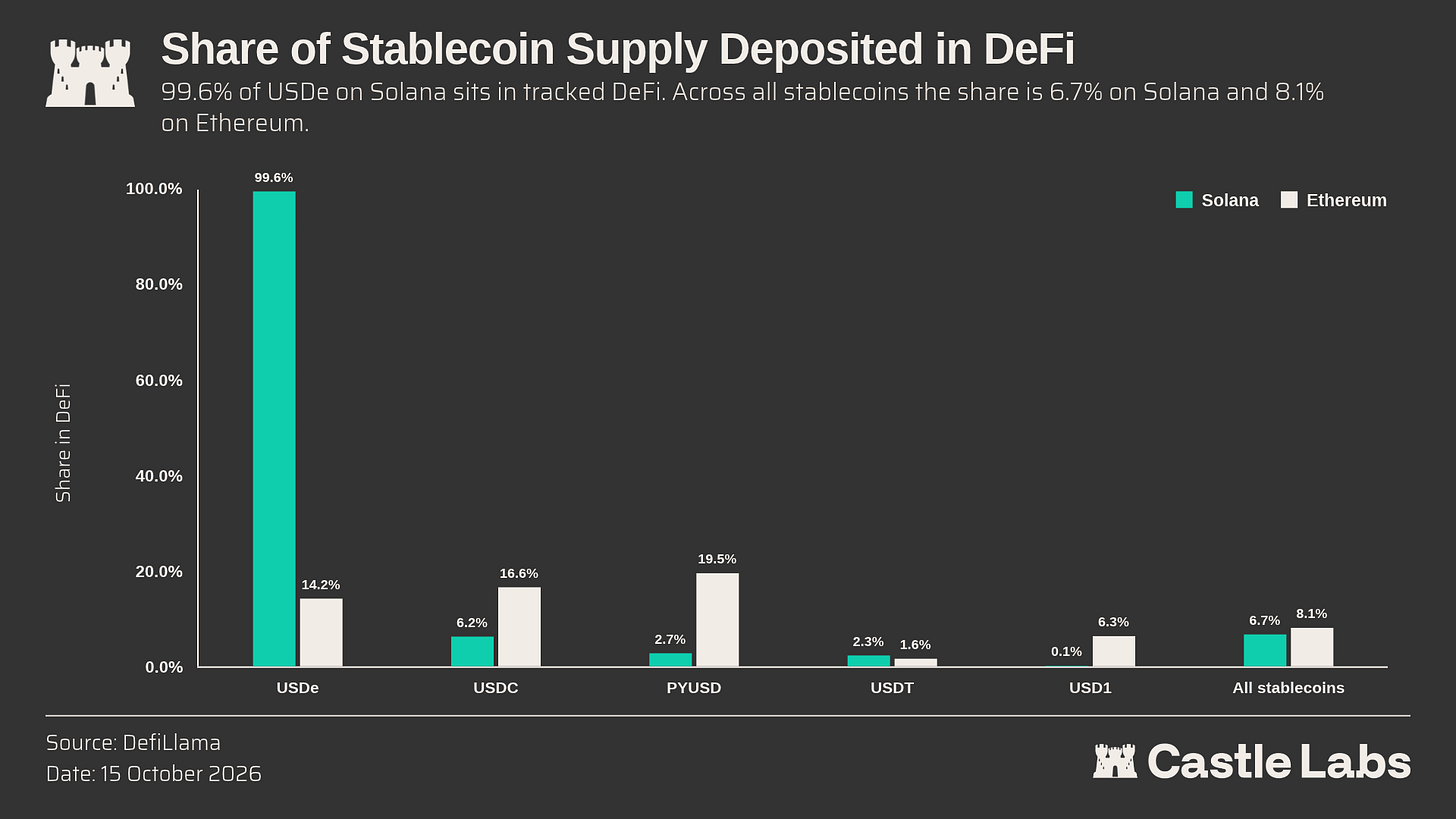
While stablecoins grew on Solana, not all contributed equally to DeFi. Only USDe is widely used because of Ethena’s established partnerships with both Jupiter Lend and Kamino.
RWAs on Solana
For RWAs, Solana’s growth rate is much higher than Ethereum’s: it grew over 600% in the last year, from $700 million to $4.3 billion, while Ethereum’s tokenised market cap stayed similar, growing just 7% from $15.5 billion to $16.6 billion.
In relative terms, one year ago Solana RWA market cap was just 4.5% of Ethereum’s, and today it is 26%. On Solana, users can now access U.S. Treasury Debt, asset-backed credit, tokenised stocks, curated strategies, commodities, and more.
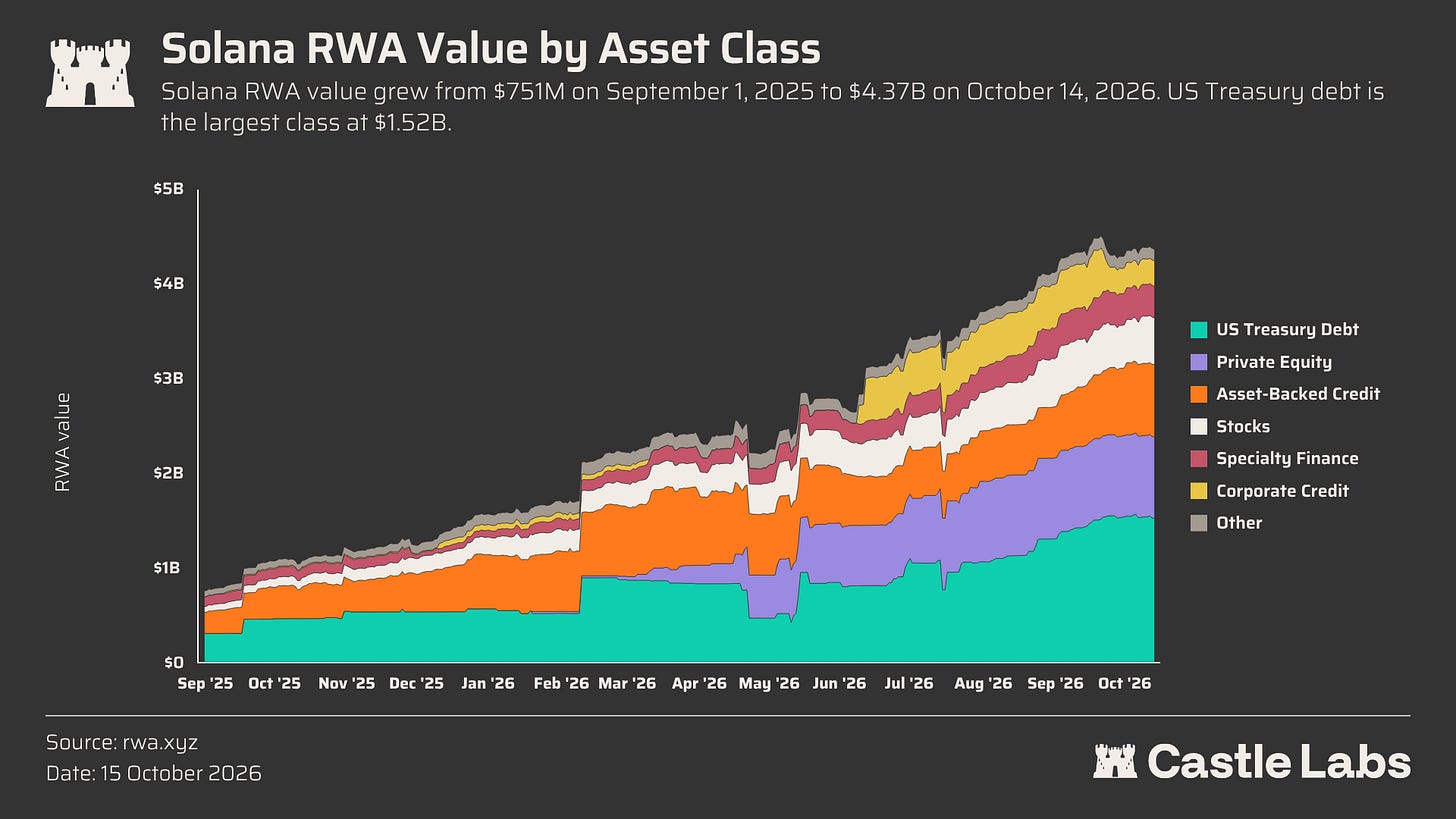
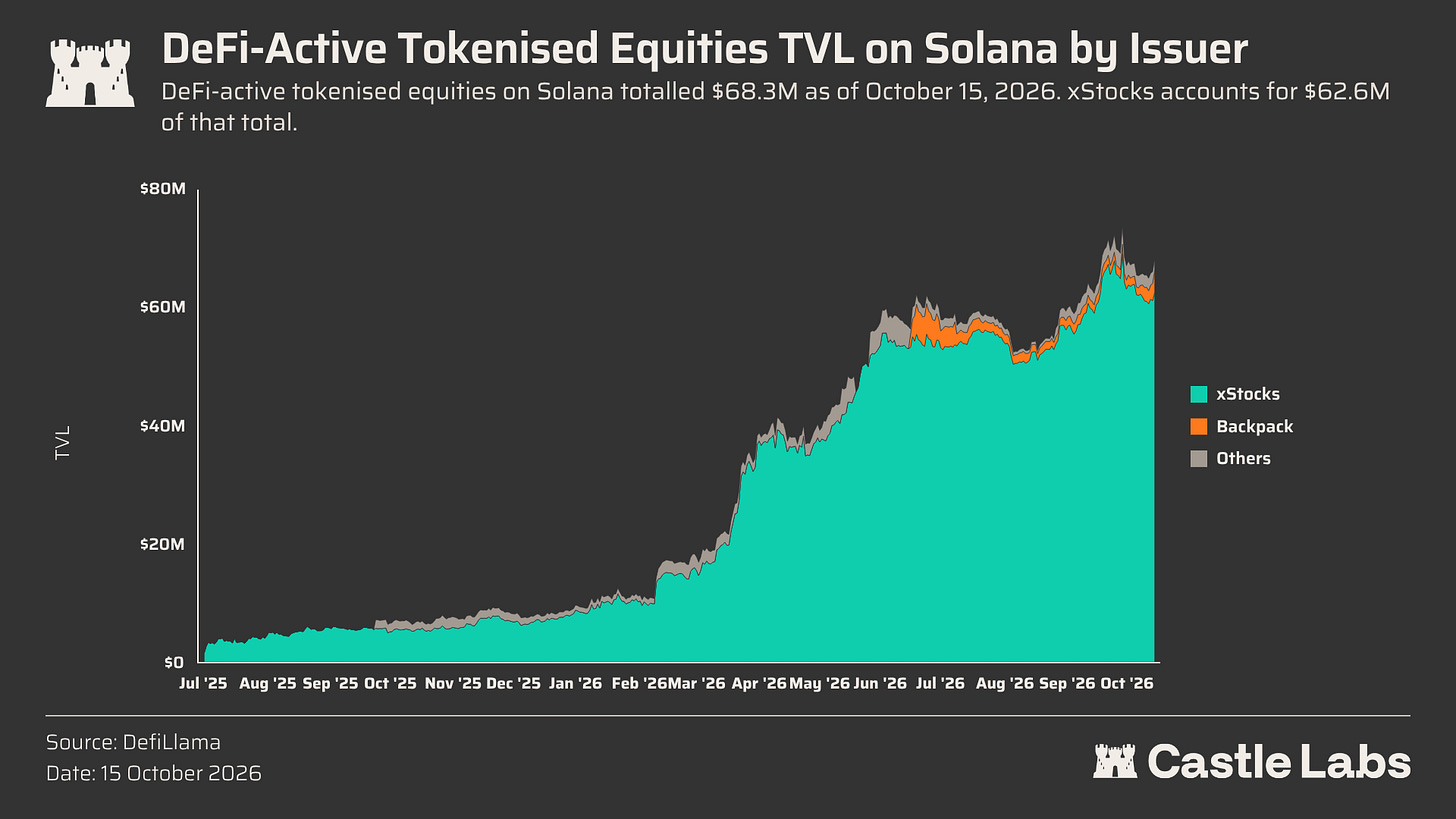
One category that grew massively on Solana is tokenised stocks, which rose from $63 million to $455 million, driven by issuers like xStocks and Backpack. On Ethereum, the same category accounts for $750 million in market cap, comparable to Solana.
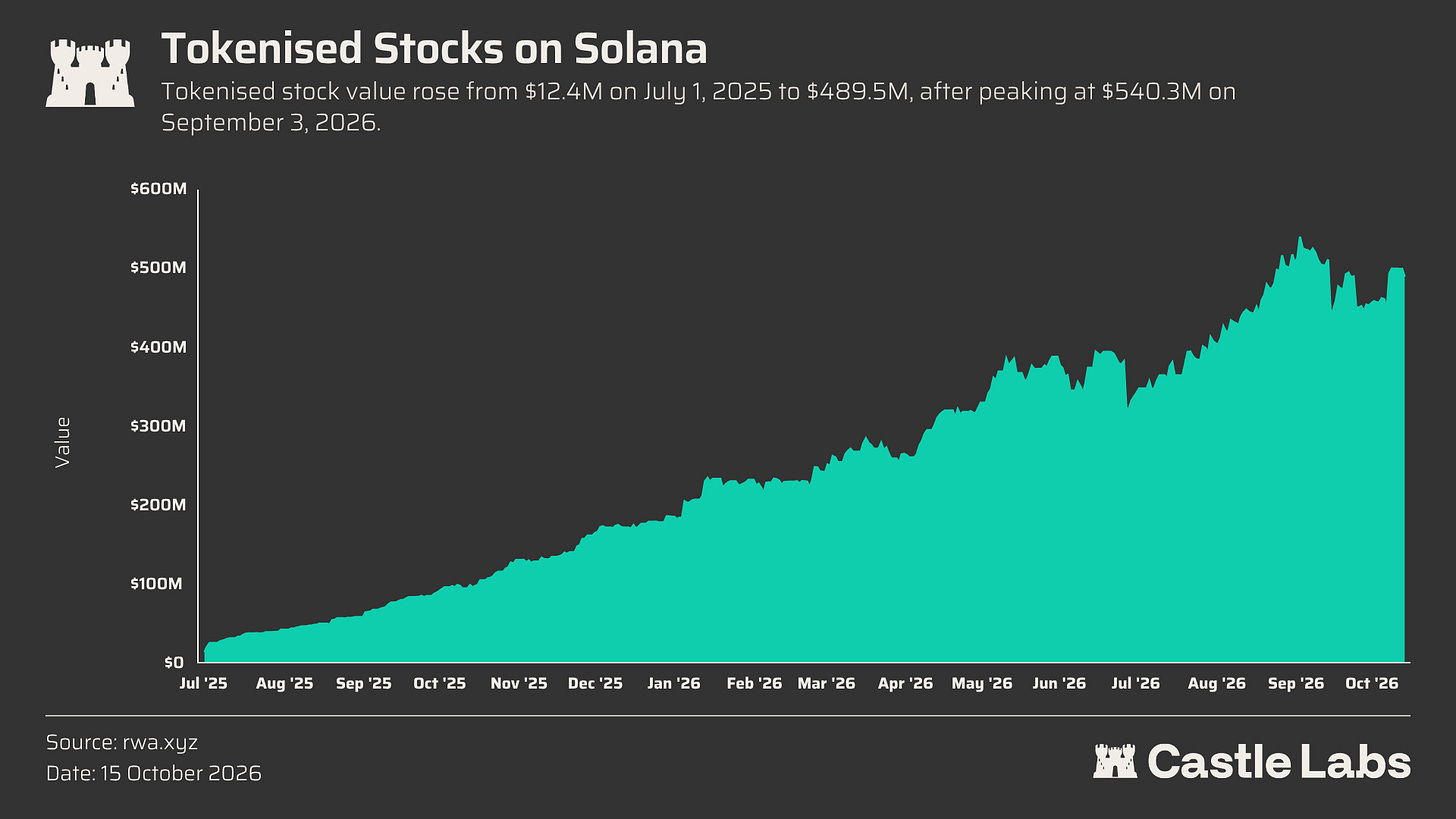
As we already established, the biggest advantage of bringing RWAs onchain is making them productive. On Solana, utilisation is growing, with over $65 million in tokenised equities earning yield, driven primarily by xStocks, which can be used as collateral on Kamino and Jupiter Lend.
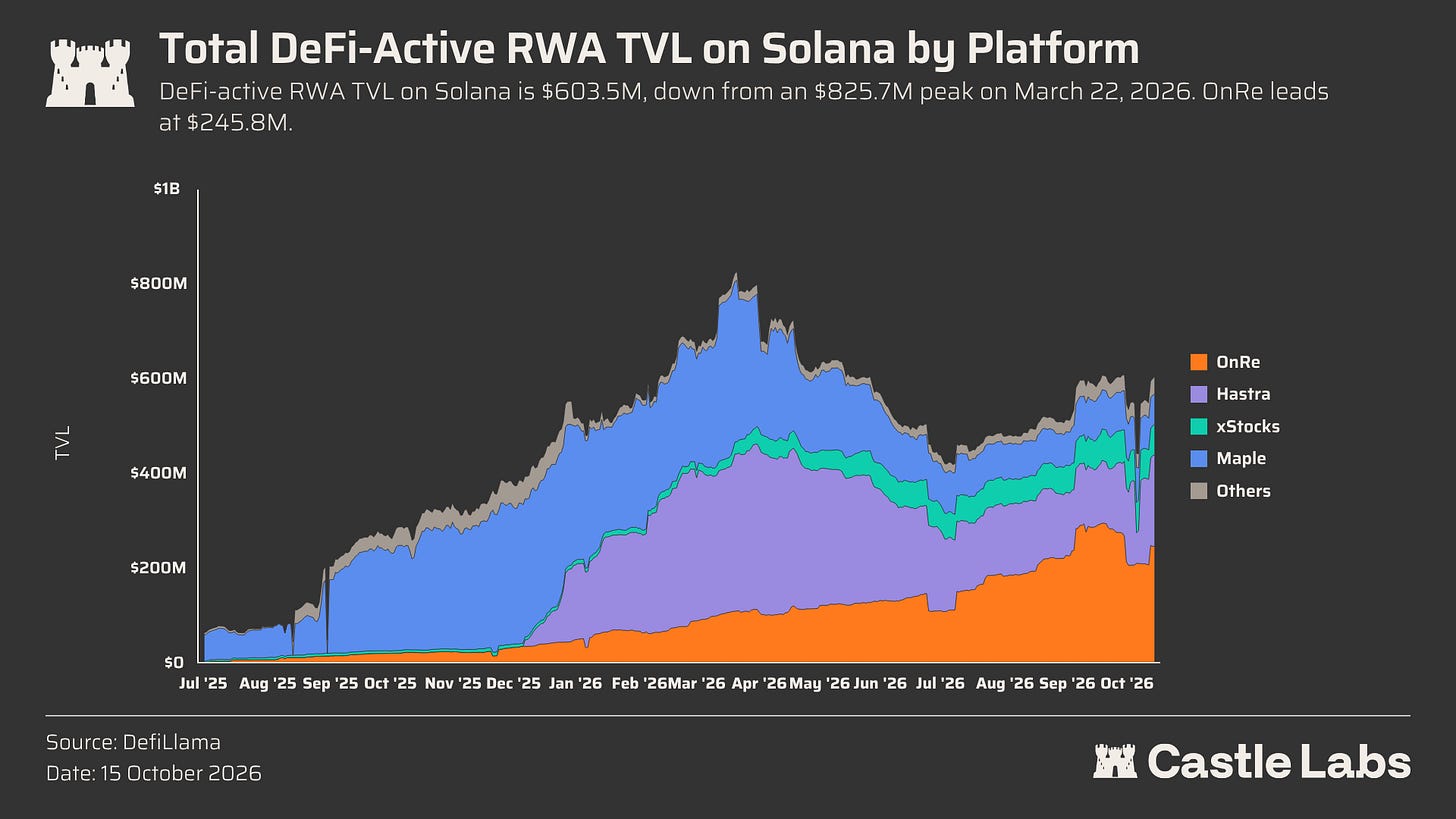
In the broader active RWA TVL on Solana, OnRe issues ONyc, backed by reinsurance premium income, and Hastra issues PRIME and AUTO, backed by home and consumer auto loans. Next is Maple, which has expanded to Solana with syrupUSDC, giving chain users exposure to institutional lending or private credit.
They issue yield-bearing assets, and as they scale, borrowing demand on Solana grows as they offer competitive yield, making looping profitable.
Closing Thoughts
Solana is home to the largest consumer applications. In terms of app revenue, it beats every other chain. These Solana applications show durable revenue, highlighting a less cyclical nature often unseen in a volatile market like crypto.
Solana’s growth isn’t limited to consumer apps; it also includes broader DeFi and RWAs. Broader DeFi growth is driven by Liquid Staking, DEXs, RWAs, and Lending, each up in the last 30 days, but categories like basis trade and yield struggle with fewer deployments.
While DeFi growth is strong, RWAs have grown exponentially onchain, gaining over 600% in tokenised value in the last year and outpacing every other major chain. The category now gives exposure to tokenised stocks, U.S. Treasury debt, reinsurance yields, car and home loans, and much more.
The contributing factors to this growth come from deliberate institutional efforts to attract more RWA deployments and capture the tokenised equities market and other niche RWAs, and, most importantly, to maintain this growth, they focused on making these assets useful across DeFi and integrating them with money markets like Kamino and Jupiter Lend, which proved fruitful for the whole ecosystem.
This growth is ultimately reflected in the chain’s DeFi growth too, with over $500 million in active RWA TVL in DeFi protocols, reaching ~8% of the chain’s net value locked. Additionally, because these assets are yield-bearing, they are becoming an important growth lever for borrowing demand on the chain through strategies like looping.
Solana has matured to become a thriving ecosystem with growth across different verticals. From here, growth depends on reinforcing similar efforts to sustain momentum and push verticals like basis trading and yield-related applications that could build more borrowing demand across lending protocols, which in turn attracts more deposits.
Originally published in the Castle Labs newsletter. Subscribe at research.castlelabs.io/subscribe.